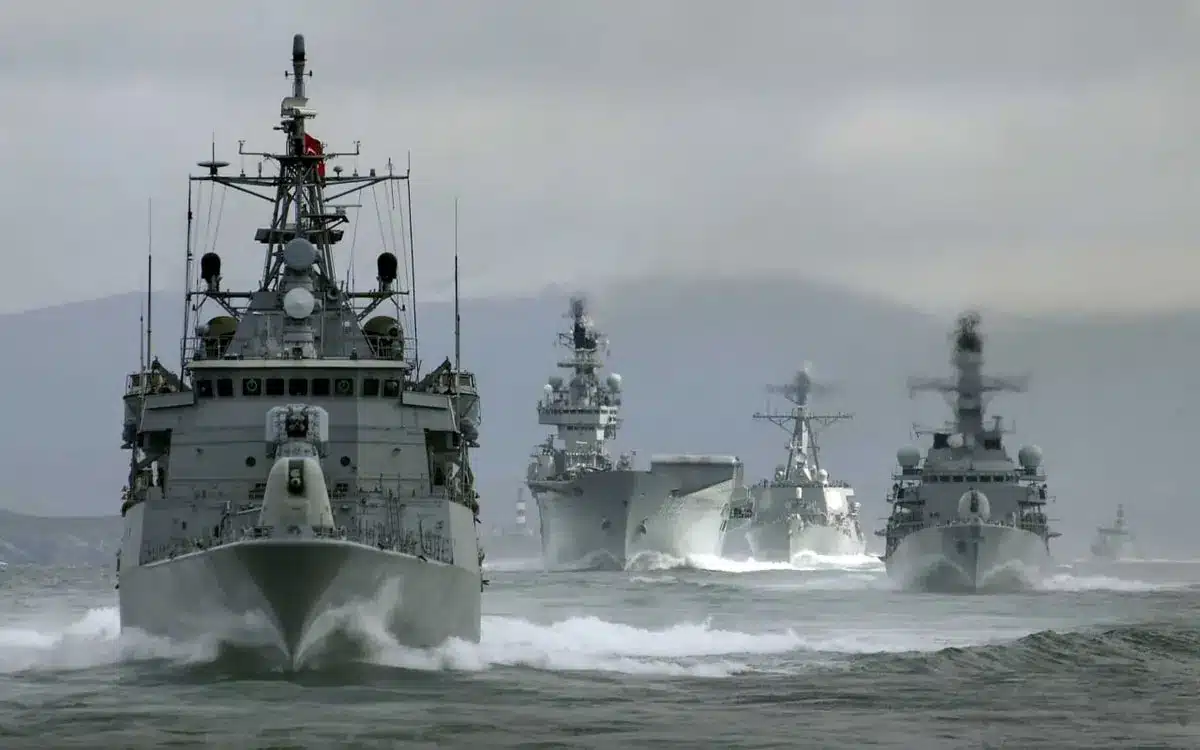



Military power is often assessed through the capabilities of armed forces: the size of armies, the number of combat aircraft or the tonnage of naval fleets. Yet recent conflicts suggest that another dimension has become equally important: the civilian systems that enable military operations.
Commercial aircraft, merchant shipping, industrial facilities and civilian supply chains have become essential components of military power. Together, they point to a deeper transformation in the way wars are fought, sustained and understood.
Understanding modern warfare increasingly requires looking beyond military organizations. It requires understanding the civilian networks that make military power possible.
Civilian logistics beyond the military
Military logistics has always extended beyond the armed forces themselves. What is changing today is the scale of that dependence. Modern military operations now rely on civilian ecosystems capable of providing a level of capacity, flexibility and geographic reach that no military organization can maintain on its own. Commercial airlines, shipping companies, road transport operators, ports and logistics providers are becoming integral components of the systems that sustain military power.

The conflict in Sudan offers a particularly revealing illustration of this evolution. In July 2026, a draft United Nations report concluded that three civilian Boeing 727 cargo aircraft had been used throughout 2025 to transport weapons, drones and foreign fighters to Sudan’s Rapid Support Forces (RSF). According to the investigators, the aircraft operated through a logistics network connecting hubs in Chad, Libya and Somalia before reaching RSF-controlled territory in Darfur. The findings reinforced months of investigative reporting by Reuters, which reconstructed the network using satellite imagery, flight records, ADS-B data and corporate documentation.
The significance of this case extends far beyond Sudan itself. None of the aircraft involved were military transports, nor were the airports, operators or logistics companies supporting the network. Yet together, these civilian assets allegedly enabled the sustained movement of personnel, weapons and unmanned systems in support of an armed force. Rather than relying exclusively on military logistics, modern conflicts exploit the scale, redundancy and global reach of commercial transport networks.
This evolution is driven by clear operational advantages. Civilian transport assets are more numerous, easier to acquire and capable of operating across established international networks. They can also make military logistics more resilient by dispersing activities across multiple operators and infrastructures while reducing the visibility normally associated with dedicated military transport.
The growing reliance on civilian logistics, however, creates a strategic paradox. The same commercial ecosystems that strengthen the resilience of legitimate military operations can also be exploited by sanctioned states, proxy forces or non-state armed groups seeking to conceal or sustain their activities. As civilian and military supply chains become increasingly interconnected, distinguishing legitimate commercial activity from military support is becoming progressively more difficult for governments, intelligence agencies and international regulators.
Sudan is therefore not an isolated case but part of a broader transformation. Since 2022, Ukraine has demonstrated the growing importance of civilian rail networks, commercial trucking companies and private logistics providers in sustaining large-scale military operations. More broadly, NATO acknowledges that around 90% of military transport during major operations relies on civilian assets, highlighting the extent to which commercial logistics have become an indispensable component of collective defense.
Military logistics no longer begins and ends within the armed forces. It increasingly depends on civilian transport networks whose resilience, and whose protection against misuse, has become a strategic requirement in its own right.
Commercial infrastructure as a strategic instrument
Military power is no longer sustained solely through armed forces or defense industries. States are leveraging commercial infrastructure to preserve their strategic freedom of action. Merchant fleets, financial networks, insurance services and corporate structures have become instruments through which governments can reduce the impact of sanctions, secure critical resources and sustain their defense industrial base.
Russia’s shadow fleet illustrates this evolution. Following the introduction of Western sanctions and the G7 oil price cap, Moscow rapidly assembled a vast network of ageing oil tankers operating under flags of convenience, opaque ownership structures and frequently changing management companies. Rather than belonging directly to the Russian state, many of these vessels are registered through shell companies spread across multiple jurisdictions, making enforcement considerably more difficult. By transporting Russian crude outside the traditional Western shipping and insurance ecosystem, the fleet has helped preserve one of the country’s principal sources of revenue despite unprecedented economic restrictions.

The strategic significance of this network extends beyond energy exports. Oil exports remain one of the principal sources of revenue for the Russian state, helping finance defense expenditure and industrial production linked to the war in Ukraine. Commercial shipping has therefore evolved beyond its traditional economic function. Under sanctions, it has become a strategic enabler that helps sustain military power. The merchant fleet itself is not a weapon, but it enables the financial resources that allow the war effort to continue.
This strategy also demonstrates how states exploit the openness of the global commercial system. International shipping depends on complex networks of registries, insurers, classification societies, financial intermediaries and maritime service providers operating across multiple jurisdictions. The sheer scale and fragmentation of these ecosystems make them difficult to regulate completely, creating opportunities for states seeking to reduce the impact of economic pressure.
Russia is not the first state to have adopted such approaches. Iran has relied for years on similar maritime networks to circumvent oil sanctions, while Venezuela has repeatedly used complex shipping arrangements to maintain crude exports despite international restrictions. Although each case reflects different political circumstances, they illustrate the same underlying trend: commercial maritime infrastructure is increasingly being used to achieve strategic objectives traditionally associated with state power.
Industrial resilience is becoming a military capability
For much of the twentieth century, military production was largely viewed as a pre-war activity. Defense industries expanded manufacturing before or during the early stages of a conflict, while armed forces relied on accumulated stockpiles and established supply chains to sustain operations. Today’s conflicts are exposing the limits of that model.
Modern warfare requires armed forces to repair, replace and adapt equipment at a pace that traditional industrial structures were never designed to support. Maintaining production throughout a conflict is becoming as important as expanding production before it begins. Industrial resilience is therefore emerging as a military capability in its own right.

Since 2022, repeated Russian missile and drone strikes have forced Ukraine to fundamentally reorganize its defense industrial base. Rather than concentrating production in a limited number of large facilities, Ukrainian authorities and defense companies have progressively dispersed manufacturing across multiple sites, expanded underground or hardened production areas, and decentralized repair activities. Equipment damaged at the front is increasingly restored through regional maintenance hubs or mobile repair teams operating much closer to combat units, reducing turnaround times and improving operational availability.
This decentralized approach also extends to production itself. Ukrainian manufacturers have expanded partnerships with domestic private companies while deepening cooperation with European and North American defense industries. Rather than relying on a handful of strategic factories, Ukraine is progressively building a more distributed industrial ecosystem designed to remain operational even under sustained missile and drone attacks. In this model, resilience is achieved not by preventing every strike, but by ensuring that no single strike can halt production altogether.
Similar thinking is now influencing defense planning well beyond Ukraine. Taiwan has intensified efforts to strengthen the resilience of its defense industrial base through dispersed production, infrastructure protection and continuity planning, reflecting growing concerns over the vulnerability of critical manufacturing sites during a potential conflict in the Taiwan Strait. Governments increasingly recognize that preserving industrial output under attack may prove just as decisive as expanding production capacity before a war begins.
Other countries are moving in the same direction. Finland has long integrated industrial preparedness into its comprehensive security model, recognizing that critical industries, supply chains and civilian companies remain essential to sustaining national defense during periods of crisis. Although national approaches differ, they share the same objective: ensuring that military production can continue despite disruption.
Rethinking military power through civilian systems
The growing integration of civilian infrastructure into military power is also transforming the way armed forces, intelligence services and governments assess potential adversaries. Tracking tanks, combat aircraft and warships remains essential, but it is no longer sufficient to understand a country’s real military capacity.
Analysts must also examine the civilian systems that sustain military operations. Shipping registries, commercial flight records, satellite imagery, customs data, corporate ownership structures and supply chain networks have become valuable sources of military intelligence. Understanding how equipment is transported, where components are manufactured or how industrial production is organized can reveal as much about a nation’s ability to sustain a conflict as the number of weapon systems it possesses.
NATO has formally recognized this reality through its approach to resilience and civil preparedness. The Alliance states that around 90% of military transport during major operations relies on civilian assets, more than 70% of satellite communications used for defense purposes are provided by commercial operators, and approximately 75% of host nation support comes from local commercial infrastructure and services. These figures illustrate that military operations are already deeply embedded within civilian systems rather than operating independently from them.
The implications extend beyond military planning. Governments must now consider the resilience of ports, transport networks, energy infrastructure, industrial facilities and digital services as integral components of national defense. Protecting critical infrastructure is no longer simply a matter of economic security; it has become a prerequisite for sustaining military operations during prolonged crises.
Military power has long been associated with the capabilities of armed forces and the weapons they operate. That perspective remains valid, but it is no longer sufficient to understand how modern wars are sustained.
The ability to fight and endure increasingly depends on civilian systems operating beyond the traditional boundaries of the military. Logistics networks, commercial infrastructure, industrial ecosystems and critical supply chains have become essential enablers of military power.
At the same time, those same civilian systems have become strategic targets and instruments of competition, exploited to sustain conflicts, preserve military power and, in some cases, circumvent international sanctions.
As military power becomes increasingly dependent on civilian systems, protecting them may become just as important as expanding military capabilities themselves.
In the future, a nation’s military strength may be measured not only by the capabilities of its armed forces, but also by the resilience of the civilian systems that sustain them.