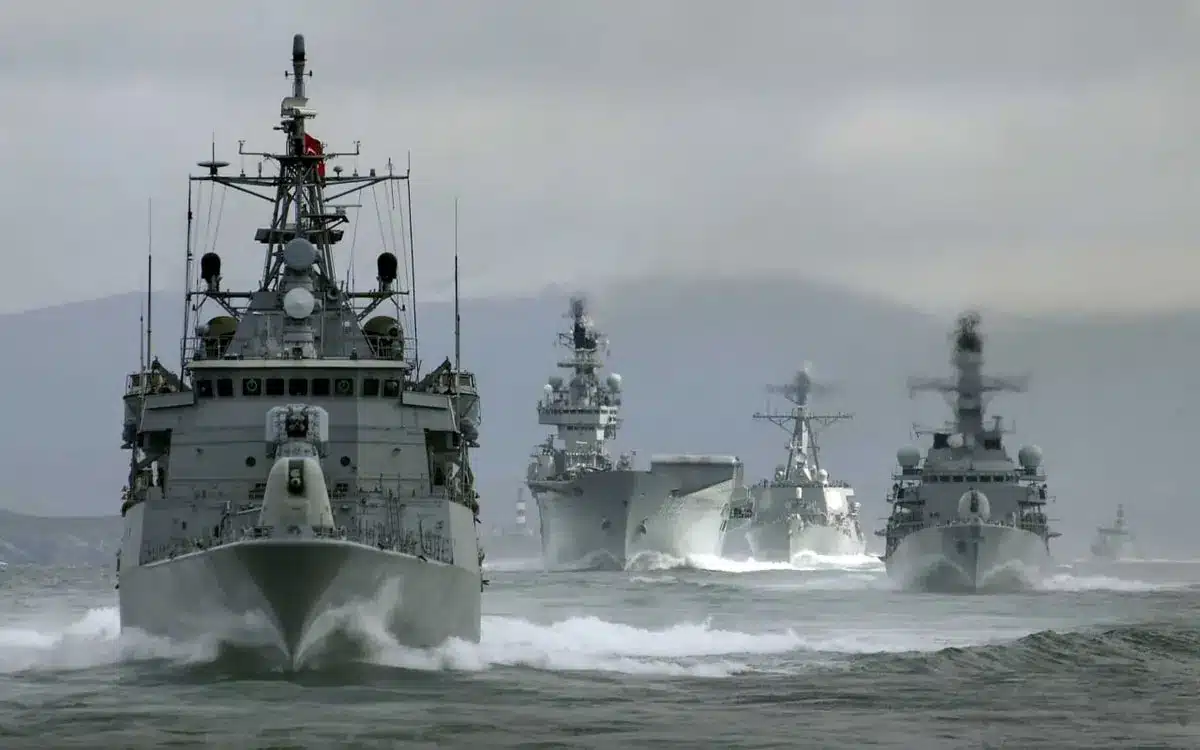



By the early 2040s, the Netherlands will have renewed most of its major naval combat capabilities. Four Orka-class submarines will replace the Walrus class, four new Anti-Submarine Warfare (ASW) frigates are under construction, and a new generation of Air Defense and Command Frigates is being prepared. At the same time, The Hague has launched a joint program with the United Kingdom to develop a common amphibious transport platform.
This modernization is also reshaping the Dutch naval shipbuilding industry. Damen Naval remains the country’s leading naval prime contractor, but current programs distribute design, production and system integration across several nations. Meanwhile, discussions reported in June 2026 about a possible Dutch government stake in Damen Naval illustrate how preserving national industrial expertise has become a matter of strategic policy.
The strategic transformation of the Royal Netherlands Navy
The fleet modernization reflects the deterioration of Europe’s security environment, the increase in Russian naval activity, and the need to protect critical maritime routes and undersea infrastructure in the North Sea and North Atlantic. The Netherlands must simultaneously replace aging ships while strengthening its contribution to NATO operations. This combination explains why several major naval programs have been launched within a relatively short period.
Dutch defense spending reached approximately €26.3 billion in 2025. In June 2026, the Ministry of Defence announced that nearly €100 million in planned expenditures had been postponed, mainly because of industrial production constraints and delivery delays.
The modernization effort covers nearly every major category of combat vessel. The contract signed with Damen Naval and Thales Nederland in 2023 includes four Anti-Submarine Warfare frigates, two for the Royal Netherlands Navy and two for the Belgian Navy, with the first delivery initially scheduled for 2028. Separately, the contract signed with Naval Group in September 2024 covers four Orka-class submarines, with the first two expected to be delivered within ten years of contract signature.

These programs are complemented by preparations to replace the Royal Netherlands Navy’s four Air Defense and Command Frigates, as well as the joint amphibious ship program currently being developed with the United Kingdom.
Together, these projects place the preservation of national industrial expertise at the center of Dutch naval policy. The objective is not to build every platform domestically, but to retain sufficient control over design, systems integration and long-term support to maintain and upgrade the fleet throughout its service life.
European cooperation: the core of the Dutch model
Belgium represents the most mature example of Dutch naval cooperation. The joint frigate program covers four identical Anti-Submarine Warfare (ASW) frigates, evenly divided between the Royal Netherlands Navy and the Belgian Navy. Damen Naval serves as both designer and prime contractor, while Thales Nederland supplies key sensors and major elements of the combat management system. By pooling procurement, both countries increase production volume while sharing development, training and life-cycle support costs.
Dutch industrial participation extends well beyond the main shipyard. Alewijnse is responsible for designing, installing and integrating the complete electrical architecture of all four frigates, including power distribution and lighting systems. Another Dutch systems integrator provides the platform management system, navigation equipment and mission management capabilities.

France follows a different industrial model. Naval Group remains the design authority for the four Orka-class submarines, which will be assembled at its Cherbourg shipyard. However, the industrial cooperation agreement also integrates Dutch companies into selected areas, including equipment supply, engineering, testing, technical documentation and long-term in-service support.
The partnership with the United Kingdom remains at an earlier stage. Both countries intend to align their future amphibious requirements around a common platform, building on decades of operational cooperation between the Royal Marines and the Netherlands Marine Corps. The project’s success, however, will depend on decisions that have yet to be made regarding the ship’s final configuration, industrial workshare and procurement schedule. The agreement signed in July 2026 marks the beginning of the development phase rather than the launch of a production program comparable to the Belgian frigate initiative.
Germany provides a more cautionary example. In June 2026, Berlin canceled its program for six next-generation frigates following repeated delays, integration challenges and rapidly escalating costs. The first four ships had been ordered in 2020 for approximately €6.2 billion, with an option for two additional vessels. By the time the program was canceled, around €2.3 billion had already been spent, while projected costs to complete the program had risen to as much as €18 billion.
This case does not, by itself, demonstrate the failure of European defense cooperation. Instead, it highlights the risks associated with fragmented industrial governance, where the design authority, shipbuilders, system suppliers and government customer do not always operate according to the same priorities, timelines or budgetary constraints.
The Dutch naval industrial ecosystem
Damen Naval remains the central player in the Dutch naval industrial base, but its activities are part of a much broader industrial group. In 2025, Damen Shipyards Group generated €3.25 billion in revenue, up from €3.02 billion the previous year. The company delivered 160 vessels, increased its order book to more than €10 billion, and completed 1,235 repair and modernization projects.
These figures provide an indication of the group’s overall scale but encompass a wide range of both civilian and military activities. Programs such as frigates and auxiliary vessels therefore benefit from capabilities, infrastructure and revenues generated by commercial shipbuilding, specialized vessels, tugs and maintenance services. This diversified business model reduces dependence on a single market segment, although it does not eliminate the financial risks associated with major defense programs.
Thales Nederland forms the second major pillar of this industrial ecosystem. The company supplies radars, sensors and key elements of the combat management system for the Belgian-Dutch ASW frigate program. Alewijnse is responsible for electrical systems integration, while other Dutch suppliers provide platform management systems, navigation equipment, water treatment systems, heating, ventilation and air conditioning (HVAC), as well as filtration systems for protected spaces.
The Orka submarine program extends this industrial network into the undersea domain. Van Halteren Technologies will supply critical hydraulic and mechanical systems, while the Maritime Research Institute Netherlands (MARIN) contributes testing facilities and hydrodynamic expertise. Other Dutch companies are involved in optical sensing, technical documentation and in-service support. Although the work is distributed across multiple industrial packages, it enables the Netherlands to retain the expertise required to sustain and upgrade the submarines throughout their operational life.

The prospect of government investment in Damen Naval should be viewed in this broader context. According to reports published in June 2026, the objective would be to secure the execution of national naval programs while preserving strategic industrial know-how within the Netherlands. As of that date, however, no final agreement had been announced.
The Dutch model beyond Europe
Beyond Europe, Damen adapts its industrial approach to the capabilities of each customer nation. In Colombia, the company provides the ship design, engineering support, technical assistance and selected components for the country’s first domestically built frigate. Construction is carried out in Cartagena by the state-owned shipbuilder, while Damen helps develop Colombia’s domestic naval shipbuilding industry through technology transfer, workforce training and local industrial participation. (Damen Shipyards Group)
Australia follows a different model based on licensed production at a much larger scale. In February 2026, Austal was awarded a contract worth approximately AUD 4 billion to build eight Landing Ship Transport (LST) vessels based on Damen’s Landing Ship Transport 100 design. Construction is scheduled to begin in Western Australia in 2026, with the final delivery expected in 2038. (Austal)
These two programs demonstrate that Dutch naval exports do not necessarily depend on ships being built in the Netherlands. In Colombia, Damen helps develop a national shipbuilding capability. In Australia, the company provides the underlying ship design under license to an experienced domestic shipbuilder. In both cases, the Dutch contribution lies primarily in naval architecture, engineering expertise and production support rather than in domestic construction.
The Dutch naval industry has entered a new phase of its development. Current programs demonstrate that competitiveness no longer depends solely on building warships, but increasingly on the ability to design complex naval platforms, integrate critical combat systems and coordinate multinational industrial partnerships.
The delivery of the Orka-class submarines, the new Anti-Submarine Warfare (ASW) frigates and the future amphibious platform with the United Kingdom will provide the first real test of this model.
More broadly, these programs illustrate how European naval shipbuilding is evolving. Strategic sovereignty increasingly depends not only on where ships are built, but on who controls their design, systems integration and long-term support.