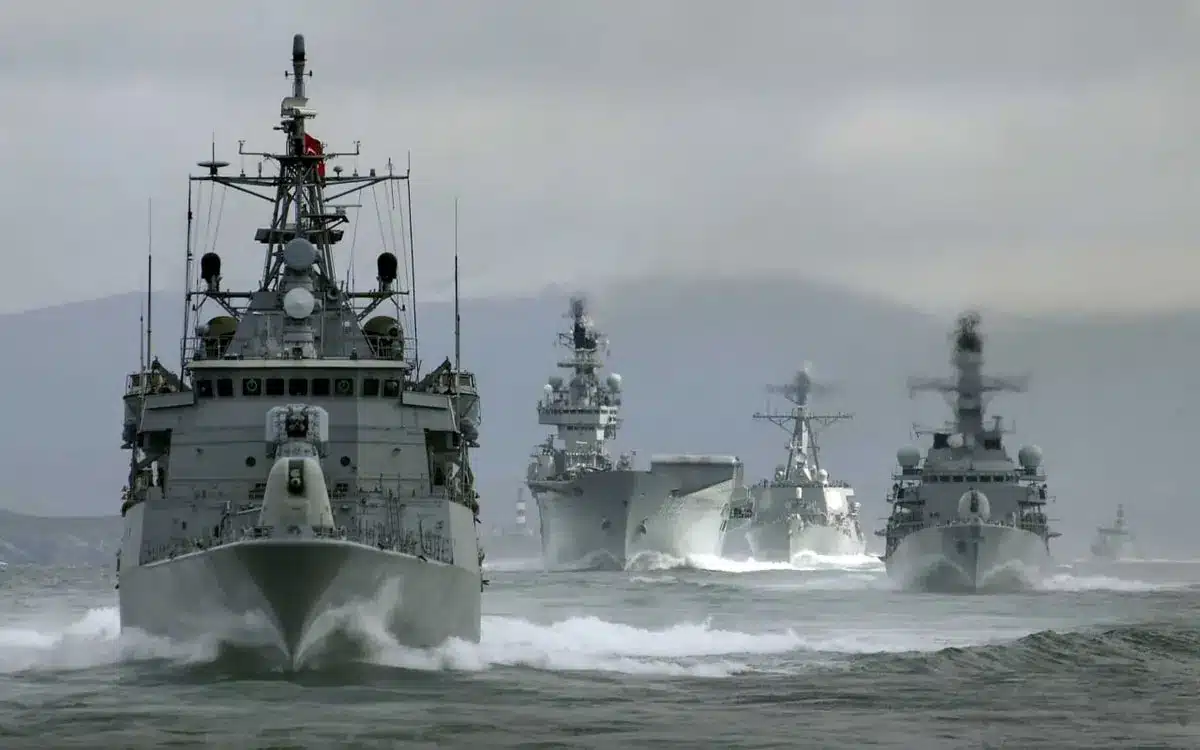
Geography defines Indonesia’s naval challenge. The Navy must maintain a credible military presence across a vast archipelago while protecting the country’s maritime approaches, economic interests and critical sea lanes. It must also prepare for high-end naval warfare, patrol the exclusive economic zone (EEZ), contribute to maritime security, and retain the sealift and response capabilities required by a country regularly exposed to natural disasters.
Tensions around the Natuna Islands illustrate the pressure on Indonesia’s maritime interests. In October 2024, Indonesian authorities said they had repeatedly driven away a Chinese Coast Guard vessel that was disrupting an energy survey within waters Jakarta considers part of its EEZ.
Jakarta’s response now goes beyond replacing aging ships with foreign-built platforms. Indonesia increasingly wants to bring shipbuilding, systems integration and fleet support into its domestic industrial base.
The question is whether those capabilities can produce not just a larger and more autonomous navy, but a coherent fleet that Indonesia can keep operational over the long term.
Modernizing a fleet built for multiple missions
Indonesia entered the current modernization cycle with an aging surface combatant fleet. In 2022, it operated seven frigates and 24 corvettes, many of them relatively old, alongside substantial amphibious and coastal capabilities.
The renewal is now taking shape. The large frigates Brawijaya-320 and Prabu Siliwangi-321, built in Italy, entered Indonesian Navy service in 2025. At the same time, Indonesia is building its Merah Putih-class frigates in Surabaya, based on the British Arrowhead 140 design.

The first ship, Balaputradewa-322, was launched in December 2025. Babcock, which granted Indonesia two design licenses in 2021, announced an initial agreement in January 2026 covering two additional licenses.
Modernization is also extending below the surface. Construction of the first of two Scorpène Evolved submarines ordered from Naval Group began in Surabaya in August 2026. The program calls for both submarines to be built in Indonesia alongside a transfer of skills and industrial know-how.
But more hulls do not automatically translate into more combat power at sea. Crews, training, maintenance, infrastructure and operational integration ultimately determine how much of a fleet is actually available when needed.
Financial constraints make that equation harder. In 2025, Indonesia’s Ministry of Defense acknowledged that the indicative 2026 budget would not be sufficient to cover all priorities, including personnel, infrastructure and procurement.
Acquisition is only the beginning of the cost. Warships remain financial and industrial commitments for decades, requiring trained crews, spare parts, maintenance facilities and successive upgrades throughout their service lives.
Building in Indonesia: how far does autonomy go?
The Scorpène program is one of the most ambitious tests of Indonesia’s industrial strategy.

The state-owned shipyard in Surabaya is expected to take part in hull construction, equipment integration, testing, final assembly and delivery of the two submarines. Indonesian engineers have also undergone training and qualification procedures ahead of construction.
That represents a significant increase in domestic capability. But building a ship domestically is only the first layer of naval autonomy. The harder steps are integrating its systems, sustaining it through decades of service, and ultimately controlling the critical technologies that determine its combat performance.
Merah Putih follows a different model. The frigate is based on Britain’s Arrowhead 140 design but built in Indonesia. The program strengthens domestic shipbuilding and integration expertise without turning a foreign design into wholly indigenous technology.

Cooperation with Italy extends the same approach into fleet support and modernization. Sriwijaya-100, the former Giuseppe Garibaldi, joined the Indonesian Navy in September 2026. Fincantieri and its Indonesian partner are preparing for the ship’s refurbishment, although its final configuration has yet to be determined. That will depend on the vessel’s condition, the obsolescence of its systems and Indonesia’s operational requirements.
Acquiring industrial know-how is one challenge. Retaining it is another.
Irregular orders and short production runs can make it difficult to retain engineers, systems integrators, skilled shipyard workers and specialized infrastructure between major programs. Indonesia therefore needs to demonstrate not only that it can build a complex warship or submarine, but that it can sustain the industrial ecosystem required to maintain, upgrade and eventually replace it.
The diversification paradox
Diversification gives Jakarta strategic freedom. It also comes at a price: fleet complexity. Indonesia’s growing network of foreign partners reduces its dependence on any single supplier, but leaves the Navy operating platforms shaped by very different industrial traditions. Propulsion systems, combat management systems, sensors and weapons vary from one ship to another, as do the spare parts, training pipelines and maintenance procedures required to support them.
Confirmed programs already leave Indonesia supporting major vessels designed in nine different countries. That gives Jakarta access to a broad range of technologies and suppliers, but it also multiplies the logistical and technical demands placed on the fleet.
Maintenance is already a concern. A program to refurbish 41 existing vessels has faced delays, while continued procurement is increasing demand for technicians, infrastructure, spare parts and funding.
Technology and skills transfers could reduce some of those dependencies if Indonesian industry becomes capable of integrating and supporting more systems domestically. Their value, however, should not be measured only by what Indonesia can build today. The more demanding test is what the country can maintain, repair and upgrade throughout a ship’s service life.
Indonesia has already crossed an important threshold by bringing increasingly complex combat vessels, including submarines, into its domestic shipbuilding base. The harder test comes next: retaining those skills, funding the support infrastructure and keeping a diverse fleet operational.
Naval autonomy will ultimately be measured not by how much of a ship is built in Surabaya, but by how many Indonesia can keep ready for operations, and how much of that readiness it can sustain without relying on foreign suppliers.