Ukraine’s defense industry in 2026 looks very different from the one that entered the war in February 2022. In July, a U.S. official estimated that the country was on track to produce between 6 million and 7 million small first-person-view (FPV) attack drones this year, roughly 500,000 a month.
Kyiv, meanwhile, puts its annual defense production capacity at around $50 billion, 50 times its 2022 level, and says Ukrainian manufacturers now supply more than half of the weapons and military equipment required by the country’s armed forces.
The two figures tell different stories. The drone number is an estimate of actual output. The $50 billion figure describes industrial capacity, not the value of weapons actually produced. A better measure of Ukraine’s transformation is therefore what its defense industry can build at scale and what it still cannot. Which systems have made the jump to serial production? Where do foreign supply chains remain essential? And which capabilities are still beyond the reach of domestic industry?
Drones: the laboratory of mass production
Nowhere has the shift been more dramatic than in small FPV attack drones. Producing 6 million to 7 million of them in a year would put Ukraine at a scale the U.S. defense industry itself cannot yet match, according to the Pentagon official tasked with expanding American drone production.
That output has emerged from a model that looks very different from traditional defense manufacturing. It relies on a large number of producers, commercial components, designs that can be modified quickly and tight feedback loops between frontline units and engineers.
There is a trade-off. Chinese components remain deeply embedded in drone supply chains, particularly flight controllers, motors and sensors. Manufacturers also depend on imported permanent magnets, semiconductors and other critical inputs.
Ukraine has, in other words, brought much of the design, integration and assembly of some drone families under domestic control without doing the same for the entire supply chain.
Interceptor drones show another side of the model: how quickly industry can respond to a new battlefield problem. Firing sophisticated air-defense missiles at large numbers of relatively cheap attack drones is difficult to sustain. Ukraine’s answer has been to add a much cheaper layer of defense. In January 2026, the Ukrainian Ministry of Defense said military units were receiving more than 1,500 interceptor drones a day, primarily to counter Russian attack drones.
By September, that solution was already being tested by the appearance of faster, jet-powered Russian drones, pushing Ukrainian manufacturers toward a new generation of interceptors. It is an increasingly familiar cycle: a new weapon appears, industry responds, the enemy adapts, and the process starts again.
Long-range attack drones follow much the same pattern. Ukrainian systems such as the FP-1 have given Kyiv a domestically produced means of striking targets more than 1,000 kilometers away.

Those strikes are having measurable effects. The International Energy Agency attributed part of the drop in Russian oil production recorded in May 2026 to Ukrainian attacks on energy infrastructure.
From Bohdana to ground robots: when innovation meets heavy industry
Drones, however, are only one measure of a defense industrial base. Ukraine’s 155 mm Bohdana self-propelled howitzer presents a much tougher industrial test. Artillery barrels, heavy vehicle chassis, metallurgy, hydraulics, electronics and ammunition all require supply chains and manufacturing infrastructure far removed from those needed to assemble a small drone.

Bohdana’s development shows how a domestically designed weapon can move into sustained production. Ukraine’s state-owned defense industry reported that total weapons and military equipment production rose from UAH 122 billion in 2024 (€2.428 billion) to more than UAH 180 billion in 2025 (€3.582 billion), with Bohdana among the systems highlighted.
Foreign funding has also become part of the production model. Under the mechanism pioneered by Denmark, funding from partner countries has been used to place orders directly with Ukrainian manufacturers. One such order covered 18 Bohdana howitzers, according to the Center for Strategic and International Studies.
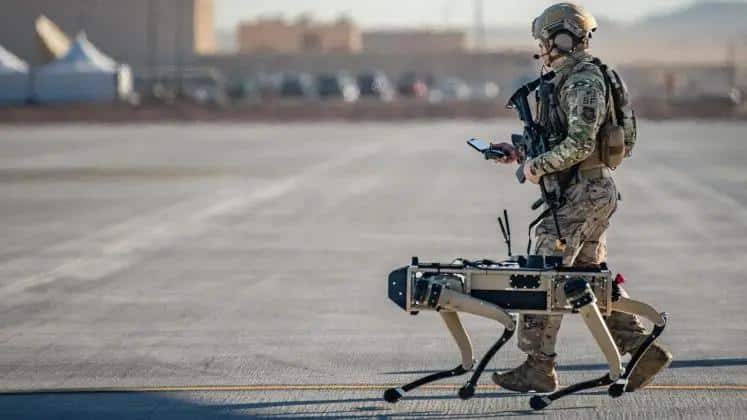
Uncrewed ground vehicles offer a different measure of change. What matters is not simply how many robots Ukraine can build, but what soldiers no longer have to do themselves. These systems are increasingly taking on missions ranging from mine clearance and mine-laying to logistics, casualty evacuation and support for ground operations.
The increase in operational use is striking. According to data recorded by Ukraine’s battlefield management system, uncrewed ground vehicles carried out 7,511 logistics or evacuation missions in January 2026. By August, the figure had climbed to 25,143 a 3.3-fold increase. Around 112,000 missions had been recorded since the beginning of the year by early September.
Missiles and air defense: the technological frontier

Ukraine’s progress is also visible in more sophisticated strike weapons. The Neptune, originally developed as an anti-ship missile, has become the basis for a land-attack weapon that Kyiv says can strike targets up to 1,000 kilometers away. Ukrainian forces reported using the system against the Russian port of Novorossiysk as early as 2025.
Missiles also show where Ukraine’s rapid-development model begins to run into harder industrial limits.
An interceptor drone and a ballistic missile defense system belong to very different technological worlds. The latter requires advanced radars and sensors, command-and-control architecture, propulsion and guidance systems, and sophisticated interceptor missiles all of them integrated into a functioning air-defense network.
For all the growth of its defense industry, Ukraine still relies on foreign weapons and ammunition for some of these high-end missions. That is also why the headline figure of $50 billion in annual industrial capacity only tells part of the story. Ukraine’s most important achievement since 2022 may be less about the absolute size of its defense industry than about the way it operates.
FPV drones, interceptors, Bohdana howitzers, ground robots and long-range strike weapons all point to the same strength: Ukraine has compressed the distance between the battlefield, the engineer and the factory floor. Lessons from combat can move into design and production unusually quickly.
But speed is not the same as industrial independence. Imported components remain embedded in key supply chains, while advanced air defense shows how difficult it is to reproduce the most complex military technologies domestically.
The question for the coming years is therefore shifting. Ukraine has already shown that it can build weapons at scale. The bigger test is whether an industrial model built to adapt faster than the enemy can also secure enough of its supply chain to endure.