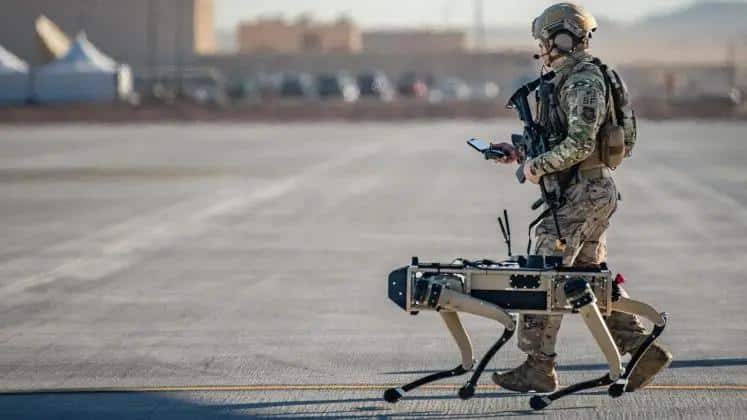
Drones have made some military capabilities far cheaper to deploy. A first-person-view (FPV) drone built from commercial components can destroy a vehicle worth hundreds of times its cost. A wide range of manufacturers can produce these relatively simple systems.
Yet drone production relies on a global supply chain for rare earth elements, lithium, graphite, gallium and other specialized materials. These dependencies become a strategic concern when militaries need millions of drones and must constantly replace those lost in combat.
If supplies are disrupted, who can keep building drones?
Drone production moves into the millions
Ukraine has developed the capacity to produce drones on an industrial scale. In January 2026, its National Security and Defense Council estimated domestic FPV drone production capacity at more than eight million units annually, spread across over 160 companies. Ukraine also reported producing 100,000 interceptor drones in 2025.
At these volumes, drone manufacturing begins to resemble ammunition production. The ability to replace losses matters almost as much as the performance of individual systems.
Producing eight million quadcopters, each with four motors, would require 32 million motors, along with millions of batteries, flight controllers, cameras and radio systems.
Components that are readily available in small quantities can become production bottlenecks when demand reaches this scale.
Rare earths: aweak point in drone motor production
Electric motors show how quickly material requirements grow as production increases.
Many small drones use brushless motors fitted with high-performance permanent magnets. Neodymium-iron-boron magnets contain neodymium and praseodymium, sometimes with dysprosium or terbium added to improve performance at higher temperatures.

According to an analysis by the Center for Strategic and International Studies (CSIS), a small motor may contain 5 to 15 grams of magnets. Across millions of drones, each requiring four motors, the quantities become substantial.
Much of the supply chain is concentrated further upstream. The International Energy Agency (IEA) estimates that China accounted for approximately 91% of global magnetic rare earth refining and 94% of sintered permanent magnet manufacturing in 2024.
Several processing and manufacturing stages separate raw ore from a finished drone motor. With much of that capacity concentrated in China, developing new mines elsewhere will not be enough to secure supplies.
Military drone batteries depend on civilian industry
Battery performance determines how long an electric drone can fly, how much it can carry and how well it performs in flight.

Lithium is a key material, while many lithium-ion cells also use graphite. Other materials vary depending on the battery chemistry.
Military demand accounts for a relatively small share of a global battery market dominated by electric vehicles, consumer electronics and energy storage. Even large defense orders represent only a fraction of civilian production.
For drone manufacturers, access to battery cells therefore depends on investments, factory capacity and commercial decisions largely outside the defense industry.
A country can assemble its own military drones while still relying on foreign suppliers for the batteries that power them.
Gallium and germanium in advanced drone systems
Not all drones have the same material requirements.
A basic FPV drone equipped with a commercial camera has a different architecture from an intelligence, surveillance and reconnaissance platform carrying advanced electro-optical and infrared sensors or communications equipment.
More sophisticated drones also require a wider range of specialized materials.
Gallium is used in certain radio-frequency semiconductors, while germanium and indium are found in some infrared and electro-optical technologies.
The quantities may be small, but losing access to a specialized component can leave a drone without an essential capability, whether night surveillance, target detection or data transmission.
Trade restrictions drive up material costs
Concentrated supply chains are already affecting material prices.
In 2026, the IEA reported that European prices for gallium and some heavy rare earth elements, including dysprosium and terbium, were around five times higher than in China. Germanium prices were nearly three times higher.
These price differences reflect the difficulties of finding alternative suppliers amid trade restrictions and limited processing capacity outside China.
Diversification is progressing slowly.
New rare earth mining and refining projects are emerging outside China, but establishing alternative magnet manufacturing capacity remains a much greater challenge.
Battery production faces similar constraints. Securing lithium supplies is of limited value without the processing facilities and factories needed to turn raw materials into finished cells.
In many cases, the hardest capacity to replace lies between extraction and final manufacturing.
Domestic assembly is not supply chain independence
A drone designed and assembled in Europe or the United States may still use Asian battery cells, magnets made from rare earth elements refined in China and electronic components sourced through global suppliers.
The final assembly plant is only one part of the manufacturing process.

Replacing an airframe supplier may be relatively straightforward. Establishing alternative supplies of permanent magnets, battery-grade graphite or specialized semiconductors can require major investment and years of industrial development.
In a prolonged war of attrition, those differences directly affect how quickly armed forces can replace equipment lost in combat.
Military strength depends on the ability to replace losses
The war in Ukraine has shown how quickly drones can move from limited production to mass consumption on the battlefield.
Sustaining production at that scale requires more than large inventories or domestic assembly plants. Armed forces also need reliable access to the materials and components that keep those factories running.
Critical materials are becoming an increasingly important part of industrial resilience and, by extension, military strength.
An army may enter a conflict with thousands of drones in its inventory. Keeping them supplied and replacing combat losses over months or years is a different challenge.