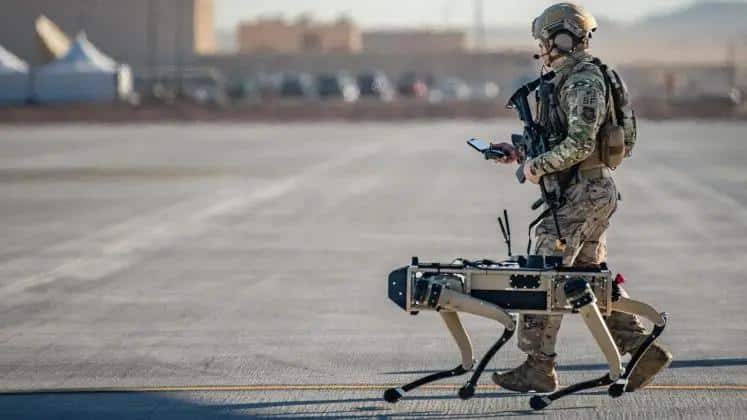



A new 120 mm mortar system unveiled in the United States highlights a growing problem for fire-support units: on a battlefield under constant drone surveillance, staying in one place for even a few minutes can be enough to draw return fire.
Global Military Products unveiled the Scorpion Medium in September before presenting it at AUSA 2026 in October. Mounted on the US Army’s Infantry Squad Vehicle-Utility (ISV-U), the 120 mm system can move from travel to firing configuration, or back again, in about ten seconds. The vehicle carries 16 rounds, while more than 95% of its components are shared with the 81 mm Scorpion Light.
The system is now moving into a demonstration phase, first with an unidentified East Asian country in November 2026 and then with the US Army in the first quarter of 2027.
The mortar itself is conventional. The real difference lies in how quickly it can fire and move.
The battlefield is becoming hostile to static mortars
Drones, counter-battery radars and increasingly connected sensor networks are shortening the gap between detection and attack. Mortars still give infantry units responsive and relatively inexpensive indirect fire. But the positions they fire from are becoming harder to hide.
The US Army has already identified the problem in its own light formations.
The 120 mm M120 mortars currently carried by Infantry Squad Vehicles can take several minutes to set up and just as long to displace. A 2026 analysis in the US Army’s Infantry magazine warned that those delays leave mortar crews more exposed to counter-battery fire as intelligence, surveillance and reconnaissance drones become more common over the battlefield. Static positions also create visual signatures that can quickly attract hostile unmanned aircraft systems.

Ukraine has shown the consequences at scale.
Ukrainian artillery pieces and mortars increasingly operate individually rather than in concentrated batteries. Crews check for hostile drones before firing, ammunition may be stored away from the weapon, and fire missions rarely exceed around ten rounds before the risk of detection becomes too high. Positions can then be abandoned as soon as there are signs they have been compromised.
Mortars still offer effects that drones cannot always replace. They provide short time of flight, substantial explosive payloads and a wide range of ammunition. They can also keep firing when weather or electronic warfare limits drone operations.
A 120 mm mortar built to keep moving
Rather than designing a heavily armored vehicle around the weapon, Global Military Products and Spain’s NTGS have mounted a 120 mm mortar on a relatively light tactical vehicle.

When the system is emplaced, the baseplate is lowered onto the ground so that recoil is transferred directly into the terrain rather than through the ISV-U chassis. That allows a light vehicle to carry a 120 mm mortar without requiring a much heavier dedicated platform.
A single command starts either emplacement or displacement, both of which take about ten seconds. Automatic laying and integration with the US Army’s Mortar Fire Control System (MFCS) are also intended to cut the time and workload needed to complete a fire mission.
The Scorpion Medium also builds on an architecture already being evaluated by the US Army. In September 2026, the service awarded Global Military Products a $12.9 million contract for 16 Scorpion Light 81 mm systems, to be integrated on ISV-Us with the Army’s digital fire-control system.

Trials of the Scorpion Light give an indication of the pace the system is designed to achieve. According to the manufacturer, during a US Army demonstration in Hawaii, one Scorpion Light reached its firing position, emplaced, fired eight rounds and moved off in one minute and one second.
Surviving counter-battery fire
Systems such as Poland’s M120 Rak or Patria’s NEMO put 120 mm firepower on highly automated armored platforms. Crews remain under armor, while automated laying and digital fire control allow the vehicle to complete a fire mission quickly before moving again.

The Scorpion and Alakran take a different approach. They favor lower weight, integration on lighter tactical vehicles, dispersion and very short emplacement times. Instead of relying mainly on armor to survive counter-fire, they are designed to be gone before it arrives.
The same emphasis on mobility can be seen in much heavier systems. Serbia is developing the TSMB M-25, a 203 mm mortar mounted on an FAP 6×6 truck, with new firing footage released in October 2026. Despite its caliber and a projectile weighing around 100 kg, the system is designed around rapid displacement and shoot-and-scoot tactics, applying the same survivability logic at a very different scale.

A light vehicle provides far less protection against artillery fragments, FPV drones or direct fire than an armored mortar carrier. Heavier systems, however, bring greater cost, weight and logistical demands.
Mechanized formations can integrate armored mortar carriers alongside their other combat vehicles. Light and rapidly deployable infantry units may place greater value on mobility and dispersion instead.
Drones are changing both sides of the equation
Drones make mortar positions easier to find, but they can also make mortar fire more effective.
An October demonstration showed how the two are beginning to converge. During the Iron Sting Precision Mortar Validation Event in Utah, a PDW C100 drone fitted with Leonardo DRS’s STAG-5 electro-optical/infrared sensor and a laser designator supported precision mortar engagements. Conducted for US Army Special Operations Command, the event included fires beyond the normal maximum range of a conventional smoothbore 120 mm mortar.
The mortar is not disappearing
What is changing is how long mortar crews can afford to stay in position.
Drone-enabled targeting, digital fire control and precision-guided munitions are pushing mortar units toward a more dispersed, mobile and connected way of operating.
The mortar position of the future may therefore look less like a fixed firing site and more like a temporary node in a distributed fire-support network: arrive, fire and move before the enemy can close its own engagement chain.