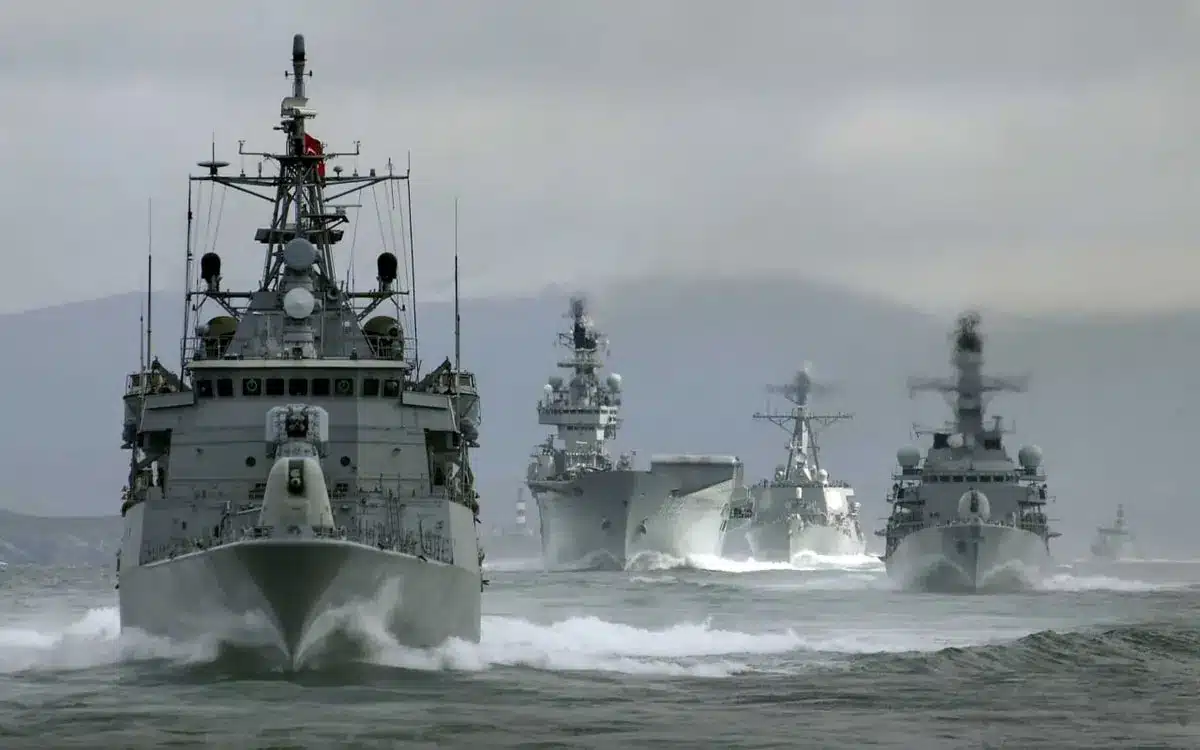
Russia’s war against Ukraine has fundamentally changed the Baltic security environment. Finland and Sweden joining NATO altered the regional balance, but Russia retains significant military infrastructure around Kaliningrad and St. Petersburg and continues to rely on the Baltic for maritime access.
The pressure now extends well beyond conventional naval activity.
GNSS jamming and spoofing have become persistent problems. Finland’s transport authority Traficom says interference affecting satellite navigation and some mobile communications frequencies originates from Russian territory. Maritime traffic in the Gulf of Finland is regularly affected, and interference can also cause incorrect vessel positions to appear in Automatic Identification System (AIS) data.
The seabed presents another security challenge. The Baltic contains a dense network of power and telecommunications cables connecting NATO members. Repeated damage to this infrastructure has heightened concerns about hostile activity below the threshold of conventional conflict.
Russia’s shadow fleet adds another layer of uncertainty. The Eagle S case illustrated the risk after a dragging anchor was linked to damage to the Estlink 2 power interconnector and several telecommunications cables in December 2024.

The combination of vulnerable infrastructure, shadow-fleet traffic, Russian electronic interference and military activity therefore creates a persistent surveillance requirement.
Geography compounds these pressures. Shallow waters, archipelagos, dense commercial traffic and narrow access through the Danish straits constrain naval operations. NATO navies must simultaneously protect shipping and infrastructure, monitor Russian activity, operate despite electronic interference and preserve the ability to reinforce the region during a crisis.
Poland and Finland build a layered Baltic defense
Three Miecznik-class frigates will form the core of Poland’s future surface fleet, providing air defense, anti-surface warfare and anti-submarine warfare (ASW) capabilities. The first, ORP Wicher, was launched in August 2026, with entry into service planned from 2029.

Warsaw has also selected Sweden’s A26 design for its Orka program. Three submarines are planned, while Sweden will temporarily lease HMS Södermanland to Poland. Combined with Poland’s land-based Naval Strike Missile batteries, these programs provide complementary capabilities to operate from land, on the surface and below it.
Finland is developing a different architecture. Its four Pohjanmaa-class corvettes will combine air defense, anti-surface warfare, ASW, minelaying and surveillance. All four are expected to be completed by 2029.

They will operate within a broader system combining mines, shore-based weapons and Finland’s archipelagic geography. Finland is therefore not trying to replicate a smaller blue-water navy, but to build a fleet tailored to the Baltic itself.
Sweden is moving beyond littoral warfare
Sweden brings decades of experience in Baltic naval operations. Its Visby-class corvettes emphasize low signatures and littoral warfare, while the new A26 Blekinge-class submarines combine air-independent propulsion with the ability to deploy autonomous systems.

Stockholm is also preparing to acquire four Luleå-class frigates and in May 2026 entered negotiations with France over a design derived from the FDI frigate. Air defense is a central requirement, with deliveries currently planned between 2030 and 2034.

Sweden is therefore retaining capabilities optimized for Baltic operations while developing larger surface combatants able to contribute to broader NATO operations.
Norway extends the flank toward the North Atlantic
Naval forces and reinforcements moving between the Baltic and the Atlantic depend on access through the North Sea and Norwegian Sea. Norway therefore belongs in the same strategic picture, even though its Navy is not a Baltic force.
Oslo plans six Type 212CD submarines and at least five Type 26 frigates, with ASW at the center of the requirement. Combined with P-8 Poseidon maritime patrol aircraft and future ASW helicopters, these capabilities will strengthen Norway’s ability to detect and track submarines across the Norwegian Sea.

Geography changes the mission. The confined waters of the Baltic favor sea denial, mines, submarines and coastal missiles. Toward the North Atlantic, endurance, wide-area surveillance and long-range submarine tracking become increasingly important.
From national fleets to a distributed maritime network
Finland and Sweden joining NATO brought all four countries into the same collective defense framework. The Joint Expeditionary Force is also strengthening alignment in maritime doctrine, training, planning and capability development.
Swedish-Polish submarine cooperation provides a concrete example. Stockholm will temporarily provide Warsaw with a submarine, train Polish crews and involve them in activities related to the introduction of Sweden’s own Blekinge-class boats.
Autonomous systems could take this integration further. NATO’s Task Force X-Baltic has tested uncrewed air, surface and underwater systems for persistent surveillance, chokepoint monitoring and the protection of critical undersea infrastructure. In 2026, the initiative moved from experimentation toward nationally owned capabilities able to operate together through NATO interoperability and shared data environments.
These systems can extend surveillance beyond crewed warships and feed a shared maritime picture, an important capability when cables, shipping lanes and chokepoints must be monitored simultaneously.

Much of this naval power is still to come
These countries are not building a common navy, and several major programs will not mature until the late 2020s and 2030s.
Much of this future naval power therefore still exists on industrial schedules rather than at sea. Crews must also be trained, ammunition stocks expanded, logistics established and national systems made interoperable.
Industry’s ability to turn procurement programs into operational capability will remain a critical variable.
From Baltic Sea denial to North Atlantic ASW
Northern Europe is not building a single fleet, but complementary forces designed to address different dimensions of the same maritime problem.
In the Baltic, conventional deterrence, persistent surveillance, infrastructure protection, electronic warfare and sea denial increasingly overlap. Farther north, the Norwegian Sea and approaches to the North Atlantic demand greater endurance, wide-area surveillance and advanced ASW capabilities.
NATO’s potential advantage lies less in the size of each individual fleet than in their complementarity and their ability to operate from a shared maritime picture.
The strategic shift is therefore not simply that Northern European countries are buying more warships. They are adapting to a maritime environment where Russian military activity, electronic interference and below-threshold threats increasingly overlap.
If these national capabilities can operate as parts of the same system, relatively small fleets could collectively generate considerably more naval power than their individual size would suggest.