

On August 1, 2025, a U.S. U-2 Dragon Lady completed a flight lasting more than 14 hours and covering over 6,000 nautical miles to mark the 70th anniversary of the type’s first flight.
It illustrates a paradox: an airframe designed in the 1950s remains useful in an environment increasingly shaped by digital communications, new sensors, and data fusion. At the other end of the technological spectrum, Denmark, Finland, Germany, and Norway announced on July 7, 2026, the acquisition of up to five MQ-4C Tritons, large uncrewed aircraft that NATO says can conduct 24-hour missions at altitudes above 15 kilometers.
But the aircraft themselves are only one part of the program. Ground stations, data management, command and control, infrastructure, and support complete the capability. This is where the transformation of the “spy aircraft” is taking place. Its value no longer depends solely on altitude, endurance, or onboard sensors, but on the entire chain required to detect, transmit, process, fuse, and disseminate information.
The aircraft becomes a node in the network
The term “spy aircraft” covers several different missions. Some aircraft observe activity on the ground, others search for electromagnetic emissions, while airborne early warning platforms simultaneously track large numbers of activities in the air or at sea.
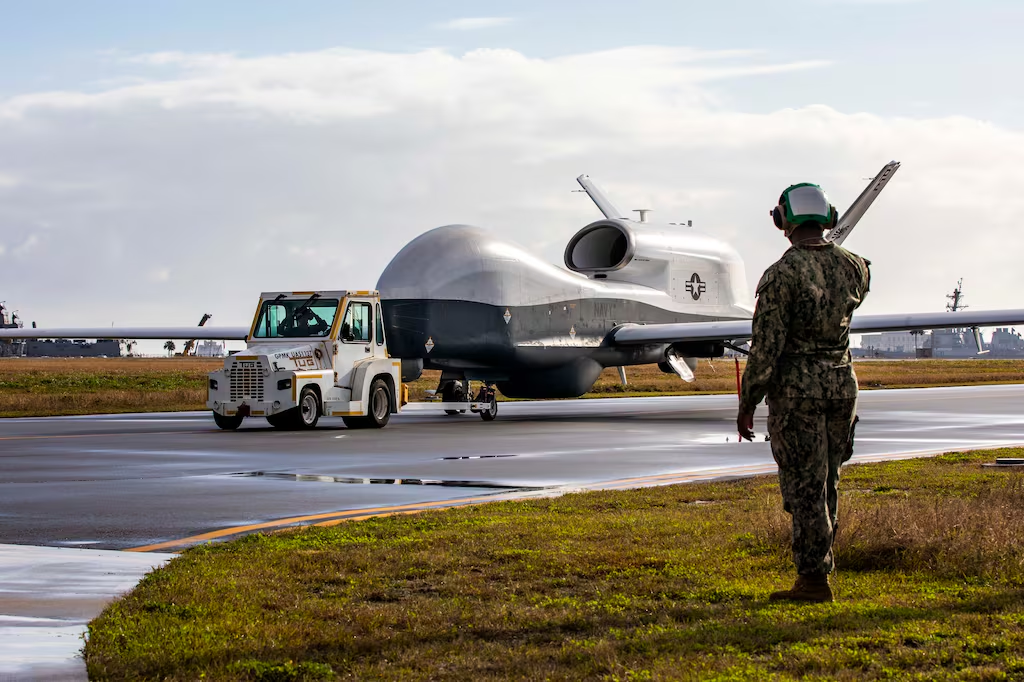
The MQ-4C Triton illustrates the shift from a stand-alone aircraft to a networked capability. The U.S. Navy describes it as a persistent maritime surveillance platform designed to operate alongside the crewed P-8A Poseidon and land-based assets.

During the Triton’s early deployments in the Pacific, the U.S. Navy found that the resources available were insufficient to process the volume of imagery and video being collected. Additional specialists had to be brought in to process and disseminate the material.
The transformation also extends to crewed aircraft. Modern business jets are becoming favored platforms for new intelligence systems. Germany, for example, is developing the Persistent German Airborne Surveillance System, or PEGASUS, around three modified Global 6000 aircraft. The program also includes a ground segment and training infrastructure.
GlobalEye, meanwhile, combines radar, passive sensors, communications, and command functions aboard a heavily modified business jet. In July 2026, NATO announced the opening of negotiations to acquire up to ten aircraft.
Constraints in the operational environment
The war in Ukraine has first demonstrated the vulnerability of large specialized platforms. Since February 2022, Russia has lost at least two A-50Us, while a third aircraft was damaged in Belarus in 2023 and sent for repairs. The number of aircraft actually available remains uncertain: open sources indicated six A-50Us remaining after the losses in 2024, while estimates published in 2026 suggest that fewer may actually be available for operations.
The A-50U also helps illustrate the value of these aircraft. According to its Russian manufacturer, the platform does more than detect targets with its radar: it also processes the information it collects and transmits it to command posts. These functions are documented by Russian industry, but their actual performance under operational conditions cannot be reliably established.
This is why the loss of such an aircraft can have consequences that go well beyond the loss of a single sensor. It simultaneously removes hard-to-replace detection, processing, communications, and command capabilities, a problem that becomes even more significant when only a limited number of aircraft are available.
China, meanwhile, is developing several families of specialized aircraft. Japanese authorities regularly document flights by Y-9 aircraft configured for intelligence collection around the Japanese archipelago. Japan’s Ministry of Defense also describes the expansion of the KJ-500 and KJ-2000 airborne early warning fleets, as well as the development of the KJ-600 for carrier operations.
It is important to note that Western architectures are far better documented in open sources than their Russian and Chinese counterparts. The absence of public information about a particular data link, sensor, or fusion method therefore does not demonstrate that such a capability does not exist.
The real advantage comes after collection
The proliferation of sensors is gradually shifting the center of gravity of airborne intelligence. Detecting more is not enough if the information cannot be exploited quickly enough.
NATO institutionalized this approach in 2023 by transforming what had previously been a ground-surveillance-focused structure into a broader intelligence force. Its large remotely piloted Phoenix aircraft operate alongside an analytical capability responsible for processing, exploiting, and disseminating the information collected.

The aircraft are therefore only the visible part of the system. Behind them are analysts, technicians, ground stations, communications networks, IT infrastructure, training, and maintenance.
Removing the crew from the aircraft does not eliminate this human requirement. The U.S. Navy specifies five personnel per ground station to operate the Triton, not including the specialists responsible for analyzing the intelligence collected. Innovation must therefore be assessed across the entire chain. A new radar may see farther and an aircraft may remain airborne longer, but the operational advantage depends on how quickly a detection can be turned into usable information.
This is why the 2026 landscape does not show the spy aircraft disappearing in favor of satellites or uncrewed platforms. Instead, it shows the coexistence of specialized capabilities: modernized crewed aircraft, converted business jets, large uncrewed platforms, command-and-control aircraft, and space-based sensors.