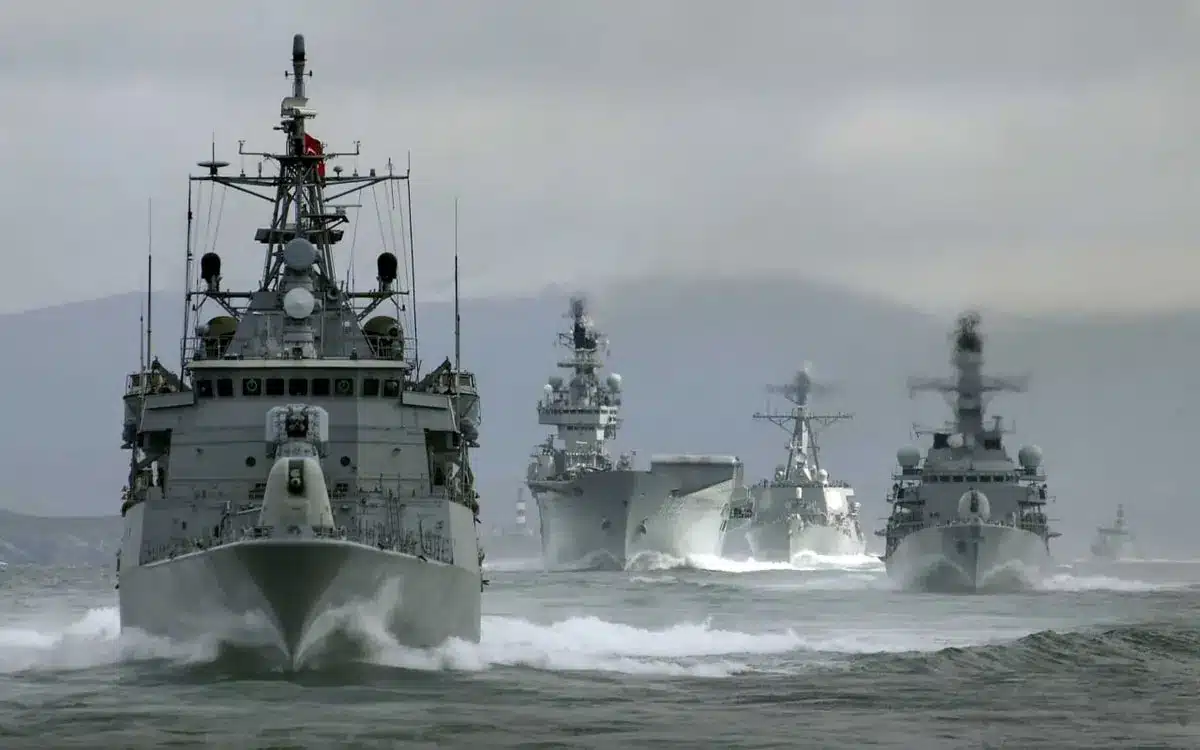



Belgium’s search for an alternative to the Anti-Submarine Warfare Frigate (ASWF) program is becoming increasingly serious. Italy’s FREMM EVO is emerging as a credible option should Brussels ultimately decide to leave the program developed jointly with the Netherlands.
But Belgium’s dilemma points to a much broader question for European navies: when does waiting for the warship best suited to future requirements become a greater military risk than fielding a proven design sooner?
Why Belgium chose the ASWF
The delays should not obscure why Belgium chose the ASWF in the first place. The Netherlands and Belgium agreed to jointly replace their M-class frigates with four ships, two for each navy. Operating the same class would preserve the unusually close naval integration between the two countries, which already coordinate procurement, training, maintenance, and logistics.

The ASWF was also designed from the outset around anti-submarine warfare. Ultra Maritime is expected to provide a new sonar suite combining the Sea Lancer towed array and Sea Sabre variable-depth sonar for operations in both deep and littoral waters.
In April 2025, it emerged that the hull design lacked approximately 180 metric tons of load capacity. The design unveiled in February 2026 is now about seven meters longer, half a meter wider, and 10% heavier. The first ASWF is now expected in 2033.
But designing in room for future capabilities has also contributed to the program’s difficulties. It exposes a familiar procurement paradox: preparing a warship for tomorrow can delay the capability a navy needs today.
The schedule has changed the equation
Three additional years matter much more when the ships being replaced are already approaching the end of their service lives. Unlike the Netherlands, which also operates four De Zeven Provinciën-class frigates, Belgium relies on its two M-class frigates as its principal surface combatants.

Leopold I and Louise-Marie are former Dutch M-class frigates that originally entered service in the 1990s before being acquired by Belgium. By February 2026, Brussels and The Hague were already taking steps to keep them operationally viable. Every additional year of delay therefore places another year of service on the aging frigates the ASWF was meant to replace.
Italy tests the value of time
The FREMM EVO is not necessarily a better frigate than the ASWF. It offers Belgium something different: greater schedule certainty.
FREMM is no longer a developmental program. Ten Italian frigates have already been delivered, while Fincantieri is building two FREMM EVO ships scheduled for delivery in 2029 and 2030.
Rather than developing an entirely new platform around Belgian-Dutch requirements, Italy can build on an established family of warships whose latest evolution is already in production.
According to Marineschepen.nl, the Italian option has become credible enough to push the Netherlands to improve the terms under which Belgium could remain in the ASWF program.
Faster does not mean like-for-like
Buying an existing design would not simply give Belgium an ASWF several years earlier. They are fundamentally different propositions.
The ASWF is a new platform developed around shared Belgian-Dutch requirements. The FREMM EVO instead builds on a mature multirole architecture that already includes a dedicated anti-submarine warfare variant.
That maturity does not mean the design is standing still. Its combat management system, radars, electronic warfare suite, communications, and sonar systems are all set to be modernized.
But the more Belgium modifies an existing design to meet its own requirements, the more it risks eroding the very schedule advantage that made the option attractive. The real question is therefore how much tailored capability Belgium would be willing to trade for an earlier delivery.
The cost of breaking commonality
A third factor complicates Belgium’s decision: its unusually close naval relationship with the Netherlands.
Cooperation extends far beyond buying the same ships. Their operational staffs form the integrated Admiral Benelux command, while training, logistics, and maintenance are closely coordinated. The Netherlands, for example, maintains the frigates, while Belgium is responsible for the mine countermeasure vessels.
Choosing another frigate would not end BeNeSam cooperation. But it would break fleet commonality, creating separate spare-parts inventories, training pipelines, and maintenance requirements.
The question is therefore not only what Belgium would gain by receiving a different frigate sooner, but also what it would lose by operating a different platform from its closest naval partner.
When time becomes a capability
European armed forces are being asked to do several things at once: replace aging equipment, integrate new technologies, expand force structure, and field additional capabilities faster.
Europe is not short of modern frigate designs. FREMM, FDI, F110, and MEKO are all available at different stages of maturity. Adapting an existing design means accepting compromises. Developing a purpose-built warship brings greater control over requirements, but also greater schedule and program risk.
Belgium’s dilemma can therefore be reduced to a simple question: How much customization is worth three, four, or five additional years?
The time required to field a capability increasingly has to be treated as an operational factor, not simply an industrial one. A frigate delivered on time is also a capability.
Three risks, not three frigates
Belgium’s decision ultimately is not simply about determining which frigate offers the best specifications. It is about balancing three risks: waiting too long, accepting capability compromises, or giving up some of the advantages of operating a common fleet with the Netherlands.
A more ambitious warship adds no combat capability until it enters service. But buying faster only makes sense if the compromises remain acceptable for the mission.
The challenge for European naval procurement is therefore no longer simply to build the best ships for tomorrow’s threats. It is to make sure that waiting for them does not create capability gaps today.