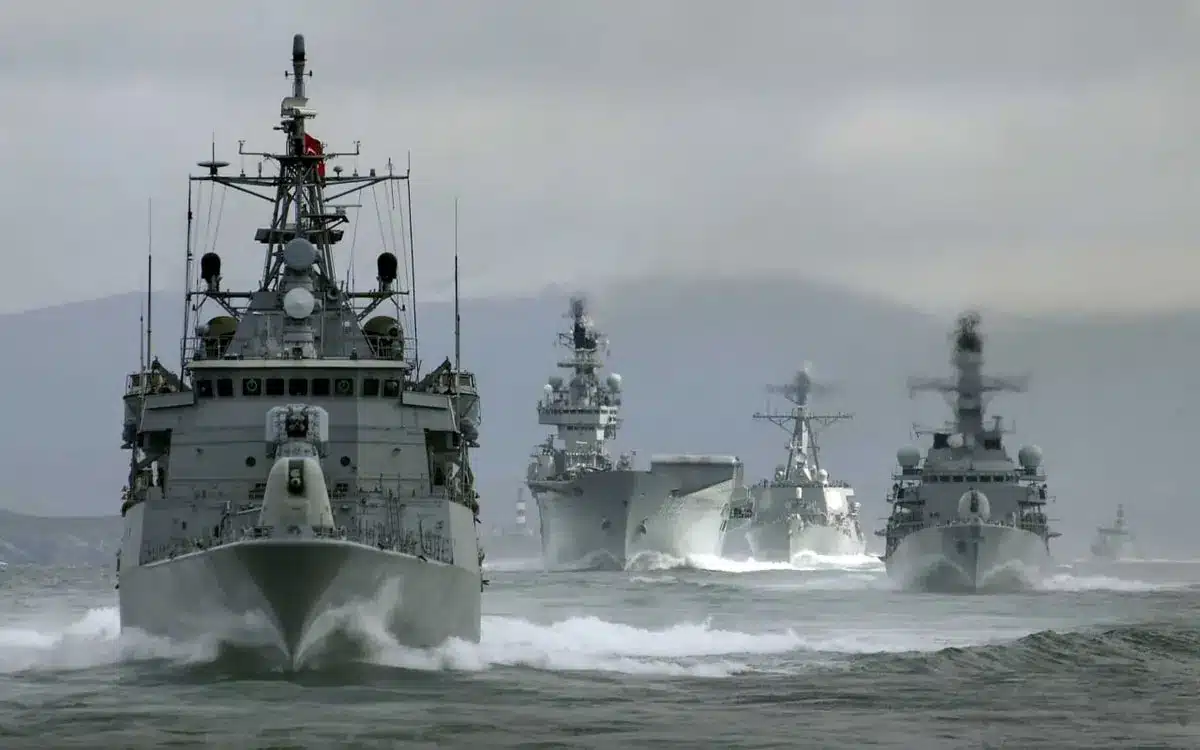



The global offshore patrol vessel market is shaped by a structural paradox: maritime threats are increasing, while budgets are not evolving at the same pace. The surveillance of exclusive economic zones, the fight against illegal fishing and maritime crime, and the persistence of piracy all require a continuous presence at sea, often across long distances. The International Maritime Bureau recorded 137 incidents in 2025, marking a year-on-year increase and confirming sustained pressure on coastal states.
In this context, offshore patrol vessels have emerged as a compromise: less expensive and more available than major combat ships, yet sufficiently enduring to cover a wide range of missions. Operational value is therefore shifting toward a simple metric: the number of days effectively spent at sea.
A global market driven by presence at sea rather than high-intensity warfare
The demand for offshore patrol vessels is primarily driven by continuous, low-intensity missions rather than high-end combat scenarios.
The Food and Agriculture Organization of the United Nations highlights the scale of illegal fishing, which directly undermines coastal economies. At the same time, the United Nations Office on Drugs and Crime emphasizes the expansion of maritime criminal networks.
The priority is not to destroy an adversary, but to detect, intercept, control, and deter over time. This naturally favors platforms capable of remaining at sea for extended periods at controlled cost.
Market assessment

Strengths: A key differentiator lies in manpower: offshore patrol vessels require fewer specialized personnel, reducing both training constraints and crew rotation pressures.
Weaknesses: A frequently underestimated limitation is reliance on information networks. Without external intelligence, an offshore patrol vessel remains capable, but effectively blind.
Opportunities: For instance, India ordered six new offshore patrol vessels for its coast guard in 2023, illustrating sustained demand in emerging regions.
Threats: A concrete example can be observed in Australia, where a public audit identified delays and support issues in a comparable program, highlighting the risk of reduced industrial credibility.
What ruggedness really means today
Rusticity can no longer be reduced to technical simplicity alone. It must now be understood as the ability to operate in a degraded environment, particularly within a contested electromagnetic spectrum. (i.e : jamming and spoffing)
In areas such as the Baltic Sea, disruptions and manipulation of satellite-based navigation signals are regularly observed. Under such conditions, a platform that depends heavily on these systems risks a tangible loss of operational effectiveness.
Rusticity therefore becomes a form of informational resilience.
A robust offshore patrol vessel must be able to:
- sustain navigation without full reliance on satellite-based positioning
- maintain a minimum level of coordination in a degraded network environment
- continue mission execution despite partial loss or degradation of onboard sensors
Modern rusticity is both operational and cognitive: it relies as much on crew proficiency and procedures as on the underlying technology.
The French model: endurance and robustness as guiding principles
The French Offshore Patrol Vessel program reflects a design philosophy centered on sustained presence at sea. The Ministry of Armed Forces indicates vessels of approximately 92 meters and 2,400 tons, with an endurance of around 6,000 nautical miles and deployments exceeding 30 days according to the industrial contractor.

Operational constraints are significantly reduced with this type of platform. Simplified systems shorten maintenance periods, crews can be trained more rapidly, and logistical dependence on complex spare parts is reduced.
The order of seven vessels for 900 million euros confirms a clear trade-off in favor of fleet size and availability.
International comparison: three operational models

Three distinct approaches can be observed in the patrol vessel market. The British model prioritizes persistent maritime presence through simple, reliable, and easy-to-maintain platforms. The Dutch approach places greater emphasis on situational awareness, integrating advanced sensors and maritime surveillance capabilities to improve the operational picture. Meanwhile, industrial players such as Damen focus on modular designs, offering adaptable platforms that can be customized to meet the specific operational and budgetary requirements of export customers.
Comparative summary
| Model | Priority | Main advantage | Main limitation |
| France | Endurance | High availability | Limited armament |
| United Kingdom | Simplicity | Controlled cost | Limited sensors |
| Netherlands | Surveillance | Information superiority | Higher cost |
| Export industry | Modularity | Adaptability | Integration complexity |
In counter-trafficking missions in the Atlantic or the Indian Ocean, the main constraint is not firepower but the ability to remain on station for weeks, conduct repeated inspections, and maintain a credible presence.
A complex but unavailable ship loses operational value. Conversely, a simpler vessel that is constantly deployed significantly increases maritime control.
The offshore patrol vessel market is built on a simple principle: ensuring credible maritime presence at sustainable cost. The French model aligns with this logic by prioritizing endurance and robustness.
However, the market remains fragmented. No single model dominates universally, and success depends as much on support, availability, and total cost of ownership as on technical characteristics.