

Launched in 2022, Alabuga Start is officially presented as an international education and employment program for young foreigners seeking professional experience in Russia. Through polished social media campaigns, training opportunities, and attractive employment packages, the initiative claims to recruit candidates from more than 80 countries to the Alabuga Special Economic Zone in the Republic of Tatarstan.
Since 2024, however, several investigations have painted a more complex picture. Reporting by the Associated Press and the Global Initiative Against Transnational Organized Crime (GI-TOC) indicates that some foreign recruits ultimately worked in facilities involved in manufacturing Russian military drones.
Beyond the controversy itself, Alabuga Start highlights a broader transformation within Russia’s defense industrial base. The program suggests that, in a war of industrial attrition, the ability to recruit thousands of workers is becoming almost as critical as building factories or securing supply chains.
Alabuga: a pillar of Russia’s drone production
Located in the Republic of Tatarstan, roughly 1,000 kilometers east of Moscow, the Alabuga Special Economic Zone was established in 2006 to attract foreign investment and develop high-value manufacturing industries. Over the following years, it became one of Russia’s leading industrial hubs, hosting companies from the automotive, chemical, logistics, and technology sectors while benefiting from tax incentives and modern infrastructure.
Russia’s full-scale invasion of Ukraine in 2022 fundamentally changed the site’s mission.
As Western sanctions tightened and battlefield demand for unmanned systems surged, Moscow accelerated the expansion of its domestic drone manufacturing capacity. Alabuga quickly emerged as one of the central pillars of that effort.
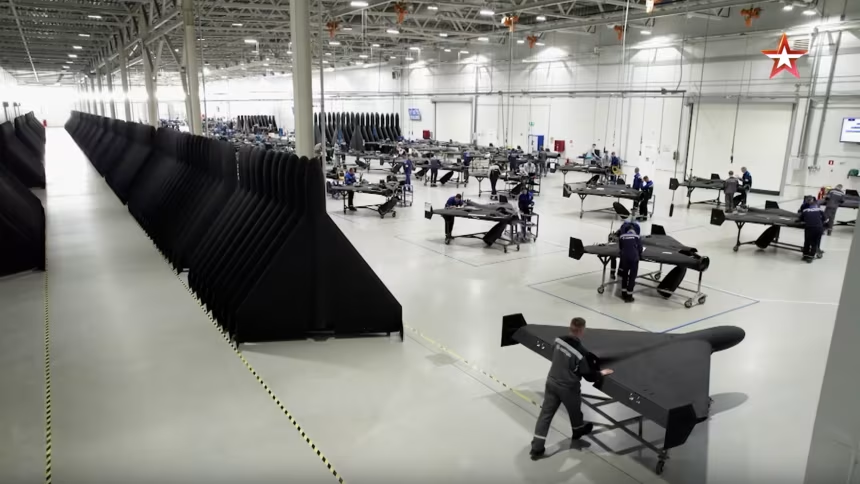
Today, governments, open-source intelligence (OSINT) analysts, and multiple research organizations widely identify the site as one of the primary production centers for the Geran-2, Russia’s domestically manufactured version of the Iranian-designed Shahed-136 loitering munition. Satellite imagery, procurement records, and corporate documentation all point to the continuous expansion of industrial facilities dedicated to drone production.
Production, however, extends beyond the Geran-2. Several open-source investigations indicate that Alabuga also assembles other unmanned systems, including the Gerbera drone—used primarily as a decoy or reconnaissance platform—as well as additional UAV variants designed for different operational roles.

This expansion reflects a broader shift across Russia’s defense industry.
Unlike traditional weapons programs, drone warfare relies on the continuous production of relatively inexpensive systems designed to be deployed in large numbers and rapidly replaced. The war in Ukraine has demonstrated that drones are no longer niche capabilities reserved for specialized missions. They have become expendable battlefield assets, making industrial output just as important as technological sophistication.
Producing hundreds, or even thousands, of drones each month requires far more than manufacturing facilities and electronic components. Despite advances in automation, production lines still depend on large numbers of technicians, assembly workers, logistics personnel, quality inspectors, and maintenance specialists.
The construction of new residential buildings and dormitories around the Alabuga complex illustrates these growing workforce requirements. Satellite imagery suggests that the site’s industrial expansion has been accompanied by a parallel effort to increase housing capacity for employees. This comes as Russia faces demographic pressures, military mobilization, and growing competition for skilled labor across its defense sector.
The human dimension of this industrial expansion often receives less attention than sanctions, electronic components, or Iranian technology transfers.
Yet sustaining mass production depends as much on recruiting, training, housing, and retaining thousands of workers as it does on securing semiconductors or expanding factory space.

This is precisely where Alabuga Start becomes strategically significant. Rather than being merely an international recruitment initiative, the program appears to be one of the mechanisms supporting one of Russia’s most pressing wartime industrial challenges: maintaining the workforce required to sustain large-scale drone production over the long term.
Recruiting an international workforce for Russia’s defense industry
As drone production continued to expand at Alabuga, another initiative grew alongside it: Alabuga Start. Officially, the program is presented as an international education and employment initiative designed to provide young foreigners with professional experience in Russia.
Its official communications follow the familiar playbook of international recruitment campaigns. Applicants are promised competitive salaries, subsidized housing, healthcare coverage, Russian language courses, and professional opportunities within one of the country’s largest industrial zones. Widely promoted across TikTok, Instagram, Facebook, and Telegram, the campaign portrays Alabuga as a modern industrial campus offering career development and international mobility.
This public narrative, however, contrasts with the findings of several independent investigations. Reporting by the Associated Press, the Global Initiative Against Transnational Organized Crime (GI-TOC), and the Foundation for Defense of Democracies (FDD) indicates that some foreign recruits ultimately worked in facilities involved in manufacturing Russian military drones, including production lines assembling unmanned aerial systems.
The investigations do not conclude that every participant knowingly joined the defense industry. Instead, they suggest that the work ultimately assigned did not always match the expectations created during the recruitment process. Given the limited independent access to Alabuga’s facilities, these accounts should be interpreted with caution. Russian authorities and program officials have also rejected many of the allegations raised by journalists and researchers.
Beyond this controversy, one trend stands out clearly: the internationalization of recruitment.
Rather than relying solely on Russia’s domestic labor market, Alabuga Start actively targets candidates abroad. Early recruitment campaigns focused on several countries across Africa, Asia, and Central Asia, including Uganda, Kenya, Nigeria, Rwanda, South Sudan, Sri Lanka, and a number of Central Asian republics.
This recruitment strategy relies heavily on digital marketing. Rather than emphasizing industrial work, promotional content focuses on career opportunities, personal development, international experience, and attractive living conditions. By leveraging social media platforms, influencers, and localized campaigns tailored to different languages and regions, Alabuga Start significantly expands its recruitment pool beyond Russia’s borders.

Several investigations have also raised concerns about the working conditions experienced by some participants. Former employees have described exceptionally long working hours, difficulties terminating their contracts, and working conditions that differed from those presented during recruitment. Some reports also mention restrictions on movement or the retention of identity documents, allegations that Russian authorities and Alabuga officials strongly deny.
Beyond these controversies, Alabuga Start illustrates a broader evolution of Russia’s defense industrial base. For decades, industrial mobilization depended primarily on domestic production capacity and the national labor force. The program suggests that digital technologies now make it possible to recruit workers internationally, turning workforce acquisition into another component of a wartime industrial strategy.
In this sense, Alabuga Start extends well beyond a conventional human resources initiative. It appears to be one of the mechanisms enabling Russia to sustain the long-term expansion of its drone industry by drawing on an increasingly international workforce.
Brazil: Alabuga Start’s new recruitment frontier
In early 2026, several Brazilian influencers publicly apologized after promoting Alabuga Start on social media. They said they had been unaware of the links that multiple investigations had drawn between the program and facilities involved in manufacturing Russian military drones.
The incident highlights a recent shift in the program’s recruitment strategy. After focusing primarily on countries in Africa, Asia, and the former Soviet space, Alabuga Start now appears to be expanding its outreach into Latin America, with Brazil emerging as one of its most prominent new targets.
Although the exact number of Brazilian recruits remains unknown, several investigations have identified Portuguese-language promotional materials and recruitment campaigns specifically designed for Brazilian audiences.
Brazil’s selection is far from accidental. According to DataReportal, the country had approximately 150 million social media user identities at the end of 2025, representing more than 70 percent of the population. Such a high level of social media penetration provides an ideal environment for targeted recruitment campaigns distributed through social media platforms.
Investigations by the Associated Press and the Foundation for Defense of Democracies (FDD) indicate that the Portuguese-language messaging closely mirrors campaigns previously directed at audiences in Africa and Asia. The promotional material emphasizes competitive salaries, housing, professional training, and international work experience while making little reference to the program’s reported links to Russia’s defense industry.
Brazil’s role extends beyond communications alone.
It suggests that Russia is gradually expanding its recruitment efforts beyond its traditional spheres of influence to support the continued growth of its defense industrial base. At a time when the country faces demographic decline, military mobilization, and increasing pressure on its labor market, diversifying recruitment pools appears to complement the expansion of industrial production capacity.
Historically, defense industries have relied almost exclusively on domestic labor. Alabuga Start suggests that this model may be evolving. Digital platforms now allow governments and industrial organizations to reach potential recruits well beyond their national borders, expanding the labor pool available to support wartime production.
From this perspective, industrial competition is no longer driven solely by access to critical materials, electronic components, or manufacturing capacity.
It increasingly extends to the ability to recruit the skilled workforce needed to keep those production lines operating.

Alabuga Start can no longer be viewed simply as an international education or employment program. Without prejudging the circumstances of individual participants, the growing body of investigations published since 2024 indicates that the initiative has become closely associated with one of the most strategically important sectors of Russia’s defense industry: drone manufacturing.
More broadly, the program reflects a significant evolution in the economics of modern warfare.
Defense industries across the world are facing increasing competition for technicians, engineers, and skilled manufacturing workers at the very moment when manufacturing requirements are expanding. As production lines scale up, access to qualified personnel is becoming as important as machine tools, critical components, or financial resources.
Viewed through this lens, Alabuga Start illustrates that countries engaged in prolonged industrial warfare are no longer focused solely on producing more weapons. They are also seeking to secure the workforce needed to sustain that production, even through unconventional recruitment methods.
In high-intensity conflicts, the industrial battle is no longer fought only in factories or across supply chains. It is also being fought in the global labor market.