


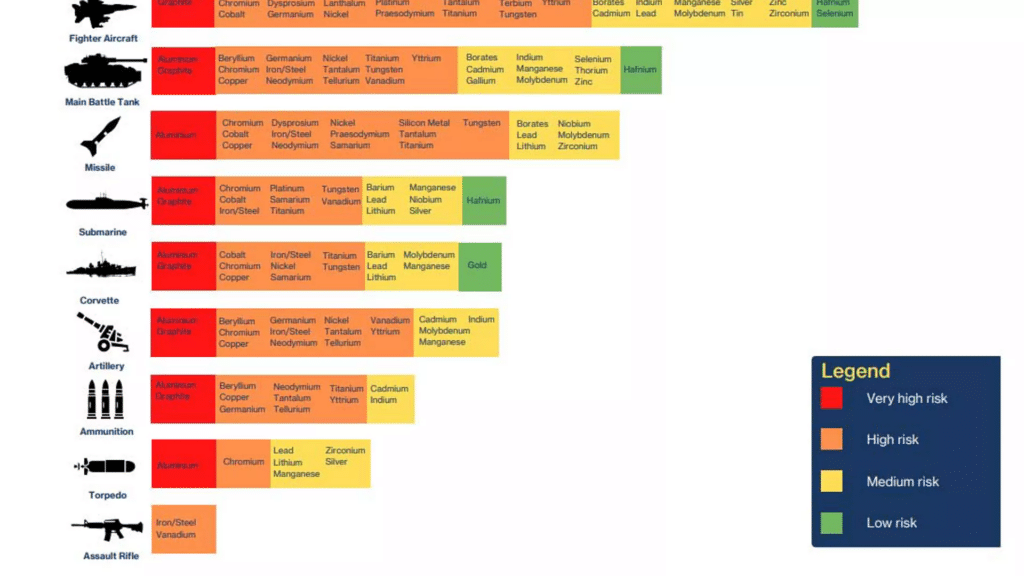
For decades, military power has been assessed through troop strength, defense budgets, or the number of platforms available. Today, another reality is gradually emerging: the ability to produce, maintain, and replace military equipment increasingly depends on access to certain strategic materials. This evolution is now recognized at the highest levels of Western defense organizations. In December 2024, NATO published, for the first time, an official list of twelve materials considered critical to the Allied defense industry, including gallium, germanium, graphite, titanium, tungsten, and rare earth elements.
This decision illustrates a major shift in perspective.
The war in Ukraine has significantly accelerated this realization. Efforts to increase the production of artillery shells, missiles, and air defense systems have revealed that ramping up industrial output depends not only on assembly capacity but also on complex supply chains, sometimes concentrated in a limited number of countries or companies.
Advanced military systems depend on materials that have become strategic assets
Modern military systems incorporate an increasing number of sophisticated technologies. This evolution naturally increases its dependence on specialized materials.
Gallium is a particularly revealing example. Used in gallium nitride (GaN) components, it enables the manufacture of electronic systems capable of operating at high frequencies while improving the energy efficiency and power output of equipment. This technology directly contributes to enhancing the performance of certain missile defense radars.
Raytheon states that the Lower Tier Air and Missile Defense Sensor (LTAMDS), a 360-degree air and missile defense radar, uses gallium nitride manufactured by the company. The contract awarded in 2025 is valued at $1.7 billion and covers radars intended for the United States and Poland, the system’s first international customer.

The operational consequence is direct: this radar is designed to detect and track aircraft, drones, cruise missiles, ballistic missiles, and hypersonic threats. The material does not constitute the military capability by itself, but it determines part of the sensor’s performance, and therefore the quality of detection, discrimination, and engagement.
The Defense Advanced Research Projects Agency (DARPA) also emphasizes that gallium nitride-based technologies have been integrated into several major electronic warfare, space surveillance, and air defense programs.
The same reasoning applies to germanium, rare earth elements, and beryllium, which are found in sensors, electronic components, optical systems, and space equipment. Critical materials do not constitute military capabilities in themselves, but they enable the existence of many capabilities considered essential.
This dependence is now officially recognized by NATO, which considers these twelve materials to be “embedded in the manufacture of advanced defense systems and equipment.”
The greatest vulnerability lies in processing, not mining
Public debate often focuses on mineral resources. However, for defense manufacturers, the primary risk frequently lies in the intermediate stages of the value chain.
Between the extraction of a material and its integration into a radar, missile, or satellite, several industrial processes are required: refining, purification, chemical processing, the production of specialized powders, component manufacturing, and industrial qualification.
The International Energy Agency (IEA) notes that several critical supply chains remain highly concentrated. Between now and 2030, approximately 70 to 75% of the growth in the refined supply of lithium, cobalt, nickel, and rare earth elements is expected to come from the world’s three largest producers. For certain graphite segments, nearly 95% of the projected growth in supply is concentrated in a single country.
This concentration creates a strategic vulnerability. A disruption does not necessarily have to occur at the extraction stage to affect military production. Constraints in refining capacity, export restrictions, or industrial bottlenecks can produce comparable effects.
Export controls have turned critical materials into geopolitical leverage
For several years, critical materials have become an instrument of industrial and strategic policy.
The restrictions imposed on certain exports of gallium, germanium, and graphite have demonstrated that supply chains can be used as instruments of strategic leverage. These measures have drawn the attention of Western governments to the true extent of certain industrial dependencies. For the armed forces, the risk is not solely economic. A prolonged disruption in supply can slow the production of air defense systems, electronic components, satellites, and electronic warfare capabilities.
This reality is particularly significant for countries seeking to maintain a defense industrial base capable of rapidly expanding production capacity in the event of a major crisis.
Critical materials are becoming indirect military capabilities
For much of the twentieth century, energy was one of the foundations of military power. Today, certain specialized materials play a comparable role in advanced technologies.
The F-35 Lightning II illustrates one form of this dependence. The U.S. Department of Defense states that a single F-35 requires more than 900 pounds (approximately 408 kilograms) of rare earth elements. The same source estimates 5,200 pounds (2,358 kilograms) for an Arleigh Burke-class destroyer and 9,200 pounds (4,173 kilograms) for a Virginia-class submarine.
These figures should be used with caution, as they represent aggregated public estimates rather than detailed industrial bills of materials. Nevertheless, they are highly significant. They show that material dependence is not limited to the small quantities of critical materials used in electronic components. It also extends to magnets, actuators, sensors, and numerous subsystems that make a platform’s overall performance possible.

The same Department of Defense source also states that rare earth magnets are used in Tomahawk missiles, radars, Predator drones, and Joint Direct Attack Munition (JDAM) guided bombs. This makes it possible to view rare earth elements not as an abstract category, but as a cross-cutting dependency affecting combat aviation, precision strike, unmanned systems, and surveillance capabilities.
The challenge is not simply to possess technological capabilities. It is also to ensure the ability to produce those technologies over the long term, maintain equipment in service, and rapidly replenish stockpiles during a prolonged conflict.
Europe is working to reduce Strategic dependencies
In response to these vulnerabilities, initiatives are multiplying.
The European Union has adopted the Critical Raw Materials Act (CRMA) to secure access to the critical materials required by strategic sectors, particularly defense and space. The regulation sets 2030 targets for the extraction, processing, and recycling of materials considered strategic.
The European Commission has also launched several Strategic Projects aimed at strengthening industrial capabilities and diversifying supply sources. This development reflects a growing recognition that industrial sovereignty no longer depends solely on assembly plants, but also on the entire upstream processing capacity.
Thales’ Ground Master 400 Alpha radar provides a clear illustration of this reality. According to the company, it is a long-range three-dimensional radar capable of detecting aerial threats at distances of up to 515 kilometers.

The industrial lesson is clear: for a European radar, sovereignty is not limited to final assembly or software. It also depends on the depth of the component supply chain, the ability to qualify suppliers, and sustainable access to processed critical materials.
A new measure of military power
Modern military power is no longer measured solely by the number of aircraft, missiles, radars, or warships a nation can field. It is also measured by its ability to produce, sustain, repair, and replace them.
The examples of the F-35, the Lower Tier Air and Missile Defense Sensor (LTAMDS), and the Ground Master 400 Alpha all point to the same reality: behind every visible military capability lies a far less visible, yet equally decisive, material supply chain.
Critical materials do not replace doctrine, trained personnel, defense budgets, or military platforms. They do, however, form one of the industrial foundations without which technological superiority becomes increasingly difficult to sustain over time.