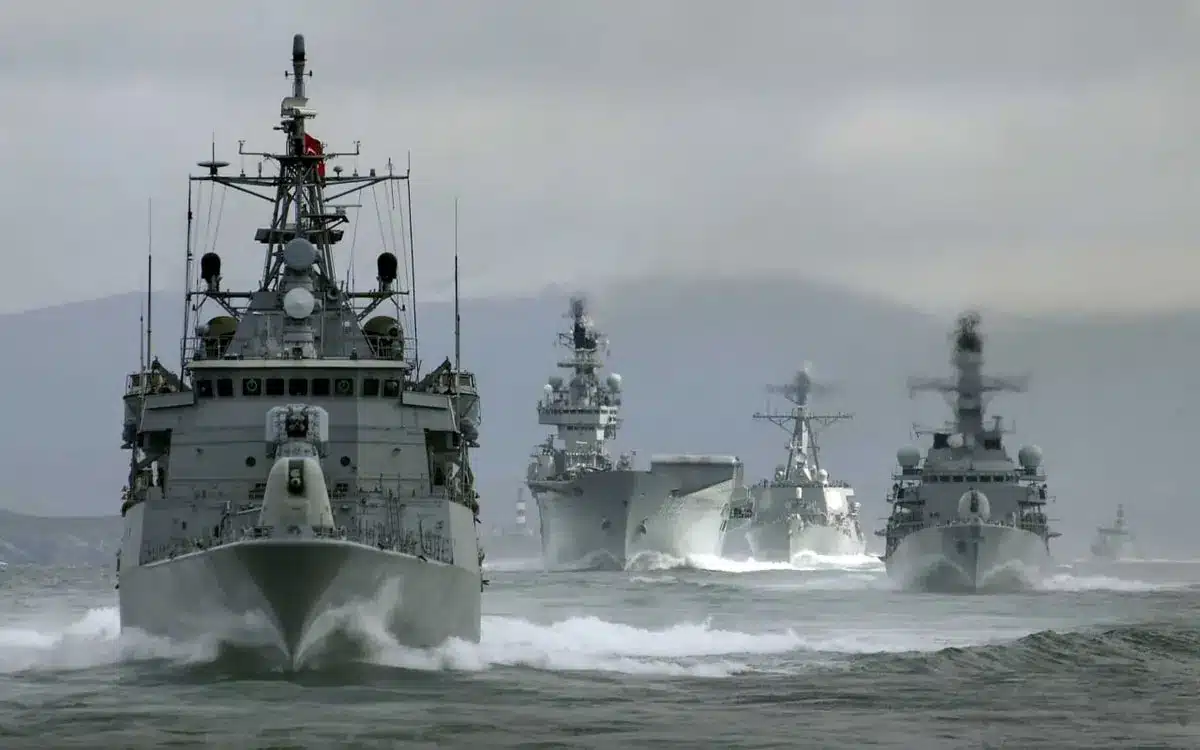



When the Russian frigate Neustrashimy conducted a live-fire exercise south of Plymouth on 20 July 2026, the event immediately triggered a political response in the United Kingdom and attracted widespread media attention. The British government described the exercise as “performative and irresponsible,” while the Royal Navy confirmed that it had monitored the warship throughout its transit.
Taken in isolation, the exercise could be viewed as little more than a symbolic demonstration of presence. In reality, however, it forms part of a much broader evolution in Russian naval activity across Northern Europe. Over the past two years, Allied navies have observed an increasing number of Russian deployments linking the Baltic Sea, the North Sea, the English Channel, the North Atlantic and the Arctic. These movements involve frigates, intelligence-gathering vessels, auxiliary ships and, above all, submarines, which remain at the core of Russia’s strategic maritime capability.
Against this backdrop, Neustrashimy‘s live-fire exercise should be seen less as a traditional show of force than as evidence of a broader transformation. Rather than seeking to project overwhelming naval power, Moscow appears to be adapting its maritime strategy to the military, industrial and economic realities created by Russia’s war against Ukraine.
Understanding this shift requires looking beyond the event itself and examining how Russian naval operations have evolved across the wider Northern European theatre.
A maritime strategy increasingly structured around northern Europe
Russia’s war against Ukraine has fundamentally reshaped the country’s naval posture. Before 2022, the Russian Navy regularly conducted large-scale multi-fleet exercises intended to demonstrate its ability to coordinate simultaneous operations across multiple theatres. Today, deployments tend to be smaller in scale but significantly more frequent.
Rather than signalling a reduction in activity, this reflects a deliberate adaptation.
Recent deployments reveal a continuous operational corridor stretching from the Baltic Sea through the Danish Straits, the North Sea and the English Channel before extending into the North Atlantic and the Arctic. Russian warships are now less likely to operate in large task groups, instead conducting individual deployments or operating in small formations with clearly defined objectives: maintaining presence, collecting intelligence, conducting training and demonstrating freedom of navigation, while occasionally escorting vessels associated with Russia’s so-called “shadow fleet.“
This approach offers several operational advantages.
First, it reduces the logistical burden associated with deploying large naval formations while preserving a visible military presence. A single Russian surface combatant transiting the English Channel is often sufficient to trigger a coordinated British response involving maritime patrol aircraft, helicopters and, in some cases, a Royal Navy escort frigate.
Second, it enables Moscow to sustain a persistent naval presence in maritime areas that remain strategically essential. The Baltic Sea provides Russia’s primary western maritime gateway. The Arctic protects the country’s strategic submarine bases. The North Atlantic, meanwhile, provides the strategic depth required to preserve freedom of manoeuvre for Russian naval forces.
Within this framework, the live-fire exercise conducted in the English Channel takes on a different meaning. The tactical value of the gunnery drill itself is arguably limited. Its real significance lies in its political visibility. Conducted in one of the world’s busiest shipping lanes, the exercise ensured immediate international media coverage while signalling that Russian warships continue to operate freely in international waters despite the current geopolitical environment.
British officials have interpreted the activity in much the same way. The Ministry of Defence has stated that Russian naval movements around the United Kingdom are now monitored on a routine basis and describes these operations as part of an enduring surveillance mission rather than an exceptional response to isolated incidents.
Lessons from Russia’s war against Ukraine
Russia’s evolving naval strategy cannot be understood without considering the operational lessons learned during the war against Ukraine.

The losses suffered by the Black Sea Fleet have had a profound impact not only on Russia’s naval reputation but also on its operational thinking. Beyond their immediate military consequences, these losses exposed the vulnerability of surface combatants to coordinated attacks combining precision-guided weapons, uncrewed surface vessels and real-time intelligence.
Many defence analysts argue that these experiences have accelerated Moscow’s shift toward capabilities considered more resilient in high-intensity conflict, particularly submarines and long-range strike systems.
The first visible consequence has been a change in how surface combatants are employed.
Large naval task groups, relatively common before 2022, have become increasingly rare. Russian warships now operate more frequently as individual units or in small formations, reducing the risk of losing multiple high-value assets simultaneously while maintaining a continuous operational presence across several maritime theatres.
The second development concerns the growing importance of the submarine force.
According to the United States Naval Institute, the Northern Fleet remains the centre of gravity of Russia’s strategic submarine capability, concentrating the country’s sea-based nuclear deterrent on the Kola Peninsula. This explains why the Norwegian Sea, the Barents Sea and the Arctic continue to occupy such a central place in Russian naval planning.
Long-range precision weapons have also reshaped operational concepts.
Russia no longer needs to maintain large surface formations close to an adversary’s coastline to preserve a credible conventional strike capability. Surface combatants increasingly function as launch platforms, while demonstrations of presence rely less on the size of deployments than on their frequency and persistence.
This has produced a subtle but significant shift in how Russian naval activity should be assessed. The most meaningful indicator is no longer the number of ships deployed simultaneously, but the Navy’s ability to sustain a continuous operational tempo across the Baltic, the Arctic and the North Atlantic.
The often overlooked factor: the invisible constraints behind naval deployments
The live-fire exercise in the English Channel also highlights a reality that is often overlooked in day-to-day reporting.
Deploying a single frigate for several weeks involves far more than the ship itself. Such a mission requires a fully trained crew, a logistics chain capable of sustaining fuel, ammunition and spare parts supplies, carefully planned maintenance cycles to preserve operational availability, intelligence assets to monitor the surrounding maritime environment, and command-and-control arrangements able to coordinate supporting or relief units if required.
This dimension is frequently underestimated. A prolonged deployment in the North Atlantic mobilises not only the crew of the warship, but also an extensive support structure encompassing logistics, maintenance, intelligence, replenishment and command functions. For a navy facing modernisation delays and constrained operational availability, maintaining a high operational tempo therefore represents as much an industrial challenge as a military one.
These constraints are particularly significant for Russia. A substantial portion of its surface fleet consists of ageing platforms that require increasingly lengthy maintenance periods and recurring modernisation work. Consequently, the true measure of naval capability lies not only in the number of ships on paper but also in the proportion that can be deployed and sustained at sea over time.

The Arctic: the true centre of gravity of Russian naval strategy
While images of Neustrashimy operating in the English Channel captured public attention, they should not obscure a more fundamental strategic reality: Russia’s primary naval effort remains concentrated in the Arctic.
Since the end of the Cold War, the region has served as the cornerstone of Moscow’s maritime power, and developments since 2022 have only reinforced this priority.
The Kola Peninsula hosts the Northern Fleet’s principal naval infrastructure, the bases supporting Russia’s strategic nuclear submarines and a significant share of the assets dedicated to protecting the country’s sea-based nuclear deterrent. It also provides access to the Northern Sea Route, whose economic and strategic importance continues to grow as Arctic navigation seasons gradually expand.
Stretching for approximately 5,600 kilometres along Russia’s Arctic coastline to the Bering Strait, the Northern Sea Route represents far more than a commercial shipping corridor. For Moscow, it constitutes a critical element of strategic maritime depth, enabling the movement of military and civilian traffic while supporting the defence of its northern approaches.
This explains why Russian deployments into the Norwegian Sea, the North Atlantic or even the English Channel should not be viewed as isolated operations. Instead, they represent extensions of a broader Arctic strategy. By maintaining a persistent naval presence along these maritime corridors, Russia complicates Allied surveillance efforts, protects its lines of communication and gathers valuable intelligence on Western responses.
Submarines remain central to this approach. Their ability to operate discreetly across the North Atlantic continues to underpin Russia’s strategic deterrence. Surface combatants, intelligence-gathering vessels and maritime patrol aircraft therefore contribute to creating favourable operating conditions for submarine deployments, even when their own missions consist of little more than routine transits or limited exercises.
This marks a noticeable departure from the naval messaging of the early 2000s and early 2010s, when Russia placed greater emphasis on showcasing the modernisation of its surface fleet. Today, preserving critical capabilities appears to take precedence over projecting the image of a global blue-water navy.
A European response built for the long term
European navies have progressively adapted to this evolution.
The objective is no longer simply to intercept individual Russian warships as they appear, but to maintain continuous surveillance across the maritime approaches to Northern Europe.
This shift is also reflected in Allied exercises. Recent editions of Steadfast Defender, NATO’s largest collective defence exercise in decades, have placed increasing emphasis on securing maritime lines of communication, reinforcing transatlantic logistics and protecting critical infrastructure.
The United Kingdom provides perhaps the clearest illustration of this evolution. British authorities now describe the monitoring of Russian naval movements as a permanent mission involving frigates, offshore patrol vessels, maritime patrol aircraft and helicopters. The emphasis has shifted from reactive interception towards persistent maritime surveillance.
The adjustment extends well beyond the United Kingdom. Norway continues to strengthen its monitoring activities in the Barents and Norwegian Seas. Denmark focuses on the Danish Straits linking the Baltic Sea to the North Sea. The Netherlands and Germany regularly contribute to surveillance missions across Northern Europe’s maritime flank. Together, these efforts form part of a broader NATO approach in which maritime intelligence sharing has become increasingly important.
Another significant development concerns the protection of undersea infrastructure. Telecommunications cables, electricity interconnectors and offshore energy installations are now widely regarded as critical components of European security. A series of incidents in the Baltic Sea has heightened awareness of their vulnerability, even where responsibility has not been conclusively established.
As a result, Allied navies are investing in new seabed surveillance capabilities, supported by autonomous systems, specialised sensors and enhanced intelligence cooperation.
This reflects a broader shift in naval competition. Modern maritime rivalry is no longer defined solely by the prospect of fleet-on-fleet engagements. It increasingly encompasses intelligence collection, the protection of critical infrastructure, information superiority and the ability to sustain a credible presence across vast maritime spaces.
The live-fire exercise conducted in the English Channel represents a symptom rather than a turning point.
Taken on its own, it neither signals the return of a Soviet-style ocean-going fleet nor suggests an imminent military escalation. Viewed within its wider strategic context, however, it illustrates how Moscow is attempting to adapt its naval posture to the operational lessons of the war against Ukraine, ongoing industrial constraints and a rapidly evolving European security environment.
The pattern of operations observed between the Baltic Sea, the Arctic and the English Channel reflects an effort to reshape Russian naval strategy rather than restore its former scale. Industrial limitations, lessons learned from recent combat operations and the growing priority assigned to safeguarding the submarine force are driving Moscow towards a strategy built on persistent presence instead of conspicuous demonstrations of naval power.
In that context, the most meaningful indicator of the Russian Navy’s future trajectory is unlikely to be the number of warships deployed at any given moment. Rather, it will be its ability to sustain a consistent operational tempo across Northern Europe’s maritime theatre despite mounting technological, industrial and operational constraints.
For European navies, this means that the challenge is no longer simply to respond to isolated Russian deployments. It is to maintain continuous maritime awareness across an increasingly interconnected operational environment where persistence, resilience and intelligence have become as important as combat power itself.