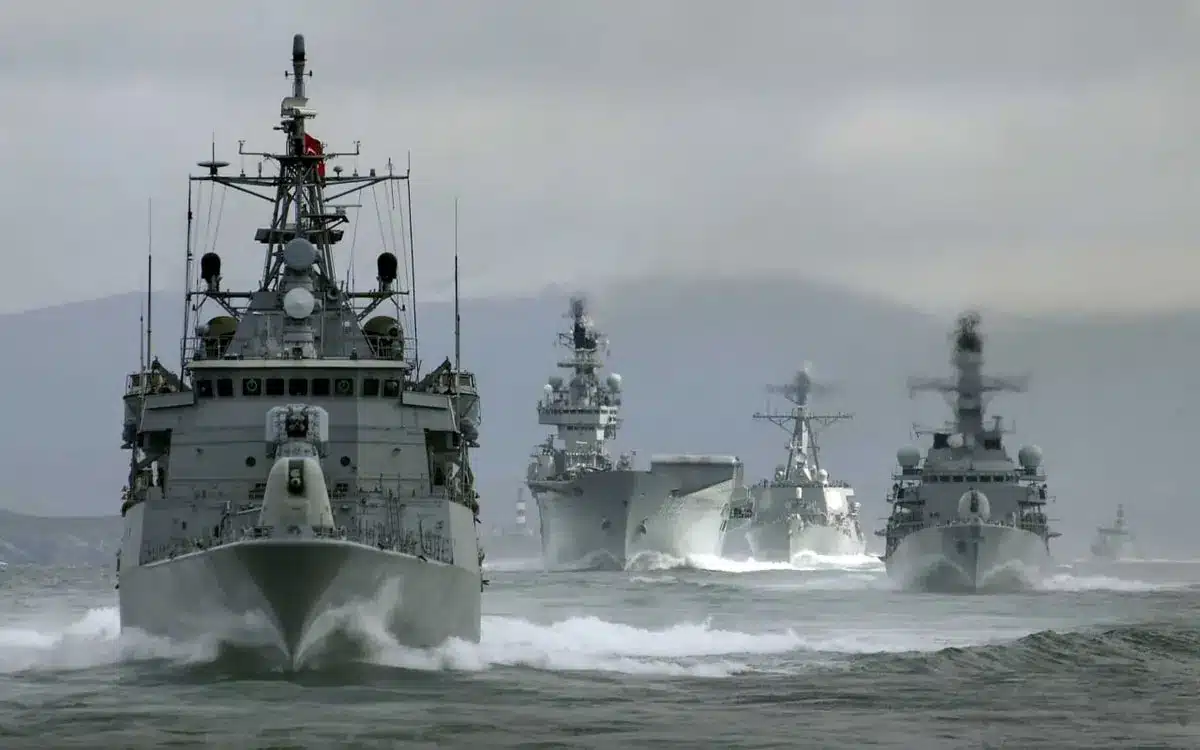



In the aftermath of the Cold War, the protection of surface combatants was built around a relatively stable assumption: the primary threat came from a limited number of high-speed anti-ship missiles. Naval air defense architectures were therefore designed to detect incoming threats at the greatest possible distance, engage them with surface-to-air missiles, and rely on close-in weapon systems (CIWS) as a last line of defense.
That approach remains relevant, but it is no longer sufficient.
Operations in the Red Sea, lessons learned from the war in Ukraine, and the rapid evolution of uncrewed systems demonstrate that navies must now contend with a far more diverse threat environment. Intelligence, surveillance and reconnaissance (ISR) drones, loitering munitions, one-way attack drones, uncrewed surface vessels (USVs), and anti-ship missiles can all be employed simultaneously to saturate a ship’s defenses. The challenge is therefore no longer limited to the individual performance of each threat, but to the way they are combined.
In response, defense companies and naval forces are developing a new generation of close-in defense systems. Their objective is not to replace existing capabilities, but to add new layers of interception capable of countering attacks that are more numerous, more complex, and significantly less expensive.
Saturation becomes the real challenge
The most significant change observed in recent years is not simply the proliferation of drones. It lies above all in the way they are employed.
A warship may now face multiple categories of threats arriving almost simultaneously. Some platforms are tasked with locating and tracking the ship, others seek to disrupt its defensive systems, while the most lethal weapons attempt to exploit the vulnerabilities created by this initial wave. An attack has become a coordinated sequence rather than an isolated engagement.
This evolution fundamentally changes the logic of naval defense.
Every interceptor missile launched from a ship represents a valuable resource. Vertical Launch Systems (VLS) carry a finite number of missiles that cannot be replenished until the ship is resupplied or returns to port. During a prolonged engagement, the crew must therefore constantly balance the immediate destruction of a threat against the need to preserve interceptor stocks for higher-priority targets.

This economic constraint has now become inseparable from the tactical one. Expending a surface-to-air missile costing several million dollars to destroy a modified commercial drone is no longer considered a sustainable solution when dozens of low-cost threats may emerge during a single deployment.
As a result, close-in defense is evolving toward a more optimized management of available effectors, where each weapon must be employed against the threat for which it provides the best balance between effectiveness, availability, and cost.
Lasers are creating a new engagement model
Directed-energy weapons are arguably the most widely publicized innovation in naval close-in defense. Their primary advantage lies not only in their precision, but also in their cost per engagement. Unlike a surface-to-air missile, a laser does not consume conventional ammunition. As long as the ship can generate sufficient electrical power and provide adequate cooling, it can continue engaging targets without depleting its interceptor inventory.
This logic explains the rapid acceleration of Western development programs.
In the United Kingdom, the DragonFire demonstrator, developed by a consortium bringing together MBDA UK, Leonardo UK, and QinetiQ, has demonstrated its ability to defeat drones during trials conducted by the Ministry of Defence. The Royal Navy now plans to integrate the system aboard several vessels from 2027 onward.

In the United States, the U.S. Navy is already testing Lockheed Martin’s HELIOS (High Energy Laser with Integrated Optical-dazzler and Surveillance) aboard the destroyer USS Preble, while the ODIN (Optical Dazzling Interdictor, Navy) system is being progressively fielded to disrupt the optical sensors of drones before they can even be engaged.
Germany is also continuing its own experimentation with Rheinmetall’s laser weapon demonstrator, which has been successfully tested aboard the frigate Sachsen.
These programs demonstrate that laser weapons are no longer viewed as laboratory technologies. They are steadily becoming an additional layer within naval close-in defense, complementing surface-to-air missiles and close-in gun systems, particularly against drones and certain classes of uncrewed surface vessels.
High-power microwaves target saturation attacks
High-power microwave (HPM) weapons address a different operational challenge. While lasers engage individual targets with great precision, microwave systems are designed to neutralize multiple drones simultaneously by disrupting their electronic components.
This approach is attracting growing interest across the U.S. defense industry. Epirus is developing Leonidas, a high-power microwave system specifically designed to generate area effects against drone swarms.
Meanwhile, the Air Force Research Laboratory continues work on the THOR (Tactical High-power Operational Responder) program, while Lockheed Martin is developing MORFIUS, an interceptor that also exploits the effects of high-power microwave technology.

In the naval domain, the Office of Naval Research is evaluating several demonstrators to assess how this technology could be integrated aboard future surface combatants.
Although these capabilities remain largely experimental, they directly address one of the key lessons emerging from recent conflicts: when a warship faces dozens of drones simultaneously, the ability to produce effects against multiple targets at once becomes almost as important as the precision of each individual interception.
Naval guns are regaining a central role
Long regarded as the final layer of defense against anti-ship missiles, naval guns are now experiencing renewed relevance thanks to advances in programmable ammunition.
Rather than relying on a direct hit, these projectiles detonate at a precisely calculated point along the target’s flight path, creating a cloud of fragments designed to intercept the drone. This approach significantly increases the probability of kill against small aerial targets while maintaining an engagement cost far below that of a missile interceptor.
Several defense companies are already fielding these capabilities. Leonardo offers its DART guided ammunition in combination with the Strales system for the 76 mm Super Rapid naval gun.

BAE Systems equips its Mk110 57 mm naval gun with 3P programmable ammunition, now widely employed by both the U.S. Navy and the Swedish Navy.
Rheinmetall continues to develop both the Millennium Gun and the Skynex air defense system, whose counter-drone performance is already influencing discussions surrounding future naval close-in defense architectures.
These developments are placing naval artillery back at the center of close-in defense. Against abundant, low-cost threats, naval guns once again offer a highly relevant layer between surface-to-air missiles and directed-energy weapons.
Drones are becoming interceptors themselves
Another emerging innovation is the deployment of drones specifically designed to intercept other drones before they can reach the ship. The defense industry is currently exploring several approaches.
Anduril has developed Roadrunner, a reusable interceptor drone capable of engaging aerial threats before returning to base if no engagement is required.

Fortem Technologies is pursuing a different concept with DroneHunter, which neutralizes its target using a net, while MARSS has integrated several counter-drone capabilities into its NiDAR command-and-control architecture.
Other manufacturers, including RTX with Coyote Block 2 and Diehl Defence with CICADA, are also developing interceptor concepts specifically designed to counter drones.
Most of these systems are currently intended for land-based air defense. Nevertheless, adapting them to the naval domain appears to be a logical next step.
Intercepting a drone several kilometers before it enters the ship’s defensive envelope would preserve the inner layers of the defensive architecture while reducing the consumption of the most expensive interceptors.
Sensors are becoming the true force multiplier
The effectiveness of these new weapons ultimately depends on the ability to detect threats early enough.
To address the growing proliferation of small, low-signature drones, several defense companies are developing radar systems specifically optimized for detecting small targets.
Thales offers the NS100 and Sea Master 400 radars, while HENSOLDT continues to develop the TRS-4D, and Saab is expanding the capabilities of its Sea Giraffe family. In the United States, Raytheon’s SPY-6(V) radar has become the backbone of the latest generation of U.S. Navy destroyers.

These sensors are now combined with electro-optical, infrared, and electronic warfare systems capable of automatically fusing data into a single tactical picture. This data fusion is becoming just as important as the individual performance of the sensors themselves.
The combat management system is becoming the core of naval defense
A warship’s combat effectiveness no longer depends solely on the performance of its weapons, but increasingly on its ability to coordinate them.
Modern combat management systems such as Lockheed Martin’s Aegis, Thales’ TACTICOS, and Saab’s 9LV are evolving toward greater automation of threat detection, classification, and weapon assignment. Artificial intelligence is beginning to assist operators by prioritizing threats, reducing false alarms, and recommending the most appropriate response.
This evolution is also shaping the next generation of naval platforms.
Programs such as the U.S. Navy’s DDG(X), the Royal Navy’s Type 83, Italy’s FREMM EVO, and Germany’s future F127 are being designed with expanded electrical power generation, increased cooling capacity, and open architectures capable of integrating weapons that are still under development today.
As threats continue to evolve, the effectiveness of a surface combatant will depend less on any single weapon than on its ability to integrate sensors, effectors, and decision-making into a single, coherent combat system.
This is likely to represent the most significant transformation in naval close-in defense since the introduction of the first Close-In Weapon Systems (CIWS).
A new definition of close-in defense
Close-in defense is no longer simply a collection of weapons arranged around a ship’s hull. It is becoming an integrated system in which sensors, software, effectors, and automation operate as a single, coordinated architecture.
Surface-to-air missiles will continue to engage the most demanding threats. Naval guns will remain the last line of defense. Directed-energy weapons will provide a cost-effective solution against selected targets. High-power microwave systems may eventually counter mass drone attacks, while interceptor drones will progressively extend the ship’s defensive perimeter.
None of these technologies will be sufficient on its own.
The operational advantage will belong to the navies capable of integrating them into a resilient, layered architecture that is intelligent enough to deliver the most appropriate response instantly against threats that are becoming faster, more numerous, and far more diverse.