


Loitering munitions have steadily become a central capability in modern warfare. Once confined to specialized missions, they now occupy an increasingly important place in land-force doctrine, whether for long-range saturation attacks or direct tactical support.
Their rapid proliferation is not driven solely by technical performance. Recent conflicts have demonstrated that these systems can dramatically shorten the sensor-to-shooter cycle while bringing strike capabilities closer to frontline units.
This evolution goes far beyond the emergence of a new type of drone. Loitering munitions are reshaping tactical organization, targeting chains, electronic warfare requirements, and even industrial planning.
Recent trials of new systems, including programs developed by countries with emerging defense industries, illustrate the accelerating democratization of this capability. Yet behind the common label of “loitering munition” lie fundamentally different operational concepts.
A logic of mass as much as precision
The first modern loitering munitions were primarily designed for Suppression of Enemy Air Defenses (SEAD). The Israeli Harop, developed by Israel Aerospace Industries, exemplifies this original approach: a platform capable of detecting radar emissions before diving onto its target.
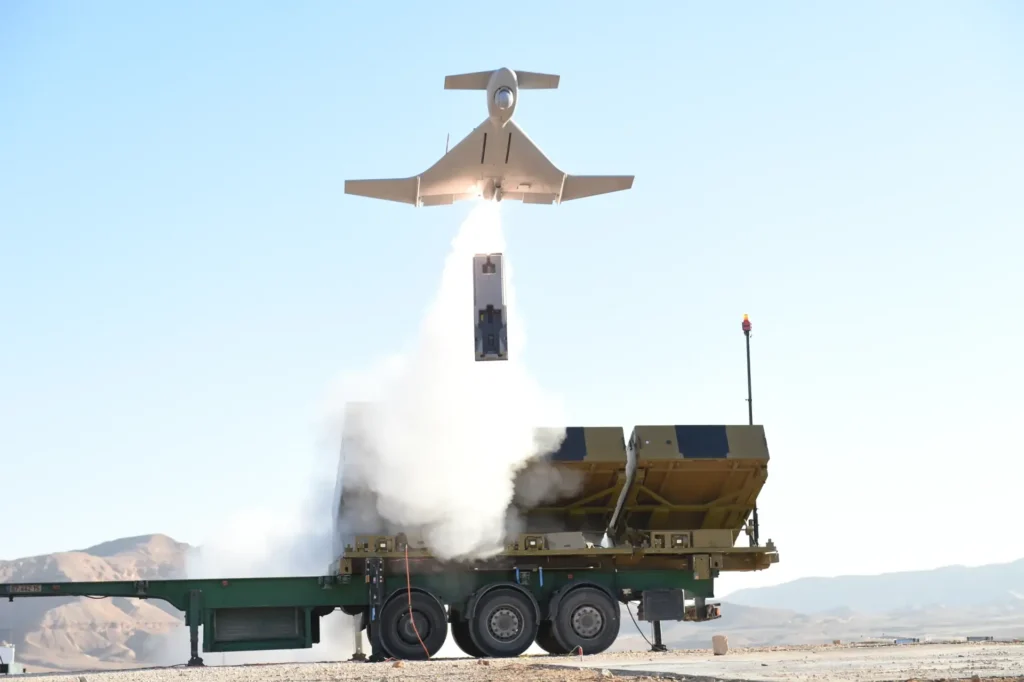
Recent conflicts have considerably expanded the role of these systems. Many armed forces are now seeking to integrate loitering munitions directly at the tactical level in order to shorten the strike cycle.
Two major trends have emerged.
The first is based on saturation and attrition. Iran’s Shahed family has become the symbol of this industrial approach: a relatively simple platform produced in large numbers and employed to maintain constant pressure on enemy defenses. Its effectiveness depends less on individual performance than on its ability to saturate defensive systems and impose a high interception cost on the defender.
The second approach favors more tactical and precise systems. The U.S. Switchblade and several variants of Israel’s Hero family are designed primarily to support ground forces at close range. Smaller and more mobile, they allow small units to field an immediate strike capability without relying on heavier artillery support.
This distinction highlights the existence of several families of loitering munitions, each designed to meet very different operational requirements.
Comparing the main families of loitering munitions
The technical differences between these systems directly shape their employment concepts. Range, endurance, propulsion, warhead size, and guidance methods all influence how armed forces integrate them into their strike architecture.
The Iranian Shahed illustrates the logic of long-range saturation. Depending on the variant, its range can extend from several hundred to more than a thousand kilometers, with endurance measured in hours. Powered by a relatively simple engine and carrying a warhead weighing several tens of kilograms, the system prioritizes volume and persistence above all else.
This architecture allows production at a significantly lower cost than a conventional cruise missile. However, its limited speed and distinctive acoustic signature make it vulnerable to certain air defense systems when these are properly positioned.
More importantly, the Shahed demonstrates how long range can become a strategic attrition tool. Even when intercepted, these drones force defenders to expend missiles that are often far more expensive.
Russia’s Lancet follows a different logic. Its shorter endurance and more limited tactical range are offset by a greater ability to engage mobile or semi-mobile targets with precision.
The variants observed in Ukraine generally carry warheads optimized for destroying armored vehicles, artillery systems, or radar assets. Its design makes it more of a tactical hunter-killer weapon than a saturation platform.
This concept also explains its reliance on an effective targeting chain. In many documented cases, Lancet operations are supported by reconnaissance drones capable of locating and tracking targets before engagement.
The U.S. Switchblade adopts yet another philosophy. Lightweight and man-portable, it emphasizes tactical mobility rather than long-duration endurance.

Its range and flight time remain limited compared with larger systems, but its rapid deployment gives small units an organic strike capability available within minutes.
The lighter variants are optimized against lightly protected targets, while larger versions are designed to engage armored vehicles.
This approach demonstrates how a loitering munition can become an organic direct-fire support asset comparable in some respects to a light mortar or anti-tank weapon.
Poland’s Warmate and the Hero family developed by UVision represent a more modular approach.
Warmate combines intermediate tactical range, low acoustic signature, and mission-adaptable warheads. Some configurations prioritize anti-personnel effects, while others are intended for more heavily protected targets.
The Hero family pushes this concept further through multiple variants covering different tactical echelons. Some platforms remain compact and portable, while others offer greater endurance and larger warheads.
The Israeli Harop retains a more operational focus. Its long endurance, ability to search for radar emissions, and larger warhead make it primarily a tool for air-defense suppression missions.
More expensive and more sophisticated than lightweight tactical systems, it occupies a space somewhere between an intelligence-gathering drone and a precision-guided missile.
Meanwhile, programs such as Phoenix Ghost and certain Zala platforms illustrate the accelerating pace of adaptation within the loitering munition sector.
Some militaries prioritize simple drones produced at scale to saturate enemy defenses. Others seek more precise systems tightly integrated into tactical operations and capable of directly supporting maneuver units.
Simplified comparison table
| System | Approximate Range | Endurance | Warhead | Primary Employment Concept |
| Shahed | Several hundred to over 1,000 km depending on variant | Several hours | Several tens of kilograms | Long-range saturation and attrition |
| Lancet | Tens of kilometers | Approximately 30–60 minutes | Anti-armor or anti-artillery | Tactical hunting and precision strike |
| Switchblade | Several kilometers to several dozen depending on variant | Tens of minutes | Light to medium warhead | Direct support to small units |
| Warmate | Intermediate tactical range | Around one hour depending on configuration | Modular warhead | Tactical versatility |
| Hero | Varies by variant | Less than one hour to several hours | Multiple warhead options | Multi-echelon architecture |
| Harop | Several hundred kilometers | Long endurance | Large warhead | Air-defense suppression |
| Phoenix Ghost | Limited public data | Limited public data | Limited public data | Rapid adaptation and experimentation |
The table above illustrates the absence of a single dominant model. Loitering munitions now cover missions ranging from strategic saturation campaigns to direct infantry support.
What truly determines their effectiveness
Manufacturer specifications alone are no longer sufficient to evaluate a loitering munition.
Recent conflicts show that effectiveness depends primarily on the ecosystem surrounding the platform: reconnaissance assets, communications networks, electronic warfare capabilities, and tactical organization. Electronic warfare has become a decisive factor.
Some systems remain heavily dependent on data links or navigation systems vulnerable to jamming. Others increasingly integrate autonomous capabilities to reduce that dependence. The targeting chain is equally critical.
In many cases, the speed at which targets are detected and coordinates transmitted matters more than the performance of the drone itself. This evolution is gradually transforming loitering munitions into components of a broader combat system centered on the rapid flow of information.
Training therefore becomes essential. Units must learn to coordinate reconnaissance drones, communications networks, anti-jamming procedures, maintenance activities, and energy management simultaneously. This shift requires a rapid increase in operator expertise and is progressively changing the tactical organization of equipped units. Effectiveness now depends as much on personnel and procedures as on the strike platform itself.
A lasting transformation of land forces
The integration of loitering munitions is altering several long-established military balances.
First, it partially reduces dependence on traditional artillery by providing tactical units with greater strike autonomy.
Second, it increases pressure on exposed armored vehicles, artillery systems, and air-defense assets. However, this evolution also creates new constraints.
Armed forces must now absorb massive drone consumption rates, secure electronic component supply chains, protect data links, and maintain logistics systems capable of supporting large volumes of expendable platforms.
The proliferation of jamming systems further increases pressure on tactical communication architectures. As a result, production capacity is once again becoming a strategic factor.
Recent conflicts have demonstrated that even sophisticated systems can quickly reach their limits if they are available only in small quantities during a prolonged war of attrition.
Loitering munitions will not replace traditional artillery or guided missiles. Instead, they create an intermediate tactical layer between reconnaissance, fire support, and precision strike.
The decisive factor will likely be less about the performance of individual drones and more about the ability of armed forces to effectively integrate intelligence, electronic warfare, communications, and mass production.