

For years, South Korea’s land defense industry was viewed largely as a regional actor shaped by the security demands of the Korean Peninsula. That view is now outdated. Since Russia’s invasion of Ukraine, South Korea has emerged as one of the few countries able to produce tanks, artillery, armored vehicles and ammunition at industrial pace, while also offering production transfers and delivery schedules aligned with the urgent needs of European and Asian armies.
This shift is not only about technology. It points to a wider transformation in the global market for land systems. Delivery speed, industrial capacity and long-term logistical support can now matter as much as platform sophistication.
Ukraine changed what armies want from land systems
Poland is the clearest example of this shift. In July 2022, Warsaw signed major agreements for K2 Black Panther tanks, K9 Thunder self-propelled howitzers and Chunmoo rocket artillery systems to rapidly reinforce its land forces after the start of the war in Ukraine. First deliveries followed on a notably compressed schedule compared with many Western industrial timelines. That speed has become one of South Korea’s strongest competitive advantages.

The war in Ukraine has changed how armies evaluate land equipment. For decades, many Western forces prioritized highly complex, expensive platforms produced in limited numbers. High-intensity combat has brought older industrial constraints back to the center of planning: immediate availability, rapid replacement of losses, ammunition stockpiles, production tempo and simpler sustainment.
South Korea has a structural advantage in this environment. Its defense industry has long been organized around the possibility of a major conventional war with North Korea. That permanent readiness has helped preserve heavy production lines able to operate at scale. While several European countries reduced parts of their defense industrial base after the Cold War, Seoul maintained a manufacturing base able to produce armored vehicles, artillery and ammunition in meaningful quantities.
An industry built to produce fast and for the long term
South Korea’s success is not based only on selling equipment. Its companies increasingly offer a broader package: training, maintenance, technology transfer, partial local production and long-term logistical support.
That approach is visible in the agreements with Poland, which include a gradual move toward local production for some K2 Black Panther variants and support for K9 Thunder artillery systems. This reduces dependency and helps customer armies build operational capacity faster.

South Korea’s ability to combine fast delivery with industrial flexibility also addresses a problem that is often overlooked: the global shortage of production capacity. Since 2022, several armies have been trying to rebuild ammunition stocks, strengthen artillery forces and modernize armored fleets at the same time.
Many Western production lines were no longer sized for large and urgent orders. South Korea has therefore become a supplier able to absorb part of this growing international demand.
Artillery is the core of South Korea’s export rise
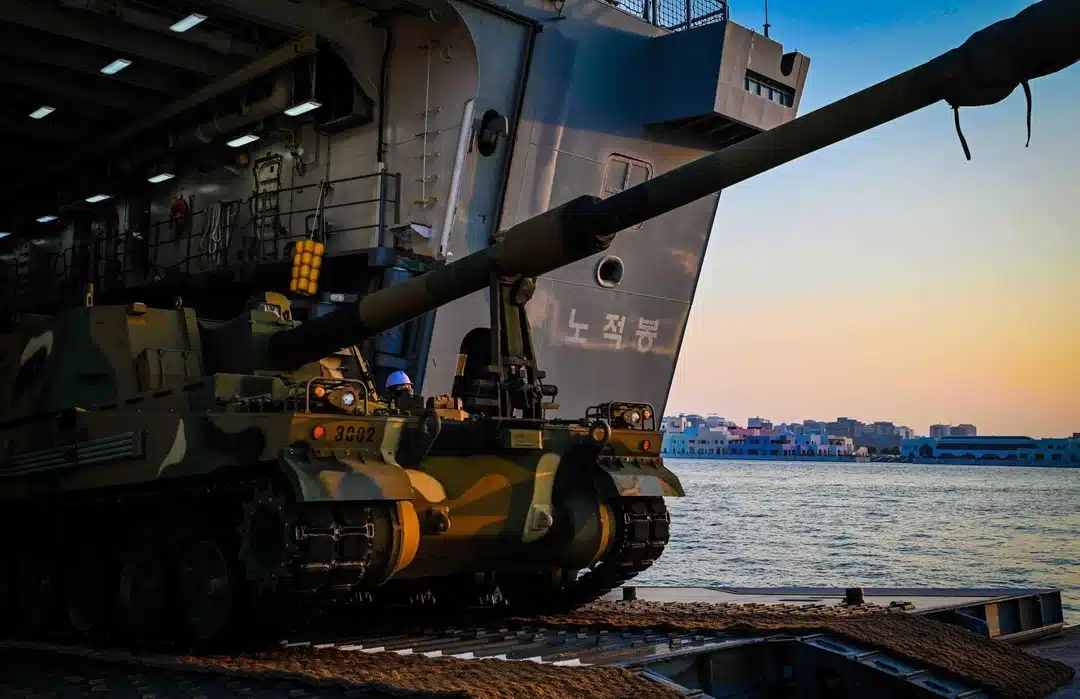
Artillery is now central to South Korea’s export success. The K9 Thunder self-propelled howitzer has become one of the most widely adopted artillery systems of recent years. Several European and Asian countries have ordered or integrated it into their land forces.

Its appeal does not come from a dramatic technological breakthrough. It comes from a balance of range, mobility, rate of fire, maintenance and ownership cost. In contemporary conflicts, armies need systems that are robust, available quickly and able to sustain large firing volumes over time.
South Korea anticipated that demand earlier than many Western competitors.
The same logic applies to armored vehicles. The K2 Black Panther combines modern performance with an industrial architecture designed for relatively rapid production and adaptation to foreign customer requirements.
Ground robots are the next industrial target
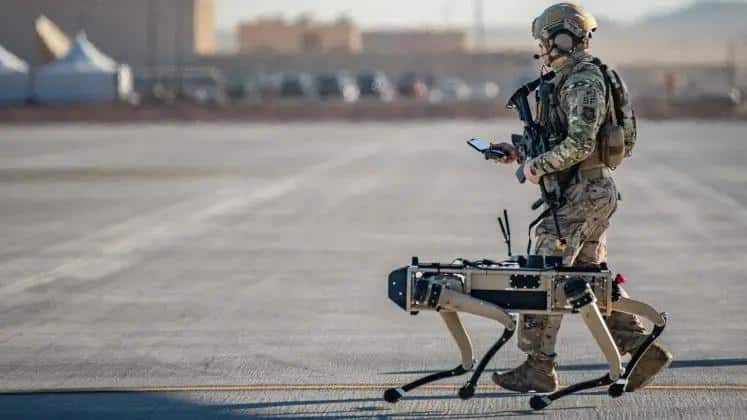
South Korea’s industrial logic is now expanding into automated ground systems. Defense companies are developing several uncrewed platforms for reconnaissance, logistics support and casualty evacuation.
Hanwha Aerospace and Hyundai Rotem are investing in ground robots designed to support mechanized units and operate in dangerous environments without directly exposing crews.
Ground robotization is becoming a natural extension of South Korea’s defense model: systems that are more numerous, more sustainable and better suited to prolonged attrition warfare.
This direction reflects lessons from Ukraine. Armies have seen that expensive crewed platforms remain vulnerable to drones, artillery and precision strikes. Ground robots offer a way to reduce human exposure while preserving logistics, reconnaissance and support functions close to the front.
A new logic for the global land warfare market
South Korea’s main advantage may be less about maximum platform sophistication than about the combination of production tempo, logistical simplicity, compatibility with Western standards and relatively sustainable cost.
In other words, Seoul is answering the exact constraints exposed by the war in Ukraine and by rising tensions in Asia. Armies are rediscovering that a system available quickly and in meaningful numbers can sometimes provide more operational value than a more advanced platform delivered slowly and difficult to sustain over time.
There are limits. South Korea still depends on foreign components for parts of some electronics, engines and sensitive subsystems. Rapid order growth could also create pressure on South Korean production capacity. Seoul’s rise also increases competition with European and American defense companies in market segments long dominated by Western suppliers.
What South Korea is really changing
The deeper change is not simply that South Korea is exporting more land systems. For decades, the global land warfare market often rewarded the most sophisticated platforms. Today, armies increasingly want equipment that can be delivered quickly, produced in volume, sustained logistically and kept in service during a long war.
In that environment, South Korea looks less like an emerging exporter and more like one of the few countries already organized for an industrial land warfare economy.