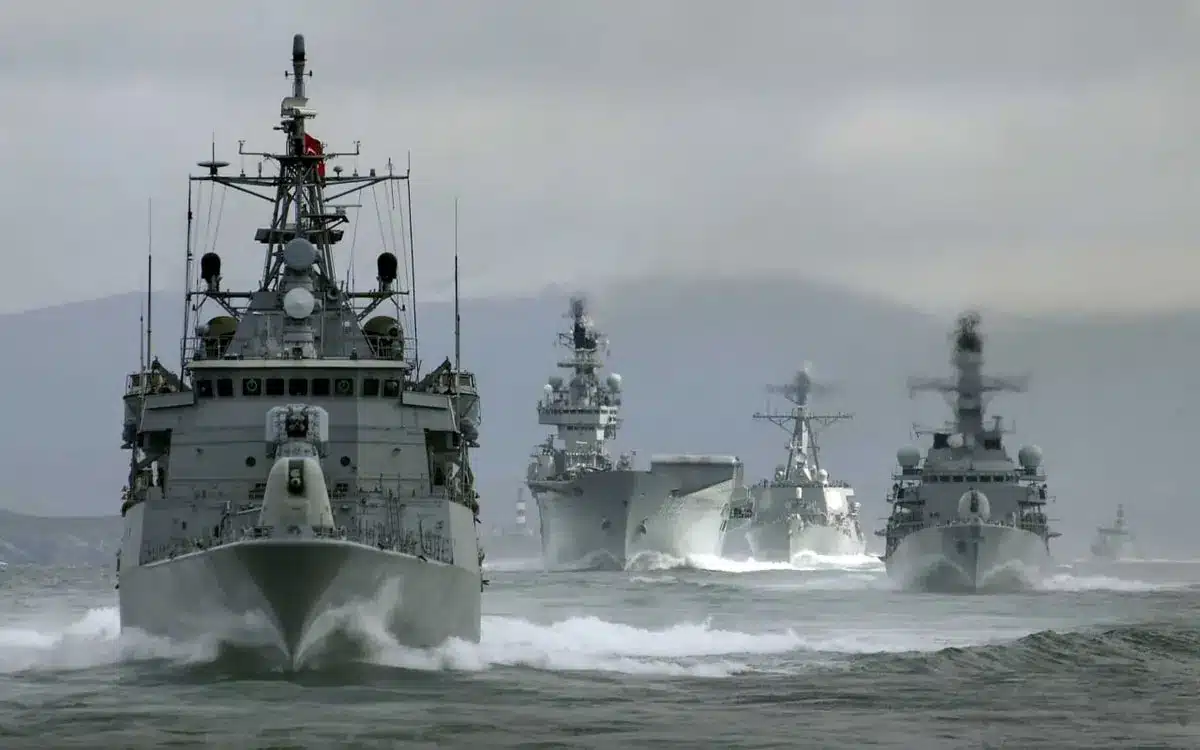



Sea-Air-Space 2026 closed its doors several weeks ago, but the event offered more than a showcase of emerging naval technologies. Held by the Navy League of the United States at National Harbor from April 19 to April 22, the exhibition highlighted several deeper structural shifts in how the U.S. Navy is now approaching innovation, unmanned systems integration, and industrial preparedness.
The main takeaway was not the unveiling of a single “revolutionary” platform. It was a shift in logic. The priority now appears to be speed of fielding, operational resilience, and the ability to rapidly integrate existing systems into a fleet already operating under growing pressure.
In that context, maritime drones are no longer being treated primarily as technology demonstrators. They are increasingly seen as building blocks within hybrid naval architectures combining crewed warships, autonomous platforms, distributed sensors, and more decentralized strike capacity.
U.S. naval innovation is shifting toward rapid integration
Several presentations from the Naval Air Systems Command highlighted a concept that has become increasingly central: “speed to fleet.” In simple terms, the phrase refers to reducing the delay between technological development and operational deployment in the force.
That shift reflects a constraint now widely recognized across Western militaries: advanced technology is no longer enough if integration remains slow, costly, or difficult to sustain operationally.
Sea-Air-Space 2026 therefore gave unusual prominence to topics that traditionally receive less attention at defense exhibitions: logistics support, industrial production, maintenance, platform availability, software architecture, embedded computing, and sustainment capacity.
That shift in emphasis is significant. For years, defense trade shows often focused on showcasing the maximum performance of new systems. Sea-Air-Space 2026 instead suggested a more pragmatic priority: rapidly integrating “good enough” capabilities into operational architectures that already exist.
That logic directly reflects lessons drawn from recent conflicts, particularly in the Black Sea and the Red Sea, where adaptability and rapid fielding often mattered more than pure platform sophistication.
Industrial capacity is becoming a strategic issue
The exhibition also underscored a broader reality: industrial constraints are increasingly becoming a strategic issue in their own right. Repeated references to volume production, supplier diversification, and faster integration of smaller technology firms suggest growing concern about whether Western industrial bases can sustain a prolonged conflict.
That may be one of the most important signals from Sea-Air-Space 2026. Naval innovation is no longer being framed solely as a technology race. It is increasingly being framed as a race in production, sustainment, integration, and operational scalability.
Maritime drones are changing status
The second major takeaway from Sea-Air-Space 2026 concerns unmanned systems at sea.
For years, maritime drones were primarily presented as surveillance or intelligence platforms. Sea-Air-Space 2026 suggested a clear shift toward systems that are increasingly integrated into naval combat architectures rather than treated as standalone niche capabilities.
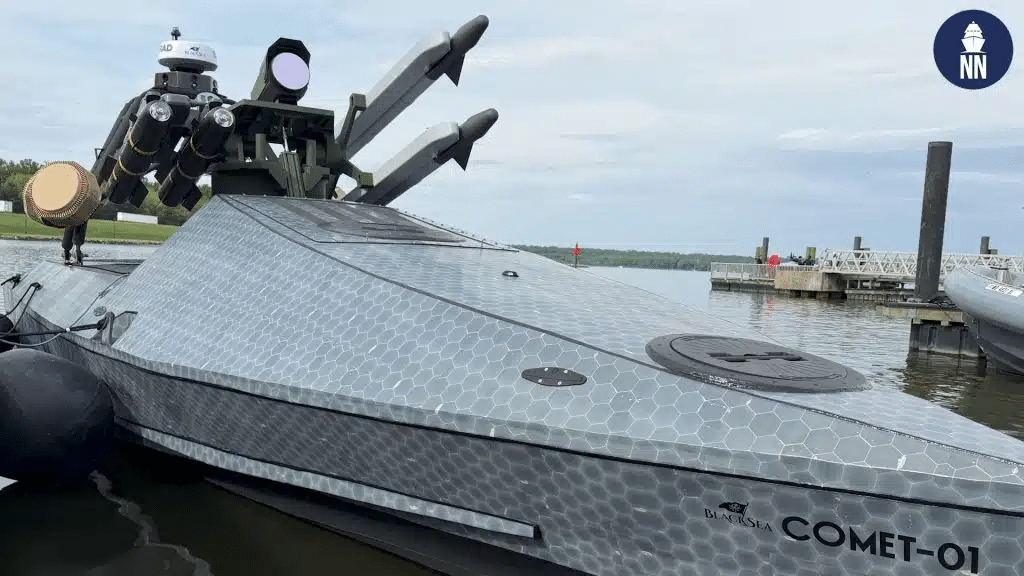
Discussions around unmanned surface vessels (USVs) focused on a much broader mission set: anti-submarine warfare, sensor relay, forward detection, electronic warfare, counter-drone defense, and in some cases even strike roles.
The stated goal of deploying thousands of small autonomous vessels in the Indo-Pacific by 2030 illustrates that change in scale.
But several U.S. officials also emphasized an important point: these systems are not intended to replace major surface combatants. They are meant to complement a more distributed fleet in which different platforms perform specialized functions.
That distinction matters. Sea-Air-Space 2026 did not reveal a rejection of the traditional naval model. It suggested a search for a new operational mix: heavy crewed platforms on one side, and more numerous, lower-cost autonomous systems on the other, each serving different roles within a distributed force architecture.
A hybrid fleet rather than a fully autonomous navy
That nuance is central to understanding the current U.S. naval approach. The objective is not to build a fully unmanned fleet. It is to increase available mass, sensor coverage, persistence, and operational reach without relying exclusively on a limited number of extremely expensive crewed warships.
Industrial demonstrations at the exhibition repeatedly reflected that hybrid logic. One relevant example is the Spectre autonomous vessel developed by Saildrone. The large USV is presented as an anti-submarine warfare platform capable of carrying multiple sensors and integrated systems developed with major defense partners.
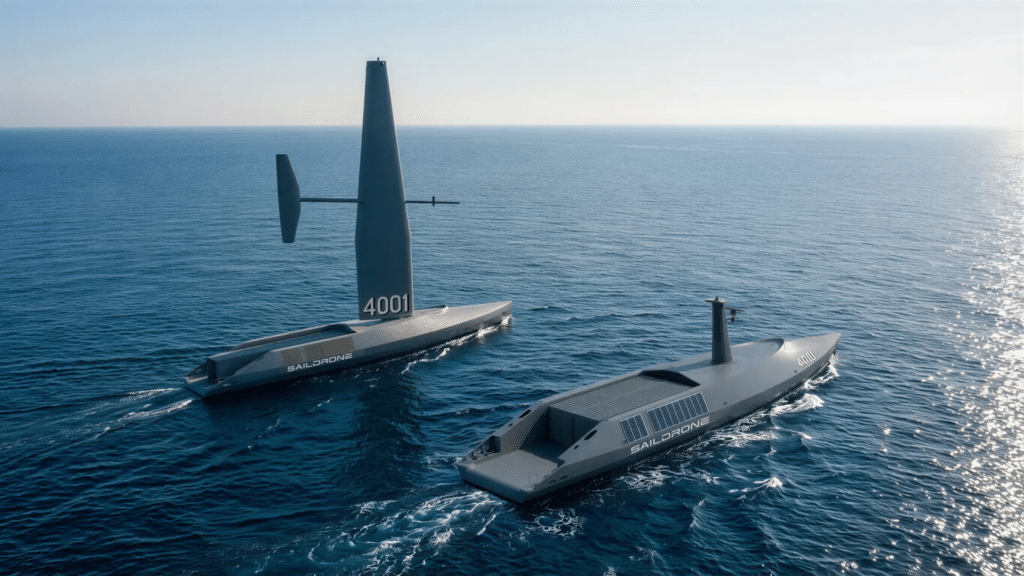
The implicit message from the show was clear: the U.S. Navy is increasingly looking for ways to expand available mass and operational coverage without depending solely on a small number of high-end warships.
That logic reflects one of the broader shifts in modern naval thinking: combat effectiveness is no longer measured only by platform sophistication. It is increasingly shaped by force distribution, sensor density, operational persistence, and cost-effective mass.
Naval defense is preparing for saturation threats
Sea-Air-Space 2026 also confirmed another major trend: Western naval forces are increasingly preparing for operating environments saturated by low-cost drones, missiles, and autonomous systems.
Demonstrations and announcements at the exhibition repeatedly focused on layered defense: counter-drone systems, anti-torpedo defenses, embedded computing, distributed sensors, and rapid data-processing architectures.
That reflects an important doctrinal shift. Large naval platforms remain essential, but they must now survive in environments where relatively inexpensive threats can saturate traditional defenses.
Recent conflicts have heavily influenced that thinking. Ukrainian naval drone attacks against the Russian fleet in the Black Sea demonstrated that relatively simple autonomous systems could produce strategic effects against much more expensive warships.
At the same time, operations in the Red Sea highlighted the difficulty of sustaining defensive postures over time against repeated waves of drones and missile attacks.
Sea-Air-Space 2026 therefore suggests a growing priority: multiply defensive layers while increasing platform dispersion and sensor distribution. That may be one of the defining realities of modern naval warfare: survivability increasingly depends on architecture, not just on platform strength.
A more pragmatic U.S. naval innovation model
Sea-Air-Space 2026 suggests a U.S. naval innovation ecosystem that is becoming more pragmatic, and more industrial, than in previous years.
The exhibition reflects a shift in priorities. The objective is no longer simply to build technologically superior platforms. It is to create naval architectures capable of rapidly integrating autonomous systems, surviving saturation threats, and sustaining operational tempo over time.
Maritime drones occupy a central place in that transformation. But their role increasingly appears complementary to crewed warships rather than as a direct replacement.
Beyond the technological announcements, Sea-Air-Space 2026 may ultimately have highlighted a more fundamental lesson: in naval warfare, innovation depends as much on maintenance, production, sustainment, and integration as it does on the raw performance of the systems themselves.
That may be one of the clearest signals the exhibition delivered: naval innovation is becomic less about technological ambition alone, and more about operational relevance at speed.