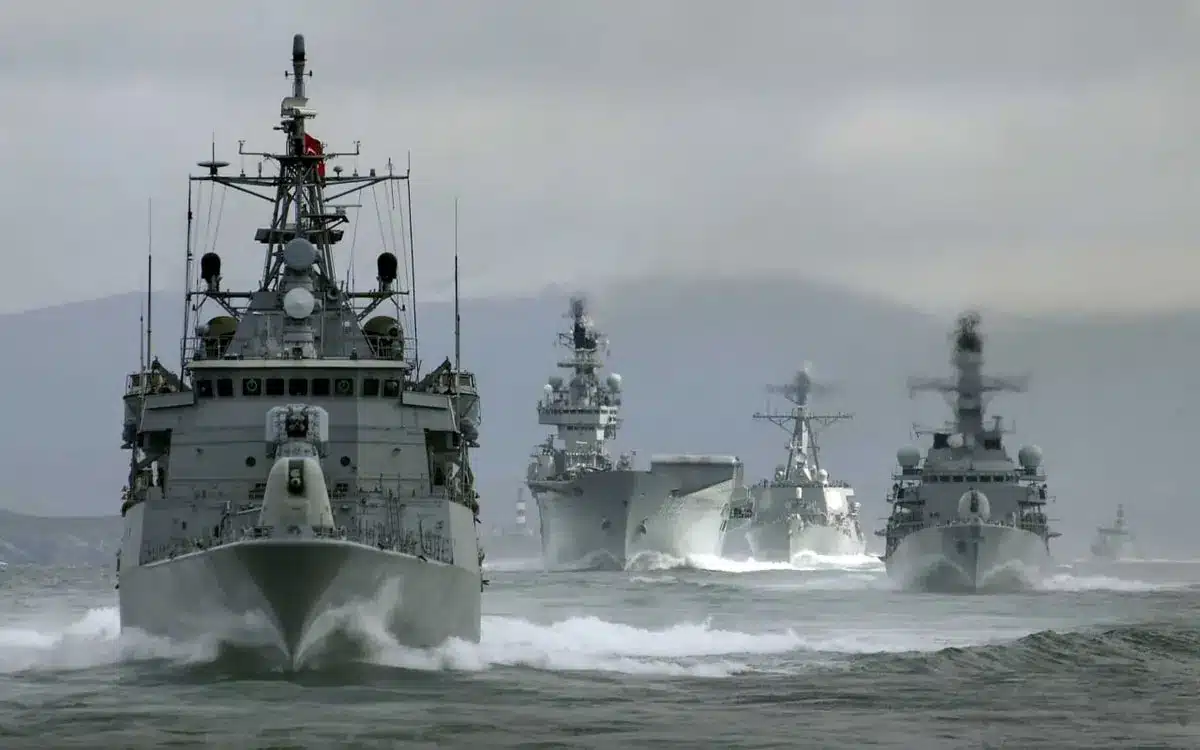


For decades, naval power was largely measured in visible terms: fleet tonnage, missile range, air defense capacity, and the sophistication of combat systems. Ports, by contrast, were mostly seen as protected support infrastructure, positioned behind the front line and largely outside the immediate battlespace.
Recent conflicts have fundamentally changed that assumption.
In the Black Sea, Ukrainian strikes against Sevastopol and Novorossiysk have shown that a fleet can be degraded without a major naval battle. Naval drones, long-range missiles, and sabotage operations have shifted pressure toward the infrastructure that sustains maritime operations over time.
A similar pattern has emerged around Odesa, where Russian attacks have often aimed less at producing spectacular destruction than at disrupting Ukraine’s port, logistics, and energy infrastructure. Reuters reported in early May 2026 that more than 900 port facilities and 177 civilian vessels had been hit since the start of Russia’s invasion.
The lesson is increasingly difficult to ignore: a fleet depends as much on its infrastructure as on its ships. Ports provide fuel, repair capacity, maintenance, logistics, storage, and the industrial continuity needed to sustain maritime operations. Modern naval warfare is no longer focused only on sinking ships. It is increasingly about slowing, degrading, or immobilizing the support systems that allow fleets to operate in the first place.
Fixed infrastructure facing mobile threats
The return of ports as strategic targets is closely tied to the evolution of modern offensive capabilities.
Cruise missiles, long-range explosive drones, cyberattacks, and clandestine operations now make it possible to disrupt critical infrastructure without having to fight a conventional naval battle. As a result, the strategic depth once enjoyed by major naval bases has narrowed considerably.
Sevastopol provides one of the clearest examples. Repeated attacks on Russian naval facilities gradually forced Moscow to shift part of its Black Sea fleet activity toward Novorossiysk in an effort to reduce exposure. Beyond physical damage, the strikes disrupted maintenance cycles, support operations, and the concentration of naval assets. The strategic logic was clear: disorganize the port ecosystem in order to steadily degrade operational tempo.
That marks an important break from more traditional naval thinking. For decades, destroying fleets was often seen as the decisive objective. Today, progressively immobilizing the infrastructure that sustains those fleets can produce similar strategic effects-often with far fewer resources.
A modern port concentrates multiple critical vulnerabilities in a relatively small area. Repair docks, fuel depots, electrical grids, data centers, rail links, logistics terminals, and maintenance infrastructure all require heavy fixed investment and are difficult to replace quickly.

Even major powers have only a limited number of facilities capable of supporting large warships or conducting complex repairs. That concentration turns ports into inherently high-value strategic targets.
A strike on an energy depot, a fire in an industrial zone, or a cyber-induced systems shutdown can significantly slow port activity without producing dramatic visible destruction. That is one of the defining realities of modern port warfare: paralysis no longer requires annihilation.
The invisible vulnerabilities of maritime power
The fragility of modern ports does not rest solely on infrastructure visible from satellites. Much of the real risk lies in technical dependencies that attract far less attention but can be exceptionally difficult to replace once disrupted.
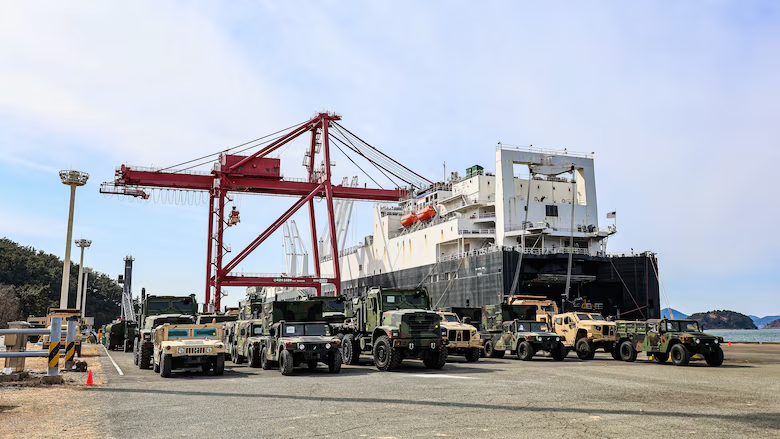
Heavy port cranes are one such example. Some terminals depend on a limited number of specialized systems capable of handling military cargo, oversized containers, or strategic energy components. If damaged or destroyed, replacement can take months of manufacturing, transport, and installation.
Energy dependency is another major vulnerability. Modern ports rely on complex electrical networks that power cranes, data centers, fuel pipelines, navigation systems, rail infrastructure, and logistics management tools. The loss of a high-capacity transformer can slow or cripple an entire logistics platform for an extended period.
Tugboats represent another critical but often overlooked weak point. Even when a port remains physically intact, a shortage of available tugboats can sharply reduce maritime throughput, particularly for tankers, large container ships, or naval vessels requiring specialized maneuvering support.
Digitization has added yet another layer of fragility. The software systems that manage cargo flows, customs processing, rail movements, automated terminals, and logistics coordination have themselves become potential strategic targets.
The 2017 NotPetya cyberattack offered an early warning of that reality when it disrupted parts of Maersk’s operations and affected multiple international port terminals for days.
Modern ports are increasingly becoming integrated critical systems whose functionality depends simultaneously on energy networks, digital infrastructure, logistics flows, rail access, industrial support capacity, and regional resilience.
In that sense, port warfare is increasingly becoming a war against invisible technical dependencies.
How a port actually stops functioning
Contrary to classic naval war imagery, modern ports rarely stop operating because of a single spectacular strike. Paralysis usually emerges gradually, through the cumulative effect of logistical, technical, financial, and security disruptions.
The first rupture often comes through maritime insurance. When a port zone is judged too risky, insurance costs can spike almost immediately for shipowners and logistics operators. Some carriers reduce calls, reroute traffic, or shift operations to secondary ports.
Traffic reductions then create secondary disruptions. Terminals begin to congest, turnaround times increase, and road or rail systems may struggle to absorb the resulting pressure.

Critical equipment shortages often follow. Fuel storage, tugboat availability, repair capacity, maintenance infrastructure, and support systems can progressively come under strain.
Military operations are affected next. Logistics rotations slow, stockpiles decline, and naval maintenance capacity may no longer be sufficient to sustain a high operational tempo. Modern port warfare is therefore less about immediate destruction than about the gradual erosion of logistical continuity.
That pattern has become visible in repeated attacks against Ukrainian ports, but also in maritime disruptions in the Red Sea and around the Strait of Hormuz. A port can now become partially unusable without ever suffering catastrophic visible destruction. That is one of the defining characteristics of modern infrastructure warfare: strategic effects increasingly come from cumulative disruption rather than spectacular damage.
A new definition of naval power
The return of ports as military targets is reshaping the very definition of maritime power.
For decades, navies largely focused on visible measures of strength: increasing the number of platforms available, extending weapon range, improving missile defense, or fielding more sophisticated combat systems. Recent conflicts suggest that this view is no longer sufficient. A fleet now depends as much on dry docks, energy infrastructure, digital networks, industrial capacity, repair facilities, and logistics resilience as it does on the ships themselves.
Ports are increasingly becoming full-spectrum military assets whose protection can no longer be approached through traditional maritime defense alone. Defending modern port infrastructure now requires layered counter-drone systems, industrial-grade cybersecurity, redundant energy networks, resilient logistics planning, and the ability to sustain activity under prolonged disruption.
This transformation is also changing the cost equation between offense and defense. Relatively inexpensive drones, sabotage tools, cyberattacks, or precision strikes can now disrupt infrastructure that took years to build and billions of dollars to finance.
The imbalance is increasingly stark. An attacker may only need to disrupt a few critical nodes to slow operations. A defender, by contrast, must protect an entire industrial ecosystem. That asymmetry is becoming one of the defining strategic realities of modern maritime warfare.
Naval warfare is therefore no longer focused only on destroying fleets at sea. It is increasingly about immobilizing the infrastructure that allows fleets to exist, deploy, sustain themselves, and fight over time. In that sense, the port is no longer simply a rear-area support facility. It has become part of the battlespace itself.