


A drone can see. A satellite can detect. But that information still has to be processed fast enough to remain useful.
Recent conflicts have revealed a quieter but increasingly important shift: modern militaries now generate enormous volumes of data that must be transported, filtered, processed, and redistributed continuously. In Ukraine, aerial imagery, targeting information, surveillance feeds, and positioning data have become part of a digital chain that increasingly shapes operational tempo.
That transformation is creating a new military dependency. Behind software, drones, and decision-support tools sit servers, electrical power, cooling systems, batteries, fuel, and technicians capable of keeping the infrastructure running. In other words, digital warfare now has its own logistics chain.
This is what is gradually turning military data centers into strategic infrastructure. Much like fuel depots or logistics hubs, they are becoming essential to the functioning of modern combat architectures, according to the Royal United Services Institute.
Modern warfare sometimes generates more Data than it can exploit
Modern militaries collect unprecedented amounts of information. Drones, satellites, surveillance systems, onboard sensors, and command software generate continuous streams of data that must often be processed almost in real time. NATO now considers data a strategic asset that must be produced, protected, and rapidly exploited under its data strategy.
But this transformation also creates a new form of saturation. Producing more data does not automatically improve decision-making. Drone footage processed several minutes too late may already have lost much of its tactical value. In contested or jammed environments, the challenge is no longer simply detecting a target, but processing and redistributing information quickly enough for it to remain operationally relevant.

That is one of the central paradoxes of digital warfare: sensors can generate more information than the processing chain can immediately exploit. Operational performance no longer depends only on what can see, but also on what can compute.
The Data Center is becoming the new logistics hub of digital warfare
For decades, critical military infrastructure was easy to identify: fuel depots, ammunition stockpiles, electrical grids, airfields, and command centers. Digital warfare is now adding another dependency to that list: computing power.

A military data center does far more than store information. It processes aerial imagery, fuses data from multiple sensors, supports planning tools, and moves information between operators, autonomous systems, and commanders. Without available processing capacity, parts of that chain slow down or lose operational value, according to NATO and its Allied Software initiative.
The logic increasingly resembles that of a traditional logistics hub: without fuel, a vehicle stops; without ammunition, a combat system becomes ineffective; without available computing power, digital military architectures struggle to rapidly exploit the data they generate.
The difference is that this dependency remains largely invisible. A drone or missile is immediately visible. The servers, electrical infrastructure, cooling systems, and networks that allow their data to be exploited are far less visible — even as they become critical infrastructure themselves.
Military computing consumes energy, cooling, and support
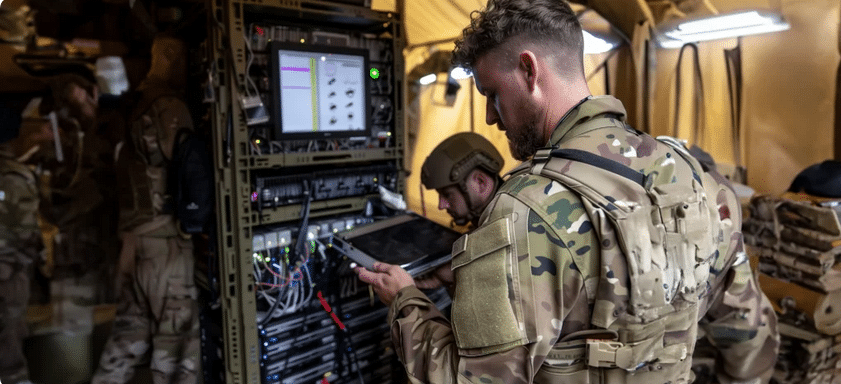
A tactical computing center is not deployed with servers alone. It also requires generators, batteries, cooling systems, backup equipment, spare parts, and technicians capable of keeping the system operational. Behind data processing now sits an increasingly complex support chain.
That dependency quickly becomes operational. The more a military architecture relies on real-time data processing, the more it depends on stable electrical power and infrastructure capable of dissipating the heat generated by computing equipment. A power outage, cooling failure, or logistical disruption can slow part of the digital chain.
The challenge is also physical. A computing system deployed near the battlefield consumes power, generates heat, and requires continuous maintenance. It must be protected, resupplied, and sometimes managed in ways that reduce its thermal or electrical signature to avoid becoming a detectable vulnerability itself.
Digital warfare often appears intangible. In reality, it depends on electricity, fuel, cooling, and a logistics chain capable of keeping computing power available at the right moment.
Why militaries are moving computing closer to the battlefield
Recent conflicts have also exposed another practical limit: not everything can be sent back to the rear for processing. Drone footage, targeting data, or sensor detections may lose value if they arrive several minutes too late.

In jammed, contested, or partially disconnected environments, some data must therefore be processed directly near frontline units. Waiting for it to transit to more distant infrastructure can slow the entire decision chain.
That reality is driving several military programs to move portions of computing capacity closer to operational zones while still maintaining larger infrastructure in the rear. NATO now explicitly discusses digital services designed to support users directly in the field. Companies such as Viasat are also developing architectures capable of distributing processing between frontline nodes and more centralized facilities.
The objective is less technological than operational: reduce delays, maintain data processing despite degraded communications, and prevent overly centralized architectures from becoming vulnerabilities themselves.
A new strategic vulnerability
This transformation also creates new targets.
Critical digital infrastructure can be disrupted not only through cyberattacks, but also through power failures, connectivity loss, hardware malfunctions, or physical attacks against computing nodes.
The more militaries centralize digital functions, the more they concentrate dependencies that must be protected. Rapid information flow now depends on energy-intensive equipment, specialized components, stable networks, cooling systems, and continuous maintenance.
That is the core paradox: digital warfare accelerates decision-making, but it also introduces new physical fragilities. A data-saturated architecture without available computing capacity can slow down despite highly capable sensors.
This does not mean every military operation will depend on massive computing infrastructure. It does suggest that highly digitized forces will increasingly have to manage computing power as a critical operational resource.
Digital warfare often appears immaterial. Yet behind software and data flows remain electricity, fuel, computing equipment, and logistics chains capable of keeping that infrastructure operational. Data may move at high speed, but exploiting it remains deeply physical.
What to watch next
Three factors are likely to shape the real value of these infrastructures in the coming years.
The first is availability: useful computing capacity must remain accessible even when networks are degraded or saturated.
The second is sustainability: energy, cooling, maintenance, and physical protection will determine how deployable these architectures truly are.
The third is sovereignty: control over suppliers, infrastructure, and technical layers will remain a major issue for highly digitized militaries.
The key trends to watch are therefore clear: deployment of digital services closer to frontline units, growing energy consumption from tactical computing centers, physical hardening of digital infrastructure, and efforts by militaries to avoid excessive dependence on a limited number of critical suppliers.