


At first light, a convoy of Griffon armored vehicle vehicles moves toward an exercise zone in eastern France. Overhead, an MQ-9 Reaper streams live imagery to a command post. Further south, Rafale fighter aircraft fighters rehearse strike coordination while logisticians hundreds of kilometers away recalculate ammunition and fuel flows under simulated disruption.
This is no ordinary training drill. It captures what ORION military exercise has become: France’s most ambitious attempt to prepare for the return of high-intensity warfare.
The 2026 edition, running from February 8 to April 30, takes place in a radically different strategic environment from that of the early 2010s. European armies are once again focused on concepts many had allowed to fade into the background: mass, endurance, industrial output, electronic warfare, concealment, and attrition.
For France, ORION now serves a central purpose: determining whether a technologically sophisticated but medium-sized military can sustain itself in prolonged major combat.
ORION is no longer a showpiece exercise
Large military exercises traditionally serve three purposes: training forces, reassuring allies, and signaling resolve to potential adversaries. ORION still does all three. But its primary value has shifted.
The central question is no longer whether France can deploy a brigade, coordinate air support, or move forces across national territory. Those capabilities matter, but they are no longer enough. ORION is now about testing the coherence of an entire warfighting system under pressure.
That includes joint command structures, intelligence flows, ammunition consumption, equipment availability, civilian-military coordination, strategic mobility, and the ability to scale force generation quickly.
In short, ORION increasingly seeks operational truth rather than public display. This distinction matters. Many modern armies remain optimized for short campaigns, limited expeditionary missions, or crisis management. ORION instead asks whether France can operate in a contested environment where losses accumulate, supply chains are disrupted, and tempo must be sustained for weeks or months. That is a much harder standard.
France’s equipment modernization is now being stress-tested
Exercises often reveal more through the equipment they employ than through official messaging. ORION 2026 is no exception.
Land Power: the scorpion transformation
The land component increasingly revolves around the modernization associated with France’s Scorpion program.
That includes the Griffon armored vehicle, designed for protected mobility and command functions, the Jaguar armored reconnaissance vehicle for reconnaissance and direct combat, the upgraded Leclerc main battle tank for heavy breakthrough capability, and the Serval armored vehicle for lighter protected mobility.
The real transformation, however, is not any single platform. It is connectivity. A Griffon identifying a target, passing that information to a Jaguar, which then relays coordinates to artillery, creates a combat effect far greater than isolated systems operating independently.
That shift—from capable platforms to networked combat systems—is one of the most significant changes underway inside the French Army.
Artillery: precision is not enough
The Caesar self-propelled howitzer has become one of France’s most visible military systems internationally. Mobile, accurate, and combat-proven, it represents modern artillery well.
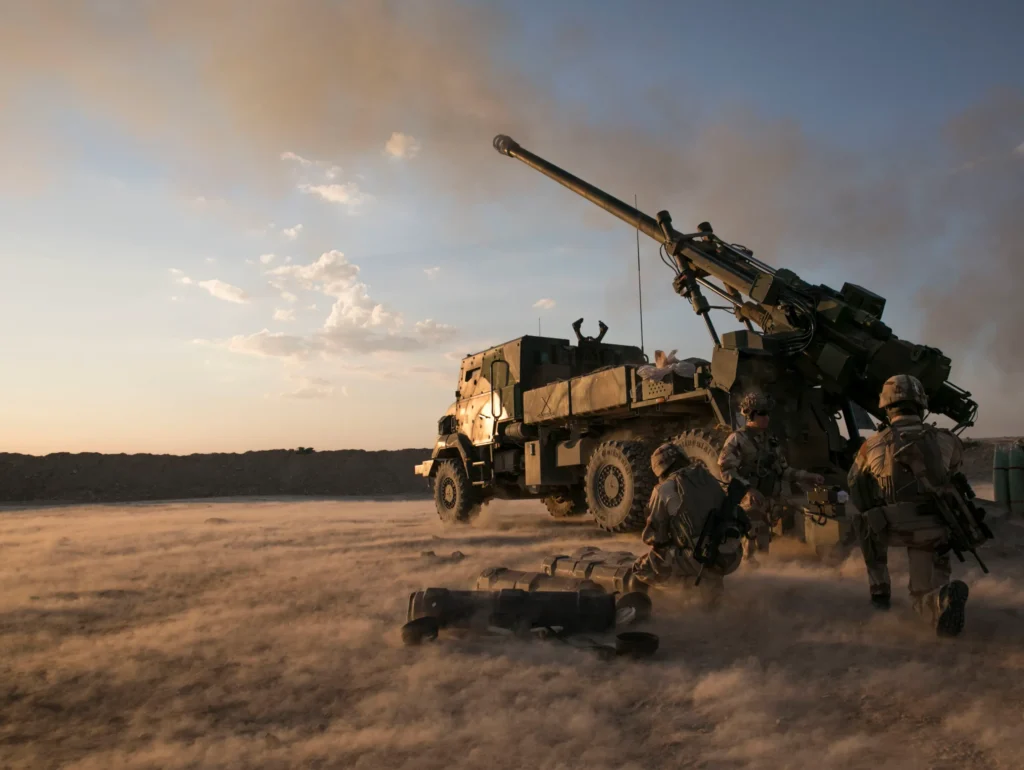
But ORION asks a harder question: can artillery fire effectively over time, not just accurately in isolated engagements? Modern artillery performance depends on barrel wear, ammunition stocks, reload speed, mobility after firing, survivability against counter-battery detection, and industrial replenishment rates.
This is where exercises become strategically valuable. They move discussion beyond brochure specifications and into wartime sustainability.
Air Power: speed, reach, integration
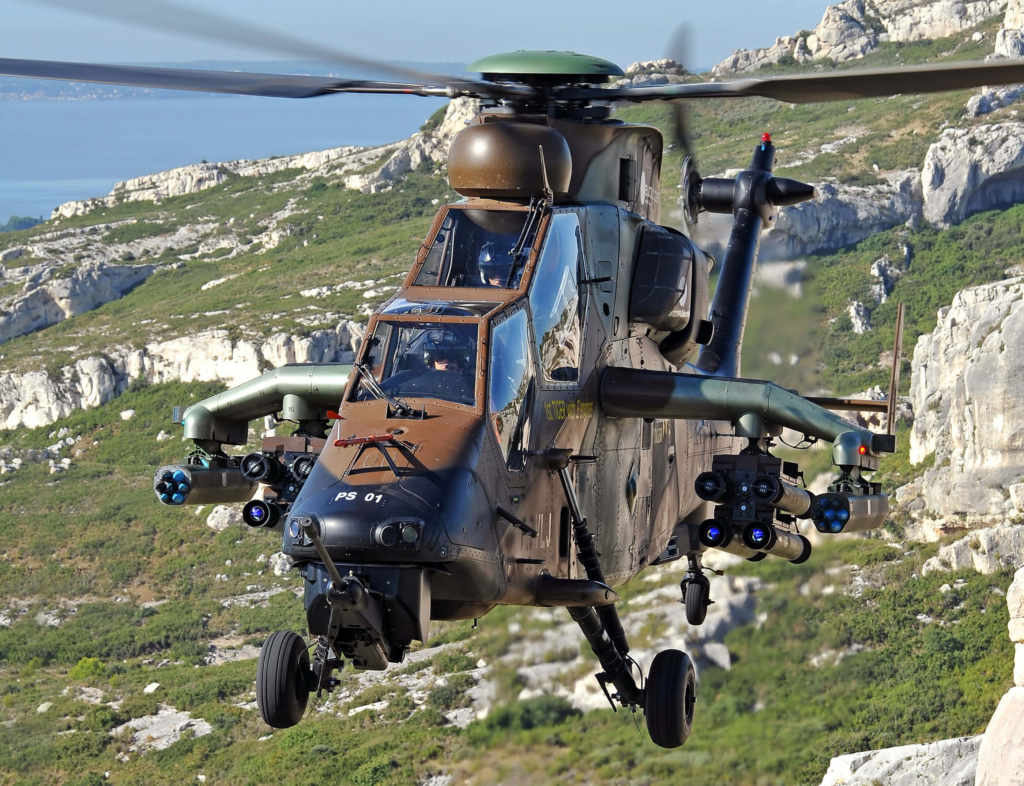
France’s air component can draw on systems such as the Rafale fighter aircraft, A400M Atlas, Tigre attack helicopter, NH90 Caïman helicopter, and MQ-9 Reaper.

Together, these systems allow France to combine strike power, mobility, transport, reconnaissance, and close support inside a single decision cycle.
The question ORION explores is whether those capabilities can remain effective once networks are degraded, supply chains are strained, and operations become prolonged.
The drone revolution is reshaping training
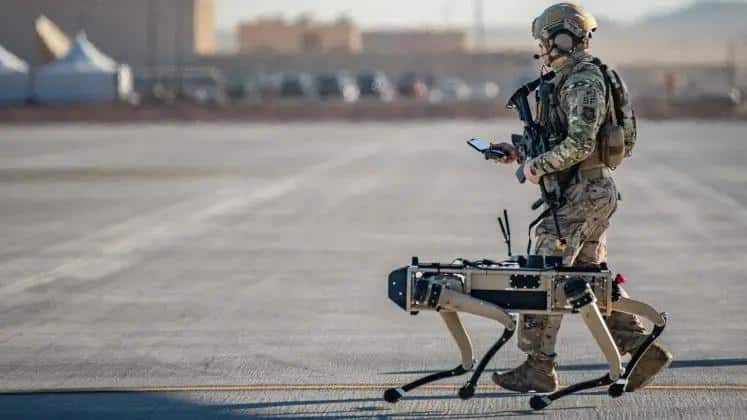
No military exercise in 2026 can ignore drones. Their impact goes far beyond reconnaissance. Drones now affect concealment, maneuver, force protection, artillery effectiveness, and decision speed. Even low-cost systems can impose disproportionate tactical costs on expensive platforms.
For forces on the ground, this means static positions are more vulnerable, vehicle concentrations are easier to detect, and electronic signatures can become lethal liabilities.
For commanders, it means the time between target detection and enemy reaction has compressed dramatically. For planners, it means survivability now depends on movement discipline, camouflage, deception, and rapid adaptation.
France therefore faces two parallel tasks inside ORION: integrating friendly drones more widely, and learning how to operate under constant drone threat. That second challenge may prove more important than the first.
Logistics is king again
Recent wars have revived an old military truth: armies move at the speed of their logistics. Fuel, spare parts, batteries, water, data links, medical evacuation, ammunition, and repair capacity often determine campaign outcomes more than headline weapon systems.
ORION is especially valuable because it forces logisticians and commanders to operate under simulated disruption rather than ideal peacetime assumptions. For France, this issue is acute.
Its armed forces field advanced systems, but advanced systems also demand specialist maintenance, reliable spare-part supply, trained technicians, and resilient industrial support.
An unavailable Griffon armored vehicle, a grounded Tiger attack helicopter, or a Caesar self-propelled howitzer awaiting repair has immediate operational consequences in a force of finite size.
This is why modernization cannot be measured by procurement alone. Sustainment matters just as much.
What ORION 2026 reveals about France
Beyond scenarios and maneuvers, ORION offers a useful snapshot of the current French military. The picture is neither one of decline nor one of completed transformation. It is a force in transition.
France retains several high-end strengths. Its personnel are professional and experienced. Its joint culture is stronger than in previous decades. It possesses credible air and naval power, a recognized command capability, and an industrial defense base with broad competencies.
It also benefits from years of operational experience across multiple theaters, experience that still shapes doctrine and leadership. But ORION also exposes harder constraints.
The first is scale. Highly capable forces can still be too small for prolonged attritional conflict. The challenge is not merely entering a campaign effectively, but rotating units, replacing losses, and sustaining combat power over time.
The second is industrial tempo. Recent wars have shown that defense industries must be able to produce more, repair faster, and rebuild stocks under compressed timelines.
The third is adaptation speed. Integrating drones, counter-drone systems, dispersed operations, and faster decision-making remains an ongoing challenge across Europe, including France. ORION’s value lies precisely in making these gaps visible before crisis makes them costly.
ORION is not only a national exercise. It is also a case study for many medium-sized advanced armies facing similar questions: how to regain mass without sacrificing quality, how to adapt doctrine faster than procurement cycles, and how to sustain modern forces in industrial warfare.
That gives ORION broader relevance. Countries across Europe, Asia, and elsewhere are wrestling with the same dilemma: technologically advanced forces optimized for efficiency must now prepare for endurance. France is simply doing so in public.
Final Verdict
ORION military exercise is now far more than France’s flagship training event.
It has become a national laboratory for modern war—testing whether advanced platforms, professional forces, digital command systems, logistics networks, and industrial capacity can function together under pressure.
The real lesson of ORION 2026 is clear. Military power in the coming decade will depend not only on owning sophisticated equipment, but on learning faster, producing faster, repairing faster, and adapting faster than competitors. France is using ORION to find out whether it can do exactly that.