



A modern missile combines multiple functions within an exceptionally constrained volume. It must generate propulsion, determine its position, receive and process information, potentially detect its target, correct its trajectory, withstand significant thermal and mechanical stresses, and ultimately deliver the intended military effect.
A missile is not simply the product of a missile manufacturer. It is the final stage of a network of industrial supply chains that can begin far upstream from the assembly plant.
Understanding the critical materials behind a modern missile therefore means less compiling a list of what it contains than determining how far upstream its industrial dependencies extend.
Seeing the target
Not all missiles “see” their targets in the same way. Some use active radar seekers, while others rely on infrared sensors. These operational differences translate into different requirements for optics, electronics, and materials.
Turkey’s SOM family illustrates how these requirements can evolve within a single missile program. The SOM-A combines GPS, inertial navigation, and terrain-referenced navigation. The SOM-B1 and B2 add an imaging infrared seeker and automatic target acquisition. The SOM-C1 adds a data link. Each additional function introduces new components into the missile’s industrial supply chain.

Aster follows a different approach during its terminal phase, using an active RF seeker. Infrared and radio-frequency systems therefore rely on different combinations of detectors, optics, circuits, and semiconductors, each supported by distinct industrial supply chains.
Infrared systems can use specialized optical materials such as germanium, zinc sulfide, or sapphire, depending on the spectral band and system architecture. RF systems rely on their own semiconductor and electronic component supply chains. Because the exact composition of these systems is rarely public, however, these materials cannot be systematically attributed to every missile using such technologies.

This distinction highlights a first essential point: there is no universal material composition for the modern missile. The weapon’s mission and architecture partly determine the industrial supply chains on which it depends.
Turning information into movement
A missile must translate information generated by its sensors and navigation system into physical trajectory corrections.
This function relies on control systems and various actuation mechanisms. Rare earth elements are notably used in permanent magnets found in many electromechanical systems. Neodymium and praseodymium are used to manufacture high-performance NdFeB magnets, while dysprosium or terbium can be added to preserve certain properties at elevated temperatures. Samarium-cobalt magnets provide another option when thermal stability is a key requirement.
Between the rare earth element and the actuator lie several industrial stages: refining, alloy production, magnet manufacturing, and component qualification.
The amount of material contained in the missile is therefore not necessarily the best measure of criticality. A few grams can become strategically important if their function is difficult to replicate with a substitute without affecting the system’s performance, weight, or design.
Propulsion and survivability
Pressure, combustion, vibration, and high temperatures require properties very different from those needed in a sensor or actuator. Metal alloys, powders, chemicals, energetic materials, and materials capable of withstanding extreme temperatures all converge within the same industrial chain.
Propulsion architectures also vary. Aster uses a two-stage solid-propulsion system. Barak interceptors rely on single- or dual-pulse motors depending on the variant, while Barak ER adds a booster to extend its range.

Nickel, cobalt, molybdenum, tungsten, titanium, and certain refractory metals can be used in components exposed to the most demanding conditions.
European regulations even control certain ultra-high-temperature ceramics, including materials based on hafnium or tantalum, for missile-related applications.
These dependencies are not limited to metallurgy. Propellants rely on their own chemical precursors, powders, and manufacturing processes. Increasing motor production therefore requires upstream chemical industries to expand output as well.
Critical does not necessarily mean rare. Aluminum, despite being produced on a massive scale, is among the 12 defense-critical raw materials identified by NATO. Criticality therefore also depends on processing capacity and the availability of substitutes.
Delivering the effect
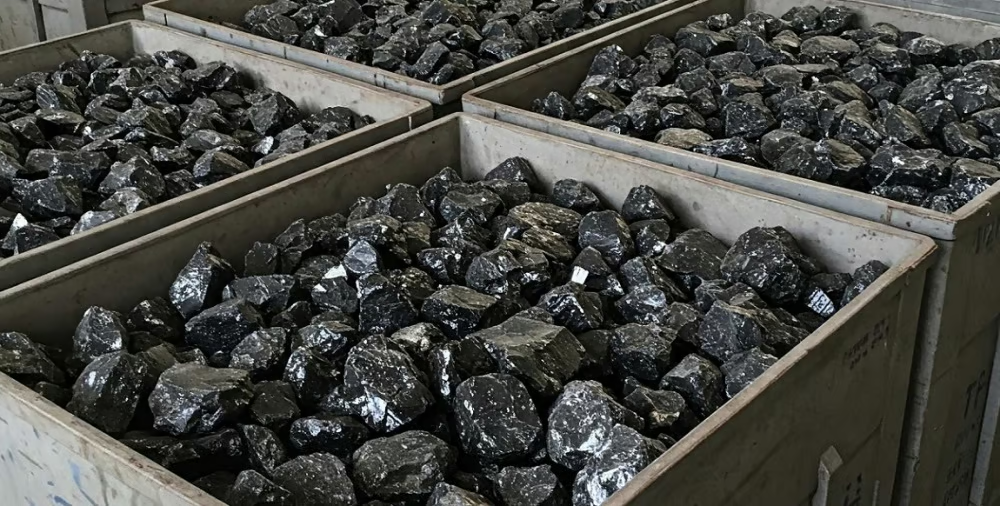
The warhead adds another industrial supply chain, with requirements that vary according to the intended effect. Metals such as copper, molybdenum, tantalum, or tungsten can be used in certain warhead and penetrator designs.
Within the SOM family, the B1 uses a blast-fragmentation warhead, while the B2 carries a tandem penetrator warhead and the SOM-J a semi-armor-piercing warhead. The mission therefore changes the material supply chain even within a single missile family.
This diversity explains why a generic list of “missile materials” can quickly become misleading. The real industrial question is which components can no longer be produced when their supply is disrupted.
From materials to production rates
These dependencies become particularly visible when production must increase. Adding assembly capacity is not enough if the production of the components and materials feeding those lines does not expand at the same pace.
The bottleneck may therefore lie far upstream from the missile manufacturer: in the production of a permanent magnet, an infrared optic, a specialized alloy, or a chemical precursor required for propellant. It can also emerge during refining or processing, sometimes concentrated among a limited number of countries or suppliers.
China’s position across several of these supply chains illustrates this vulnerability. Restrictions imposed in recent years on various critical materials have shown how a decision made far upstream can ripple through multiple levels of the defense industrial base. But dependency is not simply about where raw materials originate. A single factory, industrial process, or difficult-to-replace qualified supplier can represent an equally significant bottleneck.
Increasing production rates therefore requires identifying the stages most likely to constrain output: a limited supplier base, capacity that is difficult to expand, or components whose substitution and qualification take considerable time.
Missile production therefore does not begin on the assembly line. It depends on supply chains several tiers upstream, where a raw material becomes a component that cannot always be replaced or produced in greater quantities quickly enough.