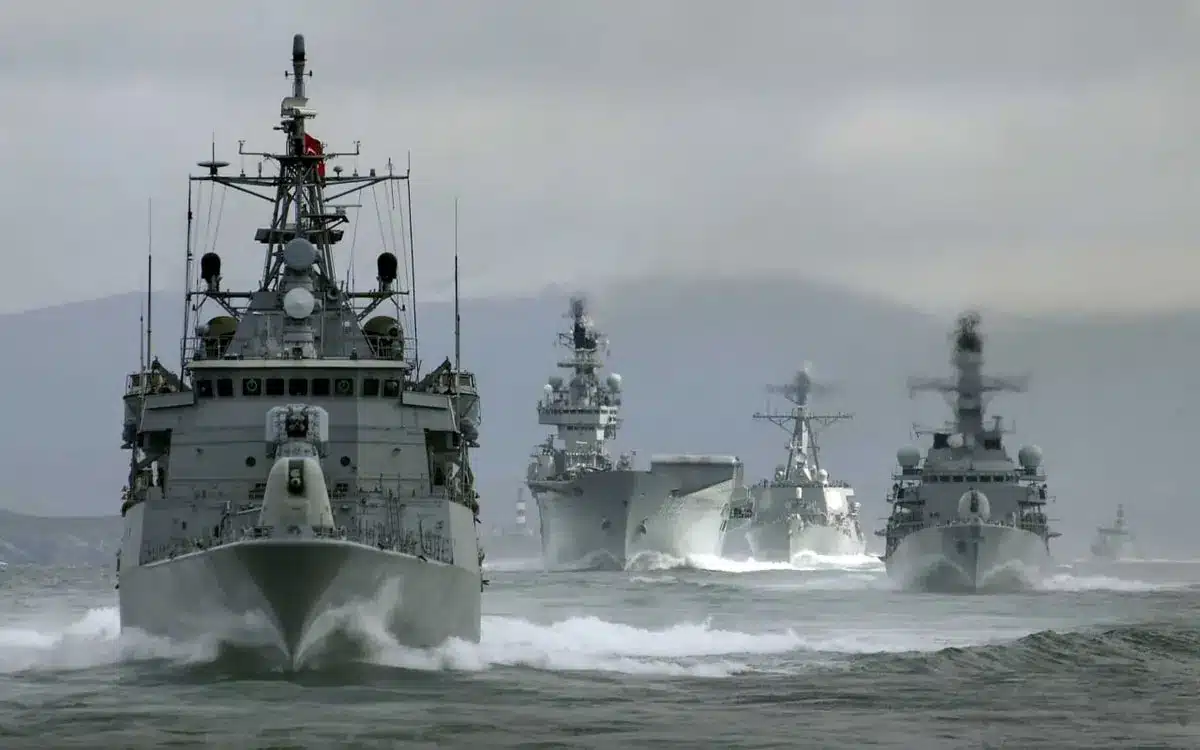



Valour, Singapore’s Multi-Role Combat Vessel, looks like a conventional warship. But Singapore is designing it to fight alongside uncrewed systems in the air, on the surface and underwater.
Adding a handful of drones to a fleet is one thing. Building a force in which a warship must deploy them, coordinate their operations, exploit their data and keep fighting is another.
The warship may change its role before it changes its shape.
Using the mothership to multiply combat power
Singapore is pushing this concept particularly far. Its Multi-Role Combat Vessel is designed to combine the capabilities of a modern frigate with those of a mothership able to carry and control uncrewed systems operating across multiple domains.
Singapore’s Ministry of Defence says a single vessel operating with its uncrewed systems could perform some missions that currently require several crewed warships. Those systems could push sensors farther from the mothership, cover a wider area or carry out missions without directly exposing a crew.
But Valour is not yet operational. Six vessels are planned to replace the Victory-class corvettes, with deliveries beginning in 2028. Singapore’s claim therefore remains a program objective, not an operational capability already demonstrated at sea.

The British experience shows what happens when the mothership concept moves from the drawing board to operations. The Royal Navy is using Lyme Bay, an existing auxiliary vessel, to transport and support autonomous and remotely operated systems specializing in mine warfare.
On May 27, 2026, Ariadne, a 12-meter uncrewed surface vessel, was recovered directly into the ship’s well deck. That experience also exposes a limitation. A drone can push a sensor or effector away from the crew, but it does not eliminate the infrastructure and manpower needed to keep the system operating: mission preparation, communications, data exploitation, recovery, maintenance and regeneration.
When Lyme Bay deployed to the Middle East with roughly half a dozen autonomous, uncrewed or remotely operated systems, more than 270 personnel were aboard, including over 100 British specialists in mine warfare, diving and explosive ordnance disposal.
Where should command reside?
This is where the national approaches begin to diverge. There is no single architecture emerging.
During Maritime Uncrewed Sea Trials 2026, the Netherlands placed the patrol vessel Galatea at the center of a force combining airborne, surface and underwater systems. The scenarios included autonomous formation maneuvering and a coordinated search for a target.

But the Dutch experiment was not only about platforms. A command system was also used to integrate information from uncrewed assets into the fleet’s combat management system.
That distinction matters. The drone is no longer just another piece of equipment carried aboard ship. It becomes part of the naval force’s combat system.
Australia is pushing in the opposite direction. Its Maritime Autonomous Systems Unit, the organization responsible for maritime autonomous systems, combines a control center with a deployable team able to operate systems from different wharves.
Command no longer has to reside entirely aboard the mothership.
This architecture is also beginning to scale. According to Janes, the Royal Australian Navy is set to receive 40 Bluebottle uncrewed surface vessels under a contract worth 176 million Australian dollars. The platforms are expected to join the organization responsible for maritime autonomous systems.

The United States offers a third approach. The United States Navy is seeking to increase the number of platforms that can operate as part of a distributed force. On May 29, 2026, it selected seven companies for at-sea trials of uncrewed surface vessels, with evaluations scheduled to continue through October 2026.
The real test comes at sea
A robotic flotilla is as much a data architecture as a naval one. As platforms become more numerous and more dispersed, the challenge shifts from putting drones in the water to keeping them connected, coordinating their actions and determining what they can still do when communications break down. NATO is testing solutions designed to make systems fielded from different platforms and by different nations interoperable.
Then comes a much more physical problem: getting them back.
The Ariadne trial aboard Lyme Bay shows why well decks, handling equipment and recovery procedures are becoming part of the capability itself.
The United States is testing that interface for other missions. During Rim of the Pacific 2026, a multinational exercise in the Pacific, a remotely controlled surface vessel entered the well deck of the amphibious ship Essex to deliver additively manufactured parts.
The harder question is availability.
Programs say plenty about platforms, sensors and intended missions. They say far less about required maintenance hours, failure rates after weeks at sea or the full cost of keeping these systems operational. Publicly available information therefore does not yet demonstrate that a fleet with more uncrewed systems will consistently be cheaper to sustain than a comparable crewed force.
This is where the mothership model runs into its central paradox. A warship can use uncrewed systems to disperse its sensors and some of its effects. But if that same ship concentrates their communications, maintenance, recovery and part of their command structure, its loss or unavailability could affect a significant portion of the force it supports.
The warship could become a node rather than the center
Current programs do not point to the imminent disappearance of the crewed warship. Nor do they suggest that every navy will converge on Singapore’s mothership model.
What is emerging is less a new type of ship than a new way of distributing naval functions.
Detection, command, effects, support and sometimes logistics were once concentrated aboard a single warship. Those functions can increasingly be spread across crewed and uncrewed platforms and, in some cases, shore-based facilities.
The warship remains important, but its role may change. It could become one of the most capable nodes in a distributed architecture rather than the platform through which every capability must pass.
Five indicators will show whether this shift can move beyond experimentation: how many platforms a team can supervise at once; what those platforms can still do when communications are degraded; how available they remain after prolonged deployments; the manpower and logistics required to sustain them; and how quickly they can be recovered, repaired and returned to operations.
The next measurable milestone will come from the United States, where at-sea evaluations of the selected uncrewed platforms are scheduled to continue through October 2026.