

Counter-drone laser systems are no longer lab curiosities. In 2025, two ecosystems are advancing in parallel: on one side, the NATO/Israel/Europe bloc, focused on integrating lasers into an already structured and demanding air-defense architecture; on the other, a non-NATO bloc, led by China, followed by India and a demand-driven Russia, prioritizing immediate, lower-power results to defeat the tactical drones proliferating on today’s battlefields. Both are solving the same equation: you can’t keep firing missiles costing tens of thousands of euros at targets worth only a few hundred.
The “Integration” School: Israel, the United States, Europe
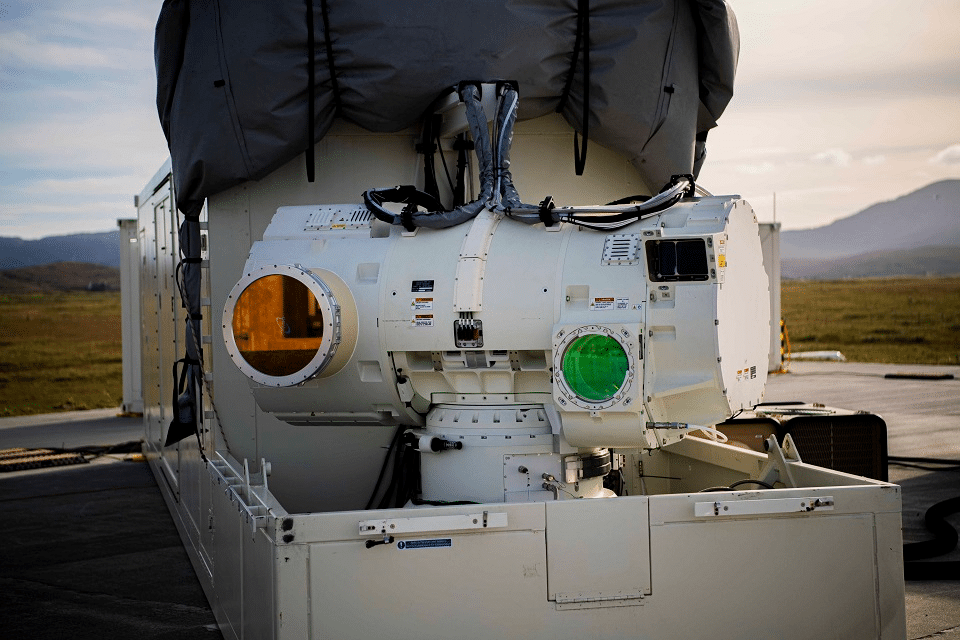
In the West, the goal isn’t to field “a laser,” but to add one more layer to an existing air-defense architecture. Israel is the most advanced with Iron Beam (on the order of 100 kW), designed to ease the pressure on Iron Dome and other tiers of the system. Its role: intercept recurring rockets, mortars and drones at near-zero marginal cost while accepting a switch back to kinetic effectors in poor weather. It’s an extra “brick,” not a replacement for the whole wall.

The U.S. Army is on a similar path, with a sharper eye on industrialization. Strykers fitted with DE M-SHORAD (Directed Energy Maneuver–Short Range Air Defense) proved that a mobile 50 kW class laser works but also exposed hard problems in availability, cooling and crew ergonomics. Hence the push for the next-step E-HEL (Enduring High Energy Laser): same mission set (C-UAS/C-RAM), open architecture, multiple laser suppliers, vehicle-mounted or palletized formats, and, crucially, a U.S. supply chain capable of true series production, avoiding a “star prototype you can’t actually buy.”
Europe is moving in a similar direction, but starts where power and cooling are easiest. The U.K. is accelerating DragonFire for an initial shipboard use around 2027; Germany is consolidating the MBDA/Rheinmetall demonstrator seen on the frigate Sachsen, with service entry around 2029. France has been more operational since 2024, using HELMA-P (High Energy Laser for Multiple Applications – Portable) in real protective deployments (Rugby World Cup, Olympic Games) via the PARADE program, and is now pushing a higher-power demonstrator (Syderal) for 2025–2030 to move beyond micro-drones.
Across Europe, the trajectory mirrors NATO’s: a progressive climb into the 30–100 kW band between 2025 and 2030, while keeping strict C2 integration requirements.
The “Pragmatism” Trend: China, Russia as a user, India
By contrast, the non-NATO camp wants something that shoots today, even if it’s less powerful. China has read this segment well with the Silent Hunter (≈30 kW): operational ranges of roughly 1–2 km against small UAVs are enough for point defense of critical sites. It lacks the weather resilience and depth of Israeli or American systems, but meets the needs of countries seeking to protect an oil facility, a base or a government building without deploying a full integrated air- and missile-defense (IAMD) architecture.
Russia exemplifies the approach. Under constant pressure from Ukrainian drones, it hasn’t waited to field an Iron Beam equivalent. It currently mixes imported means (notably from China) with domestic programs that are still scaling up, buying to meet the urgent drone threat while attempting to industrialize homegrown C-UAS lasers.

India, finally, is arriving with a logic that will resonate in Europe: modular systems that combine detection, jamming and a short-range laser. This is DRDO’s D4 program with state-owned BEL (Bharat Electronics Limited), very close in philosophy to France’s PARADE/HELMA-P. The target set is mini- and commercial-class drones, developed on a national base and at controlled cost, with the understanding that rockets or fast drones are not yet in scope.
Two philosophies, one problem
Set side by side, the gap is more doctrinal than technological:
- NATO/Israel/Europe aim to preserve a structured air-defense ecosystem, so they require lasers that interface cleanly, are traceable and C2-driven, and operate under strict rules of engagement. That demands more testing, more sensors and more budget, but yields solutions exportable to NATO partners.
- China/Russia-as-user/India seek to make mass drone use costly and painful right now. They accept weather limitations, shorter range and sometimes lighter integration to deliver quickly. For many African or Middle Eastern countries, that’s the realistic model.
Counter-UAS lasers are entering a phase of normalization driven by use cases rather than pure technology. NATO and Israel are normalizing from the top (integration, power, doctrine) while much of the rest of the world normalizes from the bottom : availability, cost, rapid export. Watching how this evolves through 2026 will be instructive.