

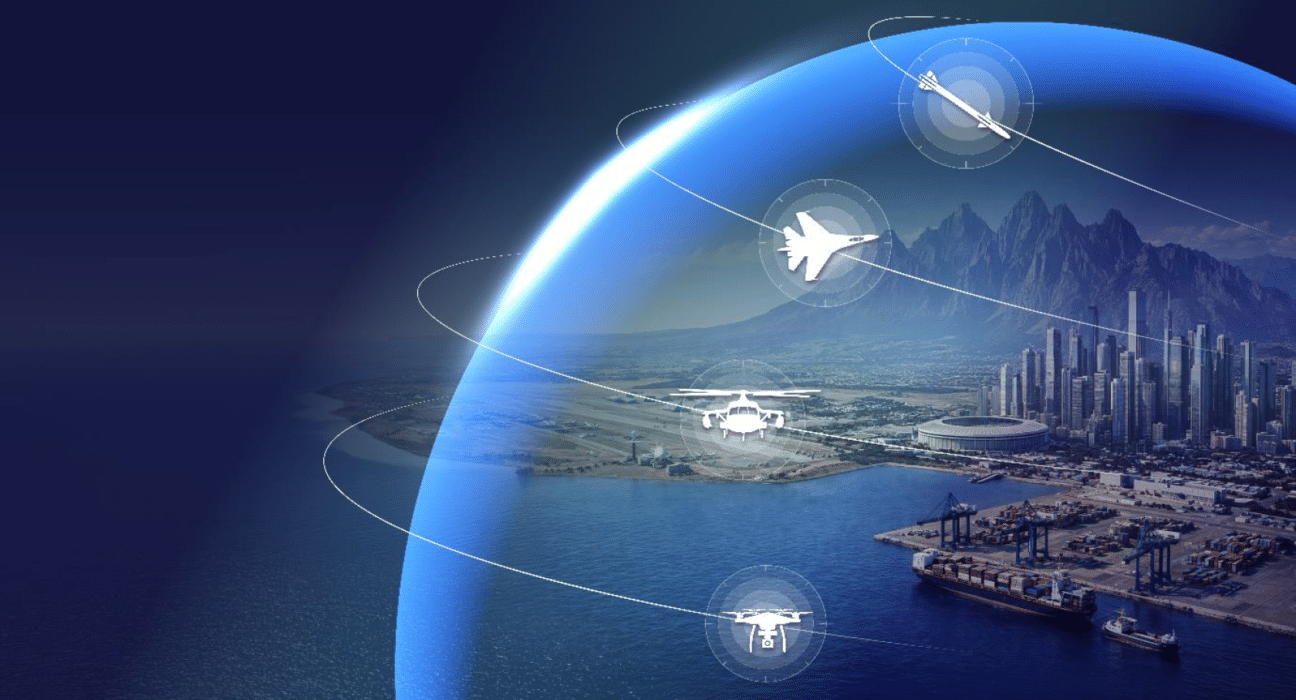
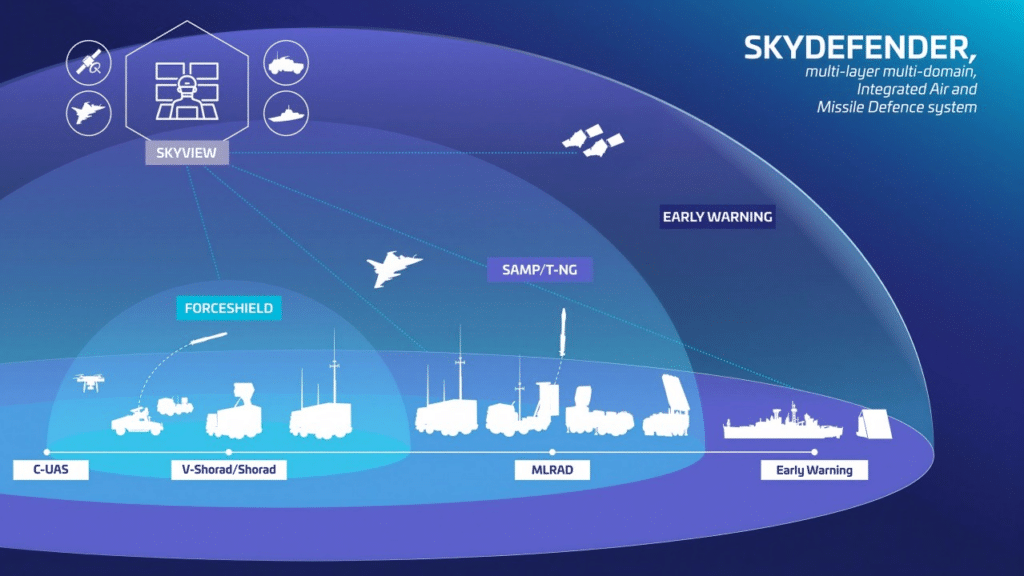
Thales’ announcement of the SkyDefender system on March 11, 2026 illustrates the return of the “integrated dome” concept in both strategic and industrial debate, with the system presented as an architecture capable of coordinating multiple layers of defense against a range of threats. This proposal is part of a broader trend aimed at responding to the diversification of air and ballistic threats, but it is above all rooted in an industrial and conceptual logic rather than in a capability already proven at large scale.
In practice, integrated air and missile defense does not refer to a single system, but to a coordinated network combining sensors, command systems, and interceptors able to operate coherently. NATO explicitly defines this architecture as the integration of interconnected assets rather than as a standalone piece of equipment, underscoring the fact that performance depends first and foremost on how the systems are organized.
Comparing “domes” therefore means comparing full architectures shaped by different strategic, industrial, and geographic constraints.
Five models, five different logics that are only partly comparable
The Israeli model is currently the most advanced reference for a fully operational multilayered architecture. The country has developed a combination of systems covering different ranges, allowing it to intercept both short-range projectiles and more complex missiles. This architecture is supported by an active industrial base, as illustrated by the increase in interceptor production capacity designed to sustain operations over time. Its effectiveness also relies on continuous operational feedback, allowing systems to be adapted to real-world conditions of use. Nevertheless, this model remains constrained by the high cost of interceptions and by the risk of saturation when the volume of threats becomes too great, a point regularly highlighted in operational analysis.
The American model is based on a different logic, centered on a globally distributed architecture rather than on continuous territorial coverage. This approach favors the separation of sensors and interceptors, making it possible to engage a threat with the most appropriate means regardless of location. It relies on command systems capable of fusing data from multiple sources in real time, which is at the core of its effectiveness. This architecture offers a high degree of flexibility, but it also involves major technical complexity, a strong dependence on networks, and a particularly high overall cost.

In Europe, air and missile defense is built around the gradual integration of national systems. The European air defense initiative aims to coordinate procurement and improve interoperability, without creating a unified architecture comparable to a single “dome.” Independent analysis points to persistent gaps, particularly in early warning capabilities and sensor coordination, both of which are essential to a truly integrated defense. This situation reflects continued dependence on national choices and an integration process that remains incomplete.
Russia, for its part, has a historically dense air defense architecture built around systems covering different ranges and integrated within a coherent doctrine. This architecture stands out for both its density and mobility, but it faces major industrial constraints that affect production and system availability. Those constraints directly weigh on sustainability and on the ability to maintain consistent coverage over time.
China is also developing a multilayered architecture comparable in principle, combining systems that cover different altitudes and ranges. However, evaluating this architecture remains limited by the opacity of available information and by the absence of public operational feedback comparable to that of other powers, making it difficult to assess its true level of integration with precision.
What makes a “dome” truly effective
The effectiveness of an integrated architecture depends first and foremost on the quality of its sensors and on their ability to detect and track threats in a complex environment. But that capability only has value if it is paired with a command system able to fuse data and coordinate interceptions in real time.
Stockpiles and production capacity are also decisive factors, because even a technically advanced architecture can quickly lose effectiveness if it lacks a sufficient volume of interceptors or if its industrial base cannot sustain the pace of engagements. Added to that are often less visible factors such as operator training, system maintenance, and coordination among different components.
Lastly, resilience against saturation remains a central criterion. No system can guarantee total interception when the volume of threats exceeds its capacity, which mechanically limits the idea of complete protection.
What this really changes: from political symbol to operational reality
The concept of the “integrated dome” carries strong symbolic weight, suggesting the ability to provide broad territorial protection. Yet existing architectures cannot ensure total coverage against the full spectrum of threats, as the very definition of integrated systems makes clear.

Real effectiveness depends on concrete conditions such as architectural coherence, stockpile depth, quality of integration, and industrial capacity. The limits appear as soon as those conditions are not met, particularly in cases of saturation or network vulnerability.
This creates a frequent gap between strategic messaging and operational reality, which makes simplified comparisons especially misleading.
No single “best dome,” but architectures adapted to different needs
So-called integrated air and missile defense architectures are not directly comparable, because they respond to different constraints. Israel currently offers the most integrated and most battle-tested model, while the United States favors a globally distributed approach. Europe is moving toward partial integration, while Russia and China are developing robust architectures that are either constrained or difficult to assess.
The central issue lies less in identifying the “best dome” than in understanding the concrete conditions that allow an architecture to be truly effective.