


Naval mines remain one of the most effective tools of sea denial: cheap to lay, hard to attribute, and capable of shutting down a port, a strait, or a trade route with disproportionate strategic effect. The modern response is no longer “a minehunter goes in.” It is an end-to-end sequence: detect → classify → identify → neutralize → reopen and the players that master the full system (uncrewed platforms, software, command, and sustainment) will reopen sea lanes faster, even under pressure.
Three Western models now stand out: the UK’s emphasis on Remote Command Centres (RCC), the US approach built around a Mine Countermeasures Unmanned Surface Vehicle (MCM USV) and modular mission packages, and Northern Europe’s replacement Mine Countermeasures (rMCM) ecosystem built around a “mothership + toolbox” concept.
The real competition: the MCM kill chain
On paper, “finding the mine” looks like the core challenge. In practice, performance in Mine Countermeasures (MCM) depends on the ability to manage ambiguity (sonar produces plenty of “false friends”), orchestrate multiple uncrewed systems in parallel, and maintain operational tempo across the cycle (detection, classification, validation, and neutralization). Recent programs also show the differentiator shifting toward the Command and Control (C2) layer and the mission-data pipeline that connects sensors to decisions.
In other words, the decisive factor is not only the sensor, it is the combination of sensors + data + software + procedures + sustainment.
United Kingdom: operating at standoff via deployable command hubs (RCC)
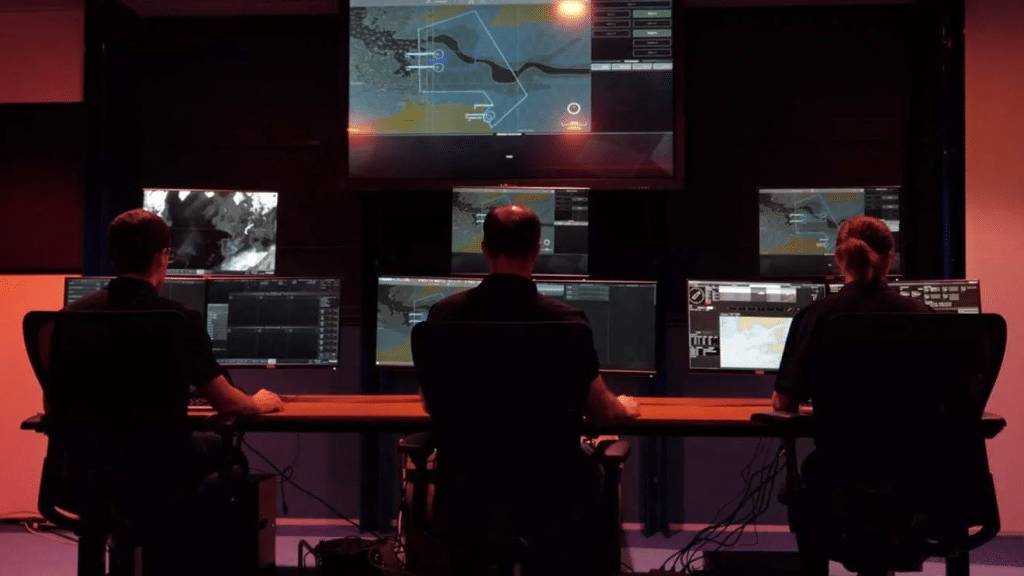
The UK bet is straightforward: if you can quickly deploy an RCC and run minehunting at distance, you reduce risk to crews and gain flexibility.
In late December 2025, the Royal Navy announced a £10 million contract for portable autonomous command centres for minehunting, awarded to Thales through the UK acquisition body DE&S. The announcement highlighted a key objective: enabling personnel to deploy these hubs rapidly and control autonomous minehunting systems “anywhere in the world,” aligned with the Royal Navy’s “Hybrid Navy” direction.
What this suggests
- The UK is investing in a deployable C2 layer (planning, orchestration, and data-flow management), not just vehicles.
- The model is designed to be agile and expeditionary: “deploy the C2” becomes a force multiplier, particularly for quickly securing port approaches or sensitive sea routes.
Likely vulnerability :
The more operations are pushed to standoff control, the more they depend on resilient data links and cyber security. In a contested environment, credibility will hinge on robust degraded modes (onboard autonomy, procedures, and tactical fallback options) and hardened control architectures.
United States: an uncrewed “carrier” (MCM USV) with interchangeable mission modules
The US approach is structured differently: treat MCM as a modular capability. The core is an MCM USV, paired with mission modules (hunting, sweeping, neutralization), then iterated rapidly based on test feedback and industrial availability.
In early February 2025, NAVSEA announced a $7.7 million Advanced Material Order (AMO) to Bollinger Shipyards to procure items intended to improve the MCM USV based on operational testing results, with performance extending into September 2025. The contract is a marker of the US method: test, identify friction, fund fixes, and cycle back into the fleet.
What this suggests
- The US model prioritizes improvement loops: testing → findings → targeted procurement → return to operations.
- Modularity provides a doctrinal hedge: payloads and software can evolve without rebuilding a dedicated minehunter fleet from scratch.

Likely vulnerability:
Modularity carries an integration tax: interfaces, mission software, and reliability across payload combinations become a central risk. The AMO logic,buying fixes after what testing revealed, illustrates how powerful the architecture is, but also how demanding it is in engineering discipline and sustainment.
Northern Europe: rMCM and the industrialization of “mothership + toolbox”
The most legible European “full system” approach is the Belgian-Dutch rMCM program, led by Belgium Naval & Robotics (Naval Group + Exail). The concept is a mothership (new dedicated MCM vessels) paired with a toolbox of surface and underwater uncrewed systems, integrated as a coherent package.
From the outset, program descriptions have framed rMCM as delivering 12 mine countermeasures vessels and roughly 100 drones, integrated into a “toolbox” carried by each ship. The key point is that rMCM is past the conceptual stage. The ship Vlissingen began its first sea trials on March 27, 2025, with delivery targeted for late 2025. In November 2025, Oostende was reported moored at Zeebrugge, an early milestone for the first ship of the program.
What this suggests :
- Europe is betting on an industrialized system-of-systems: ships + drones + C2 delivered as a package and supported over the long term.
- Scalability is built around the drone fleet: more parallel search and clearance, faster reopening cycles, and reduced human exposure.

Likely vulnerability :
A toolbox-sized uncrewed fleet increases complexity by design. Hidden costs tend to appear in sustainment (spares, batteries, repairs), software configuration management, training pipelines, and cyber resilience.
French Focus : France: an unmanned-first direction confirmed (SLAM-F / MMCM)
France is moving in the same direction. In December 2024, the Organisation for Joint Armament Co-operation (OCCAR) announced delivery of the first Maritime Mine Counter Measures (MMCM) system to France. In February 2025, Thales highlighted a “world first” with delivery of a first autonomous mine countermeasures drone system and noted the 2025 delivery profile under « Système de Lutte Anti-Mines Futur » (SLAM-F), including six surface drones (three “system-of-systems” sets of two drones each).
Comparison: where each model has the edge
In deployment terms, the UK’s Remote Command Centres (RCC) are built for speed: push a C2 node forward, run minehunting at standoff, and stay agile without relying on a single specialized platform. The US model, centered on the MCM USV, is less about expeditionary command hubs and more about modularity, swap mission packages, iterate quickly, and evolve the capability as testing reveals what breaks. Europe’s rMCM takes the long view: a coherent mothership-plus-toolbox ecosystem designed to be industrially supported and repeatable at scale
Scalability follows the same logic. rMCM is explicitly sized for parallel operations, more drones, more sectors worked at once, faster reopening cycles. The UK can scale through command architecture too, but only if networks and cyber defenses hold under stress. The US approach can scale, but it is more sensitive to module availability and integration reliability across the fleet. And each model’s vulnerability mirrors its strength: RCC-led standoff depends on resilient communications; MCM USV lives or dies on multi-module integration and fleet reliability; rMCM’s system-of-systems promise will ultimately be judged by the real sustainment burden of keeping a large uncrewed fleet mission-capable over time.
Mine warfare is back, but the era of manned minehunters pushing into the threat is fading. The UK is prioritizing standoff operations via RCCs and a strong C2 layer. The US is betting on a modular architecture centered on the MCM USV and continuous improvement based on testing. Europe is industrializing a mothership + toolbox rMCM ecosystem, sized (12 ships, ~100 drones) and already marked by concrete trials and delivery milestones.
In 2026, the decisive question is not “who has the newest drone.” It is: who owns, and can sustain, the full MCM kill chain, from first sonar contact to reopened sea lanes.