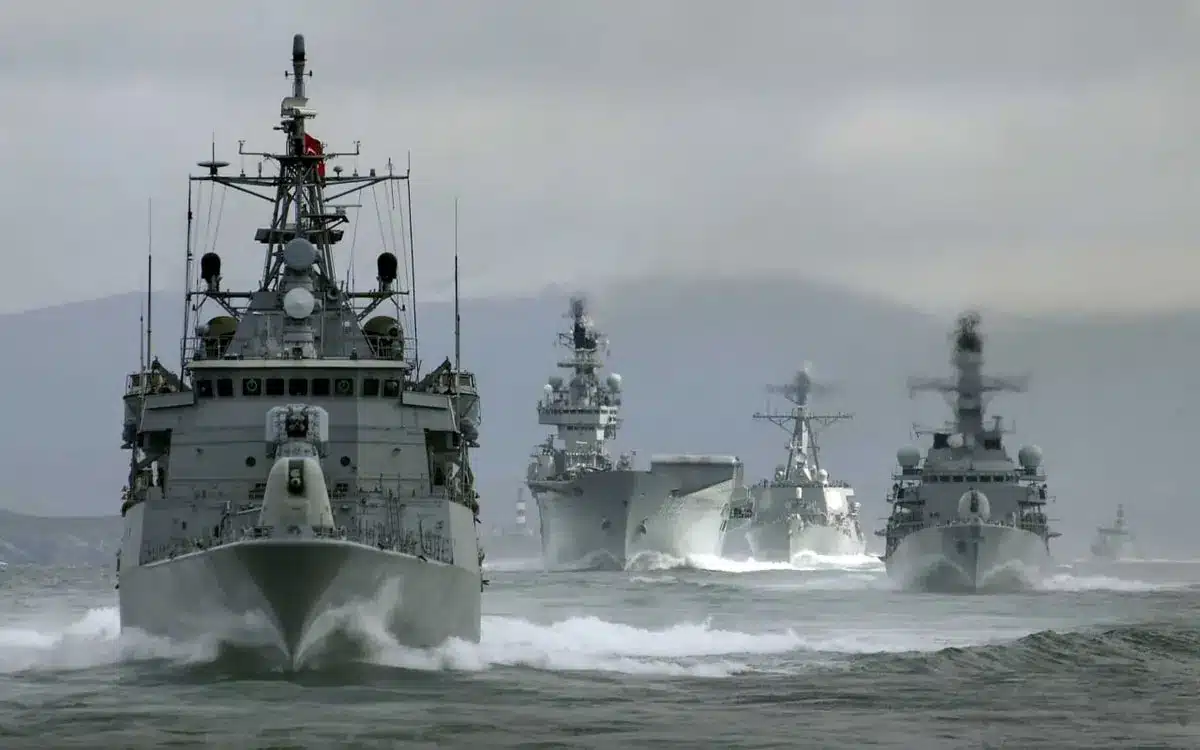



Naval mines remain one of the most effective tools for blocking a port, disrupting a trade route, or slowing a naval deployment. Inexpensive and difficult to attribute, they can generate a strategic effect far greater than their technical complexity would suggest.
Yet mine warfare rarely dominates media coverage. Attention generally focuses on a handful of highly visible technological programs, particularly robotic architectures and unmanned systems developed in Europe and the United States.
This focus creates a bias. Many European navies maintain active mine countermeasure capabilities, but their daily activity largely remains under the radar. Understanding this gap requires examining three factors: the bias created by flagship programs, the inherently discreet nature of this naval mission, and the specific geography of European maritime spaces.
The bias of flagship programs
Media visibility in mine warfare is now largely captured by a small number of technological programs.
The most widely discussed announcements involve unmanned systems, drone architectures, or major industrial initiatives. These efforts are frequently accompanied by contracts, technology demonstrations, and official communications, which contribute to their strong visibility.
By contrast, navies operating older fleets or gradually modernizing their capabilities generate fewer high-profile announcements. The result is a distorted perception: the impression that only a handful of actors are investing seriously in mine warfare, even though many states continue to maintain operational capabilities.

This media dynamic therefore hides a broader reality. In several regions of Europe, mine countermeasure operations remain a routine naval mission.
An inherently low-visibility naval mission
Mine countermeasure operations are among the least visible activities in naval operations.
Unlike naval combat or demonstrations of maritime power, mine neutralization often involves repetitive and methodical work: sonar inspection, object classification, visual identification, and neutralization.
A large portion of these activities also takes place within multinational frameworks.The standing maritime groups of NATO regularly include mine warfare units in their operational rotations and exercises, without these deployments necessarily generating detailed national announcements.
This routine character partly explains the limited public visibility of these missions. Nevertheless, such activities remain a critical component of European maritime security.
“Geography: exposure isn’t proportional to coastline length”.
A state’s dependence on mine warfare does not simply depend on the length of its coastline.
The decisive factor is the presence of maritime pressure points, such as:
- strategic straits
- port approaches
- undersea cables
- energy terminals
- concentrated shipping routes
In such areas, the introduction of only a few mines can trigger major disruption. Ships must slow down, inspections multiply, and maritime insurers may reassess risk levels, immediately increasing the cost of transport.

The growing attention paid to undersea infrastructure in Northern Europe illustrates this vulnerability.Recent incidents involving cables in the Baltic Sea have highlighted the dependence of European economies on these invisible networks.
In this context, mine warfare is not only about protecting naval forces. It is increasingly part of the broader security of maritime infrastructure.
Baltic Sea: mine warfare as infrastructure protection
The Baltic Sea concentrates several characteristics that amplify the potential impact of naval mines.
It is a semi-enclosed sea, relatively shallow and densely used by commercial shipping routes. It also hosts a dense network of undersea infrastructure, including communication cables and energy links.
Following several incidents affecting these infrastructures, NATO announced the launch of Operation Baltic Sentry in December 2024, aimed at strengthening maritime surveillance and protecting undersea infrastructure in the region.

Within this framework, Lithuania announced the deployment of several naval vessels, including mine countermeasure assets, to support maritime security operations in the Baltic Sea.
For the Baltic states, mine warfare is not merely a specialized military capability. It functions as a form of access assurance for ports, trade routes, and critical infrastructure.
In constrained maritime environments, even uncertainty about the possible presence of mines can be enough to disrupt shipping flows.
Mediterranean: structured capabilities with limited visibility
The Mediterranean offers an interesting contrast. Several navies maintain structured mine warfare capabilities there, yet these forces receive less media attention.
Spain
The Spanish Navy operates a mine warfare squadron based in Cartagena, composed of Segura-class minehunters specialized in detecting and neutralizing underwater explosive devices. These vessels are particularly suited for operations in port approaches and Mediterranean shipping routes.

Italy
Italy has entered a phase of capability renewal. In 2024, a contract was announced for the construction of new minehunters intended to modernize the Italian fleet. This modernization reflects the continued importance of mine countermeasure capabilities in a maritime environment where ports, straits, and commercial routes remain highly sensitive.
Greece and Portugal
Other Mediterranean and Atlantic navies also maintain mine warfare capabilities but communicate less frequently about these activities. These countries regularly participate in exercises and standing maritime groups of NATO, where mine warfare units contribute to securing maritime approaches.
This limited media visibility therefore does not mean that operational activity is absent.
Mine warfare in Europe remains paradoxically under-reported.
Media coverage is largely dominated by a small number of high-profile technological programs, while day-to-day operational activity often takes place far from the spotlight.
Yet in several maritime regions, these capabilities remain essential to maritime security. Commercial ports, undersea infrastructure, and energy routes all depend directly on the ability of navies to detect and neutralize mines.
In this domain, the central issue is not only technological. It is also geographical: which states depend most on access to the sea and on critical maritime infrastructure.
Naval mines remain a highly attractive tool of maritime denial in strategic transit zones a dynamic that deserves analysis at the global level.
Article 1: Who Owns the Mine Warfare Kill Chain?
Article 2: Mine Warfare Goes Global: Chokepoints, Infrastructure, and Low-Cost Maritime Denial