

In an era where information dominance defines victory, airborne surveillance has become one of the most critical components of modern military power. From NATO’s E-3 Sentry to Sweden’s GlobalEye, airborne early warning and control (AEW&C) aircraft serve as flying command posts, detecting, tracking, and managing threats across vast distances.
These aircraft, integrating powerful radar systems and networked data links, act as force multipliers. They enable advanced warning, airspace management, and real-time coordination across domains. As threats evolve, stealth platforms, cruise missiles, hypersonics ; so too must the surveillance platforms tracking them.
Platforms of strategic surveillance
E-3 Sentry (AWACS)
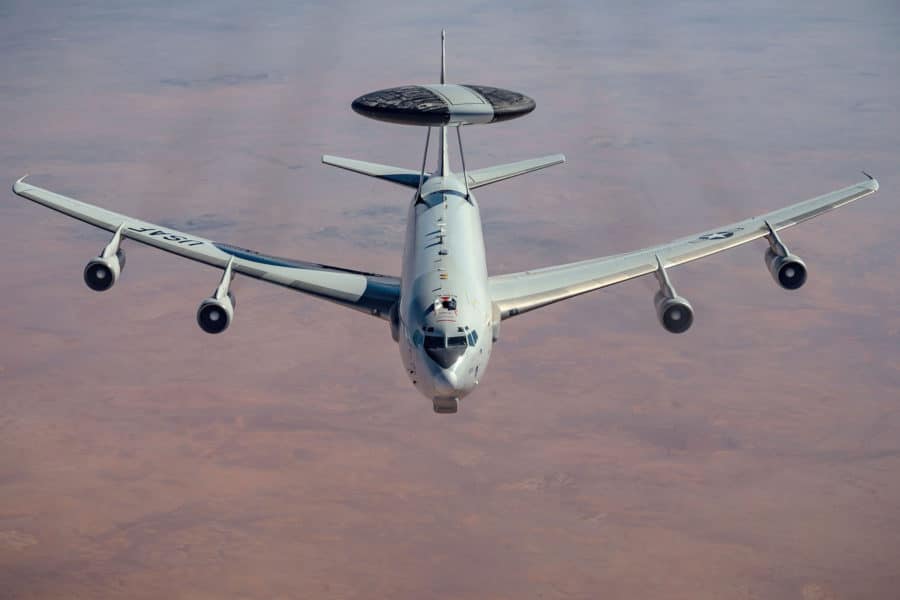
Derived from the Boeing 707 airframe, the E-3 Sentry has been the backbone of NATO and USAF airborne surveillance since the 1980s. It features a 9.1-meter rotating radome mounted above the fuselage, housing the AN/APY-2 pulse-Doppler radar. This radar provides 360° coverage, detecting targets over 400 km away, including low-flying aircraft and cruise missiles.

With an endurance of over 8 hours (extendable via aerial refueling), the E-3 is not just a radar platform, it is a flying command center equipped with mission consoles for surveillance, IFF, and air battle management. Recent upgrades under the DRAGON and Block 40/45 programs have modernized its electronics and user interfaces.
E-7 Wedgetail
Built on a Boeing 737-700 platform, the E-7 features the MESA radar mounted atop the fuselage in a fixed dorsal fin. Unlike the rotating dome of the E-3, this radar offers a solid-state AESA system capable of simultaneously performing air and maritime surveillance. The aircraft has been selected by Australia, the UK, Turkey, South Korea, and most recently the United States.
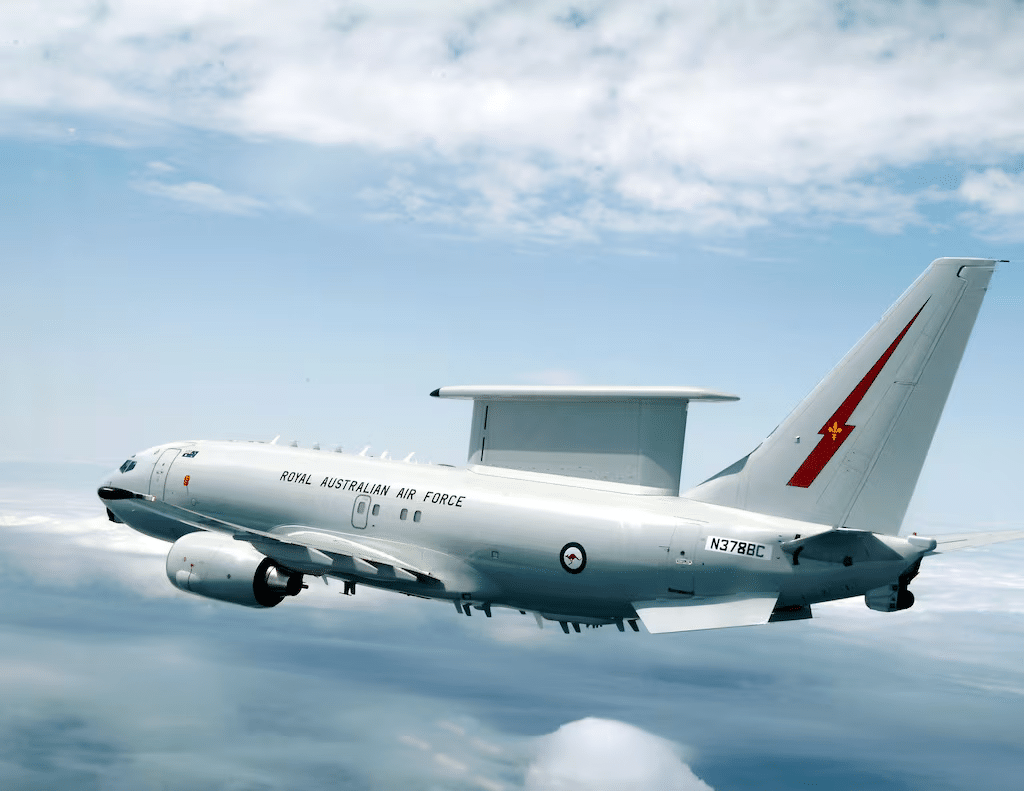
Its lower operating costs, rapid deployment, and modular design make it the natural successor to the aging E-3 fleet. The USAF aims to begin fielding the E-7 by 2027, while already exploring next-generation upgrades such as cognitive electronic warfare, distributed apertures, and AI-enabled sensor fusion.
Saab GlobalEye
The GlobalEye is a new-generation AEW&C platform based on the Bombardier Global 6000 business jet. It integrates the Erieye ER radar a fixed AESA array mounted above the fuselage and includes maritime surveillance radar, signals intelligence (SIGINT), and electronic support measures (ESM) in one airframe.
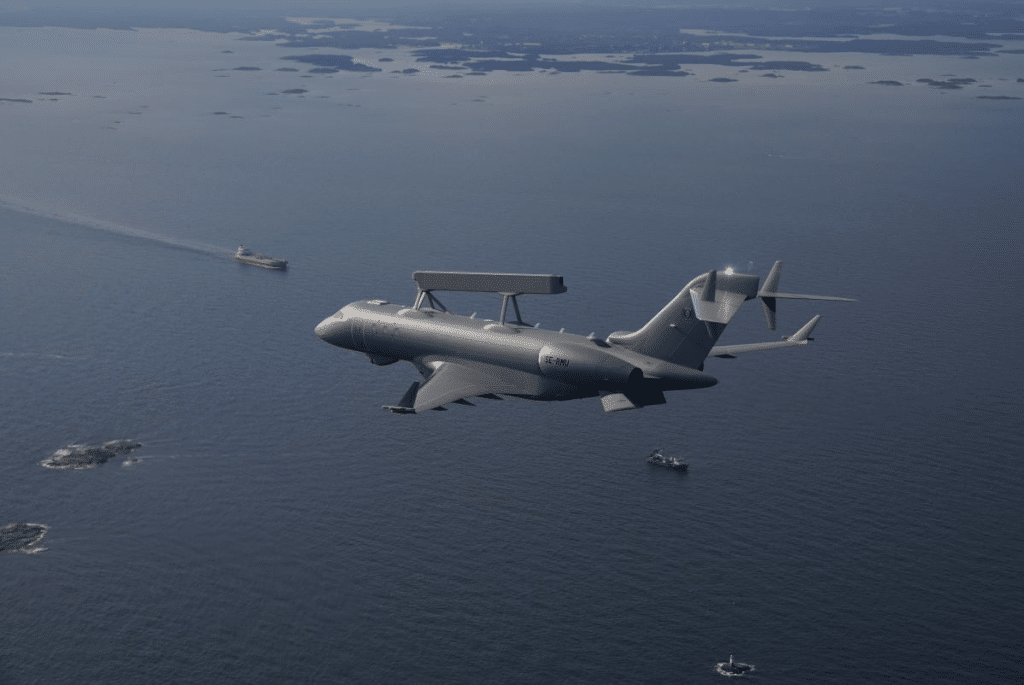
With a range of over 9,000 km and mission endurance up to 11 hours, GlobalEye is one of the most versatile multi-domain surveillance aircraft available today. It has been adopted by Sweden and the UAE, and was recently ordered by Poland, which signed a letter of offer and acceptance for two GlobalEye aircraft in 2023.
The technology behind the mission
Modern surveillance aircraft use Active Electronically Scanned Array (AESA) radars for enhanced resolution, target tracking, and electronic counter-countermeasures. AESA enables beam steering without moving parts, allowing for faster and more agile surveillance compared to legacy systems. Systems like MESA also provide simultaneous tracking of air and maritime targets with better resistance to jamming.
Advanced platforms like the E-7 and GlobalEye integrate radar with other sensors: ELINT, SIGINT, infrared, and optical payloads. Data is fused onboard and distributed across data links like Link 16, enabling joint targeting and real-time command and control (C2) across allied forces.
Fusion is not just sensor-based, it includes AI-assisted threat classification, target prioritization, and predictive analytics. These aircraft form the core of modern multi-domain awareness frameworks.
Operational deployments
- NATO has deployed E-3 Sentry aircraft to monitor Russian activity over Eastern Europe, flying out of Geilenkirchen, Germany, and forward bases in Romania and Greece.
- Ukraine has targeted Russian A-50s using long-range weapons and FPV drones, severely disrupting Russian air control capabilities.
- In the Indo-Pacific, the U.S., Australia, and Japan are integrating E-7 and GlobalEye platforms to monitor the Taiwan Strait and South China Sea.
The surveillance aircraft is no longer just an “eye”, it’s becoming a multi-sensor, multi-domain command-and-control node. Miniaturization, modularity, AI-enabled processing, and survivability are converging on the same goal: turning raw data flows into immediate operational advantage. Tomorrow, the edge won’t go to whoever detects first, but to whoever fuses, shares, and exploits information faster.