



Since February 28, 2026, United States and Israeli strikes against Iran, and subsequent Iranian retaliatory actions, have created an operational environment in which multi-axis salvos are designed to overwhelm defensive capacity and force prioritization decisions.
Iranian retaliation has notably combined one-way attack unmanned aerial systems such as the Shahed 136 with ballistic missiles drawn from an arsenal that, according to open sources, includes Sejil, Emad, Ghadr, Shahab-3, and Khorramshahr, as well as cruise missiles such as Hoveyzeh.
In this context, missile defense is not a uniform “shield.” It is a layered architecture designed to increase the probability of preventing impacts on critical assets, not to guarantee the systematic interception of every detected object. On the Israeli side, the layered construct integrates Iron Dome, David’s Sling, and Arrow. On the United States side, publicly cited assets in the campaign include Patriot and Terminal High Altitude Area Defense, supported by naval capabilities and Tomahawk cruise missiles during the initial strike phase.
Saturation matters more than interceptor quality
United States Central Command announced the launch of Operation Epic Fury on February 28, 2026, initiating a sequence of actions in which the threat from missiles and unmanned aerial systems remains a central operational factor. According to public reporting, the campaign includes Patriot and Terminal High Altitude Area Defense among the deployed defensive assets, while the opening phase incorporated precision strikes including Tomahawk cruise missiles.

In the days that followed, retaliatory strikes and intercepts were reported across multiple Gulf states, with disruptions and damage noted by international media, illustrating that missile defense operates at a regional scale rather than solely over a single national territory.
This type of networked confrontation highlights the primary limiting factor: volumetric capacity—that is, the number of tracks the architecture can process, decide upon, and engage within a given timeframe.
The Defense chain: sensors, decision, interceptors
Sensors
Even with extensive coverage, detection and tracking remain sensitive to geometry and threat altitude, directly affecting the time available for engagement.
Layered defense is built on the concept of engaging a threat at multiple points along its trajectory, which requires sensors capable of maintaining sufficiently reliable tracks to support engagement decisions.
When objects fly at low altitude—such as certain cruise missiles and many unmanned aerial systems—late detection mechanically compresses the engagement window and increases the probability of leakage, even if the interceptor itself is highly capable. This is a critical factor against drone profiles such as the Shahed 136 and against low-flying cruise missiles: later detection translates into less decision and engagement time for defenders.

Fusion and Decision
Between initial detection and interception, the architecture must correlate tracks, confirm classification, estimate probable impact points, and assign firing units, all under latency constraints.
Doctrines focused on munitions economy and efficiency—engage, assess, then re-engage if necessary—require available time, which becomes scarce when salvos are dense.
In a multi-vector salvo, the constraint is not purely technical; it is a prioritization challenge. Defenders may decide not to engage certain objects if the estimated trajectory does not threaten populated areas or critical infrastructure.
Interceptors
Even in controlled testing, missile defense programs report performance in terms of test and evaluation results, reflecting a fundamental reality: interception is a probabilistic event dependent on detection, tracking quality, fire control solution accuracy, and execution.
A classical probabilistic model shows that the relevant outcome, for a given posture, is the probability that “nothing gets through,” which depends in part on the probability of kill per engagement and the probability of detection and correct classification.
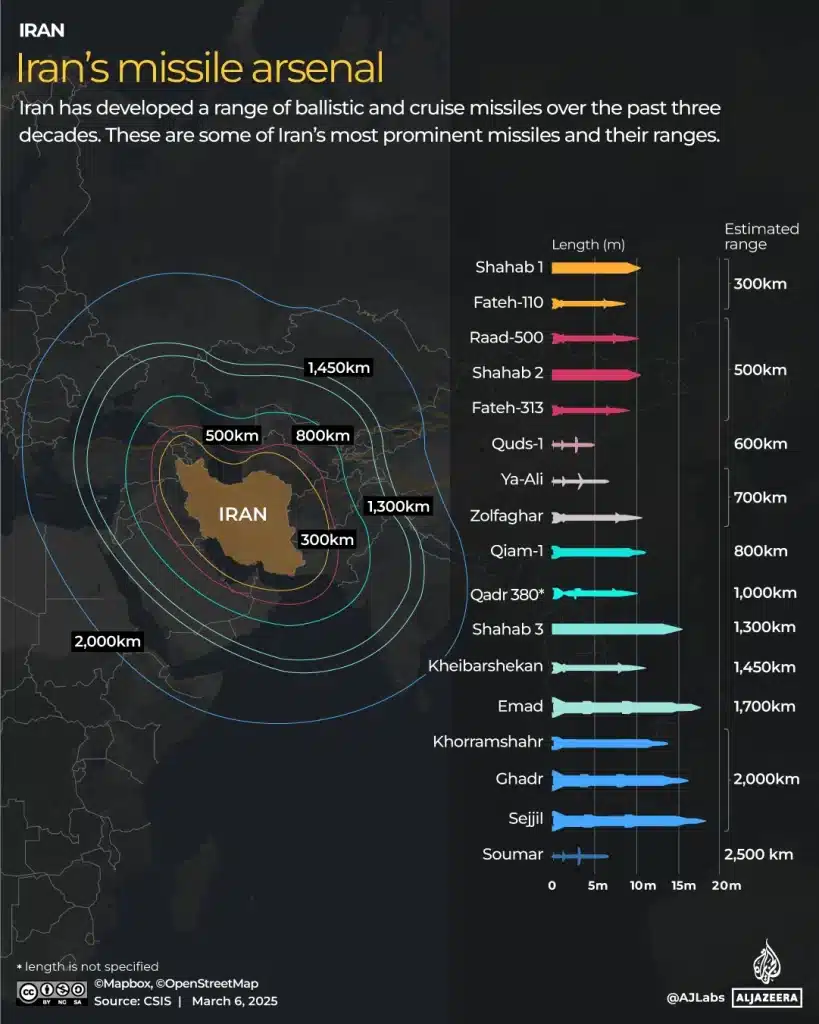
Accordingly, increasing the probability of destruction often requires firing more than one interceptor against a single threat, immediately reducing the capacity to absorb a large-scale salvo. This trade-off becomes particularly visible when the threat mix combines ballistic missiles—such as Sejil, Emad, Ghadr, Shahab-3, and Khorramshahr—with large numbers of one-way attack drones such as the Shahed 136.
Saturation: When volume drives the outcome
Saturation operates by simultaneously increasing the number of objects, diversifying profiles—slow and low versus fast and high—and multiplying axes of approach, thereby overloading decision cycles and consuming interceptor inventories.
In the recent Middle East conflict, missiles and unmanned aerial systems have remained present over extended periods, testing stockpile endurance and unit availability.
Another often misunderstood aspect is the difference between local capacity and regional capacity. An architecture may perform effectively over a specific area yet remain constrained by the density of simultaneous engagements, the requirement to defend multiple sites—air bases, ports, command centers—and the coordination required among different countries.
Stocks and Tempo: The economics of interception
Modern interceptors, particularly those designed for ballistic missile defense, are costly and produced in limited quantities, turning missile defense into an industrial sustainability challenge once intensity is prolonged.
A recent industrial announcement regarding a significant increase in Patriot interceptor production capacity illustrates global demand pressure and, indirectly, the importance of stockpiles.
The question is therefore not only “can intercept?” but “for how long can a high interception rate be sustained before more stringent prioritization becomes necessary?”
The conflict involving the United States, Israel, and Iran demonstrates that modern missile defense is fundamentally an architectural discipline: sensors, fusion, decision-making, effectors, stockpiles, and regional coordination. A well-integrated layered defense significantly increases the probability of reducing impacts on critical assets, but saturation, temporal constraints, and munitions economics make the objective of zero leakage structurally unrealistic.