



Sweden’s Luleå-class frigate program is emerging as one of the most consequential naval procurement decisions in Northern Europe. With a contract expected in 2026 and first deliveries targeted from 2030, the program is defined as much by its timeline as by its technical ambition.
That timeline changes the terms of the contest. The key question is no longer which design appears most capable on paper, but which solution can deliver credible naval power on schedule, with the lowest level of industrial and operational risk. In the Baltic Sea’s deteriorating security environment, and within the framework of NATO commitments, delay or underperformance at entry into service carries strategic consequences.
In that context, Naval Group’s Defense and Intervention Frigate is increasingly positioned as the offer most closely aligned with Sweden’s constraint. Opposite it, Babcock’s Arrowhead proposal, developed in cooperation with Saab, reflects a different logic, one centered on industrial architecture and national integration.
Execution versus integration
A program already moving through production
The core strength of the Defense and Intervention Frigate lies in its status. It is not a design awaiting validation, but a program already in execution. Built for the French Navy, the platform is in production, with multiple hulls launched and industrial processes stabilized.
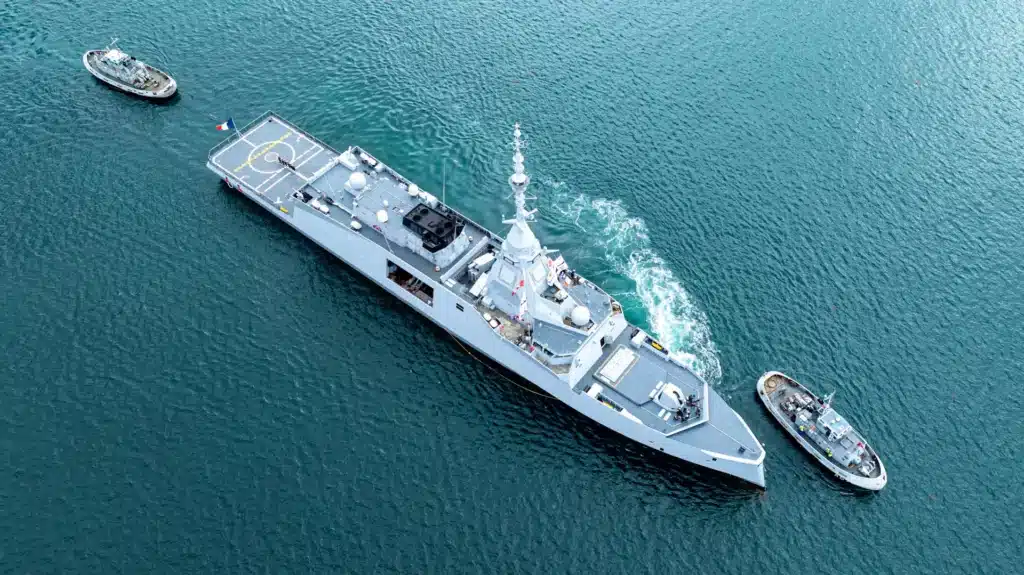
Naval Group presents the frigate as based on a fully defined digital architecture from the outset, supported by an industrial system designed for serial delivery under controlled risk. This is not simply a design claim; it reflects a program that has already moved beyond early uncertainty.
That credibility is reinforced by export activity. Greece ordered three ships in 2022 and added a fourth in 2025, with the first vessel delivered at the end of 2025. This sequence provides a tangible benchmark. The platform is no longer hypothetical, it is being built, delivered and integrated into an operational navy.
In a program constrained by a 2030 delivery horizon, that distinction matters. A warship already moving through production inherently reduces uncertainty across design validation, supply chain coordination and system integration.
Arrowhead: industrial logic, but less immediate delivery certainty
Arrowhead follows a different model. Developed by Babcock with Saab, it emphasizes flexibility and national industrial ownership. Saab’s role as a central design and integration authority reflects a deliberate effort to anchor the program within Swedish industry.

This approach has clear strengths. It supports sovereignty, long-term control and the ability to adapt the platform to national requirements. But it also introduces a different type of risk. The architecture must be progressively stabilized, and multiple subsystems must be integrated under a compressed schedule.
Arrowhead’s credibility is supported by export references. Indonesia has acquired multiple design licences since 2021, with further agreements in 2026, while Poland is developing three frigates under the Miecznik program based on the same architecture. These cases demonstrate the design’s exportability and its ability to fit national industrial frameworks.
However, they also underline a structural difference. Arrowhead’s value is closely tied to local integration and adaptation, rather than to a standardized product already moving through serial production. In the Swedish context, where timing is critical, that distinction becomes central.
Operational readiness as a differentiator
Designed for contested environments
The Defense and Intervention Frigate was conceived from the outset for operations in contested environments. Its design integrates a strong air-defense capability and is structured for seamless participation in allied operations.
Naval Group highlights a combat system built on proven technological building blocks, combined with a digital architecture that enables rapid adaptation without altering the ship’s core design. This approach reduces the need for bespoke development and reinforces system robustness.

The result is a platform closer to fielded capability than to projected capability. It is not presented as a future optimization, but as a system already taking shape within an operational framework.
Reducing risk where it matters most
In this context, maturity is not an abstract concept. It translates into a measurable reduction of risk across technical, industrial and operational dimensions.
For Sweden, this is decisive. Any uncertainty left unresolved during development risks translating into delays, cost escalation or reduced effectiveness at entry into service. Under a compressed timeline, these risks are magnified.
The Defense and Intervention Frigate addresses this constraint directly. It offers a platform where key uncertainties have already been absorbed within an existing program, rather than deferred into future integration phases.
Saab’s central role: strength and constraint
Saab’s position within the Arrowhead proposal is both a defining strength and a structural constraint. As a central integrator, Saab would ensure coherence across the system and maintain long-term national control over upgrades, support and operational evolution.
This aligns closely with Swedish strategic culture, which places a premium on industrial sovereignty and domestic competence.
At the same time, this central role increases the burden of integration in the early phases of the program. Final performance will depend on Saab’s ability to coordinate multiple technological components within a tight schedule. The industrial model strengthens long-term control, but it also concentrates short-term execution risk.
The Danish mirror: a different balance of priorities
Denmark provides a useful comparison. Unlike Sweden, Copenhagen is not yet engaged in an immediate procurement decision for new frigates. It remains in a phase of defining its future naval posture and industrial approach.
In that environment, Arrowhead’s model appears more naturally aligned. Its adaptability and compatibility with local construction fit a context where industrial participation and long-term flexibility remain central.
The Defense and Intervention Frigate, by contrast, represents a more direct, execution-focused solution. It is less dependent on industrial transformation, but built around a stronger guarantee of delivery.
This contrast highlights a key point. The competition is not uniform across the region. In Sweden, time and risk reduction dominate. In Denmark, industrial structure and long-term flexibility remain more open variables.
Maturity as a form of superiority
The competition between the Defense and Intervention Frigate and Arrowhead is not simply technical. It reflects two distinct models: one prioritizing execution certainty, the other industrial sovereignty and adaptability.
In Sweden’s case, the timeline acts as a filter. It favors solutions that can demonstrate immediate readiness and a credible path to delivery.
By that measure, the Defense and Intervention Frigate holds a structural advantage. It does not guarantee selection, but it offers something increasingly decisive in modern naval programs: the credibility of a warship already moving beyond design and into execution.