

In recent conflicts, drone-on-drone interception is not the result of theoretical debate, but of a very concrete reality: the growing difficulty of sustainably neutralizing low-cost drones using expensive and scarce ground-based defenses.
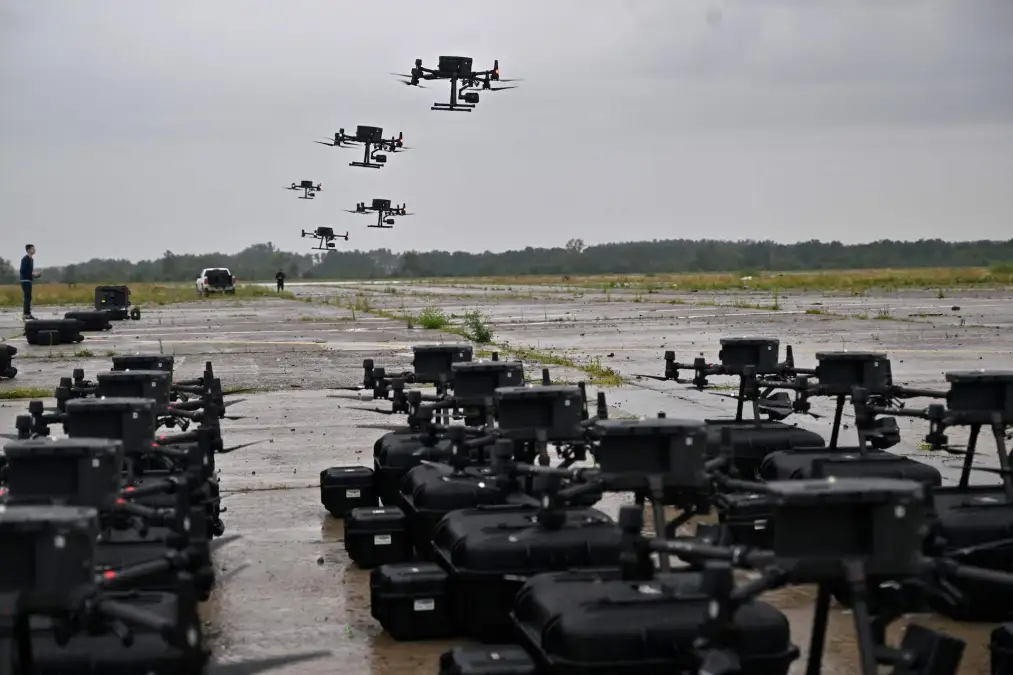
In Ukraine, reconnaissance and attack drones assembled for only a few thousand euros have repeatedly forced forces on both sides to rely on missiles or specialized munitions whose unit cost far exceeds that of the target. This unfavorable attrition dynamic has been documented since 2022 and has pushed both sides to explore more frugal, if imperfect, interception solutions.
Electronic disruption remains widely used, but its effectiveness has eroded as drones have adopted preprogrammed navigation modes, autonomous flight phases, and frequent frequency changes. Several Ukrainian units have publicly acknowledged that electronic interference alone is no longer sufficient against drones operating on terminal trajectories without an active radio link.
It is in this context that physical interception by another drone has emerged not as an ideal solution, but as an attempt to fill a capability gap: a low-cost, expendable airborne interceptor able to act where ground-based systems or electronic measures arrive too late.
Two approaches observed in operations and trials
Net capture and entanglement
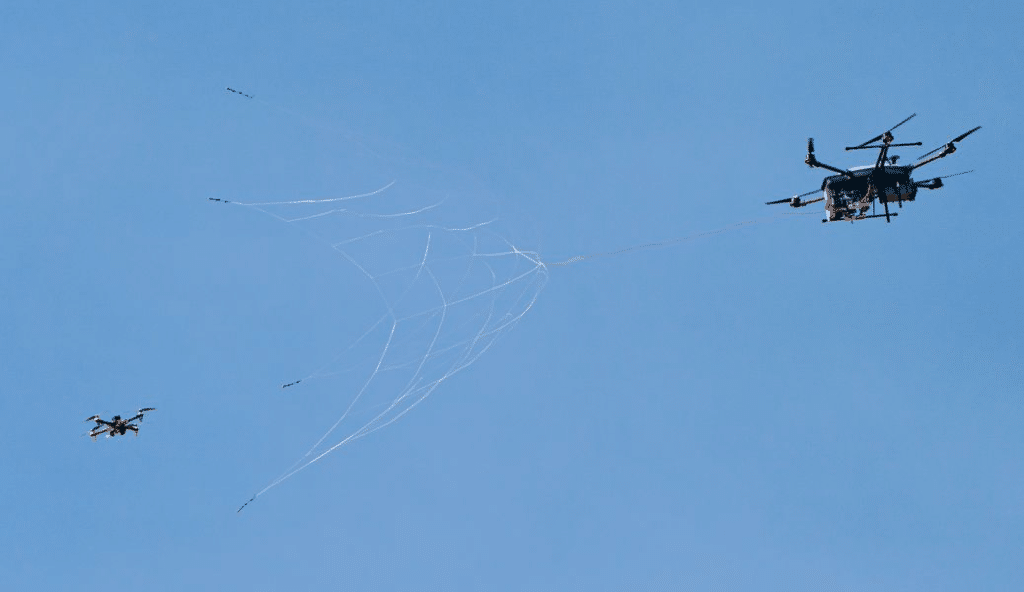
Non-explosive capture is primarily associated with controlled trials and very specific use cases. The principle is to block the propellers or airframe of an opposing drone using a net or a cable.
In Ukraine, several videos released since 2023 show improvised drones fitted with wires or flexible lines, used in attempts to entangle enemy drones in midair. These attempts are rare and difficult to reproduce, but they highlight a key point: aerial interception is possible at very short range against slow, lightly maneuvering drones provided a high failure rate is accepted.
On the industrial side, solutions developed by companies such as Fortem Technologies have been tested during Western exercises focused on the protection of sensitive sites, with an emphasis on recovering the intercepted drone and limiting ground risk. At this stage, however, these systems remain largely confined to controlled environments.
Collision-based interception
Collision-based interception is closer to what has been observed under degraded operational conditions. The concept is straightforward: destroy or neutralize the target through direct impact.
This approach has been tested in several programs, including interceptor drones developed by Anduril Industries, emphasizing rapid engagement without complex mechanical systems. While feasibility has been demonstrated in trials, there is currently no public evidence of large-scale use in high-intensity combat.
In Ukraine, collision-based interception exists mainly in improvised form: drones deliberately sacrificed to ram an enemy drone, without certainty of mutual destruction, but with the goal of disrupting an imminent reconnaissance or attack mission.
Observed contexts of employment
Drone-on-drone interception is primarily observed against small, short-range drones operating at low altitude and limited speed, particularly around trench lines or fixed positions. In these contexts, reaction time remains compatible with rapid launch, and relative maneuverability allows for visual engagement.
This approach is also used for point defense missions, such as around logistics depots, command posts, or crossing points. In these cases, the interceptor is not a standalone solution but a complement, used when terrain, urban density, or troop proximity make ground fire too risky.
Finally, many of the uses observed in Ukraine reflect tactical opportunism rather than established doctrine. Teams attempt aerial interception when other options have failed, accepting a low success rate in exchange for a limited marginal cost.
Recurring factors of failure
Failures, however, outnumber documented successes.
The first limitation is detection. Without early warning, the interceptor simply has no time to act. In many cases, the opposing drone is detected too late for an interceptor drone to launch and reach the engagement area.
Saturation is another major constraint. Against simultaneous or near-simultaneous attacks, a single interceptor can only engage one target at a time. In environments where drones are employed in waves, this approach quickly becomes insufficient.
Environmental conditions also weigh heavily. Strong winds, rain, reduced visibility, or electronic interference directly affect the stability and accuracy of small interceptor drones, which are often more sensitive than heavier ground-based systems.
What recent experience actually shows
Industrial demonstrations and official communications should be treated with caution. Successful interceptions are typically achieved under simplified conditions: a single target, known trajectory, and absence of opposing interference.
By contrast, combat feedback from Ukraine shows that drone-on-drone interception is possible, but rarely decisive. It is mainly used to buy time, disrupt a mission, or temporarily reduce pressure, without ever constituting a systematic solution.
The few observed successes highlight a consistent point: the interceptor drone is only the final link in the chain. Its effectiveness depends above all on detection, rapid information transmission, and the ability to decide and act within seconds. Added to this are very concrete constraints: limited availability, battery recharge, operator training, and a high attrition rate the interceptor often being consumed as quickly as its target.
Drone-on-drone interception is therefore neither an illusion nor a miracle solution. Recent conflicts show it as a stopgap response, driven by economic constraint and tactical adaptation. It works occasionally, fails often, and never replaces a coherent layered defense but it does provide an additional option when other means are too slow, too costly, or unsuitable.