


Between contested airspace and IED-ridden roads, the goal is no longer to replace the armored ambulance, but to cut the time to care. Drones open the critical window; protected medical vehicles ensure continuity all the way to surgery.
The Golden Hour is no longer just a medical guideline. In environments saturated with IEDs, electronic jamming and FPV drones, it becomes an operational imperative. Evacuation is no longer a straight shot to a Role 2 facility, but a segmented chain: stabilize under fire, move under protection, treat without interruption.
What drones change
Their key advantage is speed. In a matter of minutes, a logistics drone can take off, cross a contested route, deliver blood or a stabilization kit, and relay vital data.
But human CASEVAC remains largely experimental. The Royal Navy only authorizes the T-150 for light resupply, and the US TRUAS is still limited to tactical delivery. These systems buy precious minutes, without replacing the medical evacuation chain.
Their use shifts risk rather than eliminating it: they protect crews, but require secure launch sites and strict air–ground deconfliction.
The armored ambulance remains the backbone
As drones increasingly target ambulances and medical teams, even marked and protected vehicles are no longer guaranteed any immunity. Yet they remain the backbone of the MEDEVAC chain, and armed forces are investing heavily to adapt them to this new threat environment.
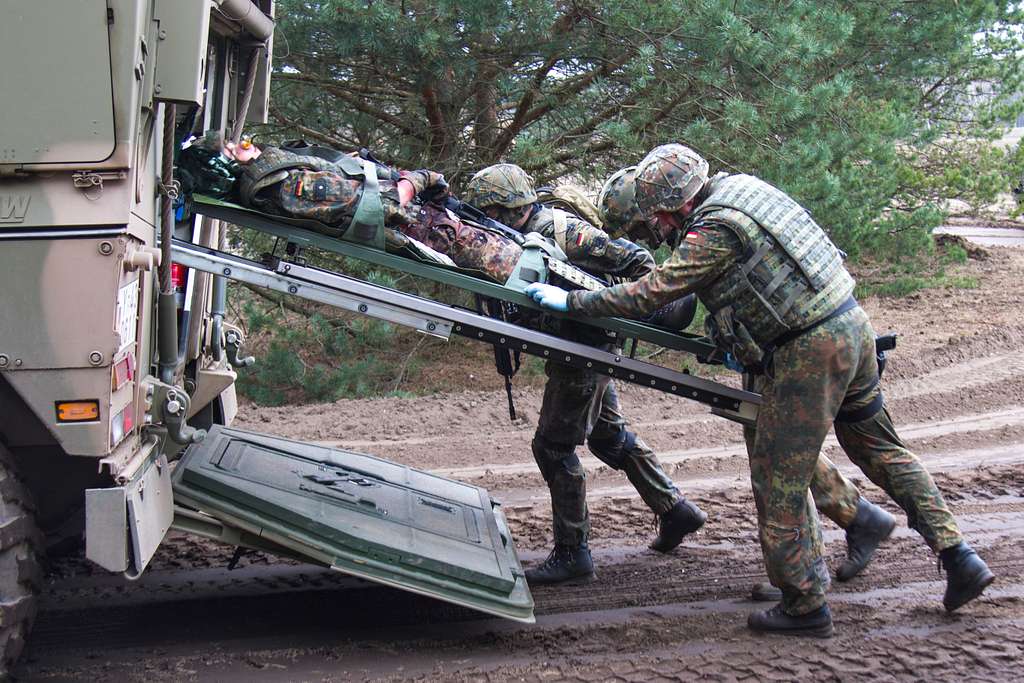
Boxer MedEvac, JLTV ambulance, medical Griffon and Didgori AMEV remain the platforms that provide continuous care under armor: monitoring, oxygen, IV therapy, multi-casualty capacity, and telemedicine. The current trend is toward upgraded medical capability (near–intensive care under armor) and full digitalization of the medical cell.

Germany, in particular, is acting as a laboratory for the Boxer in the medical role:
- 72 Boxer Ambulance (sgSanKfz) will be modernized under a contract worth around €117 million. The package includes next-generation medical equipment, enhanced capability for intensive care under armor, and new digital radios as part of the broader land forces digitalization effort (D-LBO). First deliveries are expected from 2027.
- In parallel, the Bundeswehr has ordered 48 additional Boxer vehicles (ambulance and driver training variants), scheduled to enter service from 2028, expanding the fleet and reinforcing the first line of the mechanized medical chain.
In this model, the armored ambulance becomes a true mobile medical node connected to C2 and BMS systems (SICS/SCORPION, JBC-P, national BMS):
- it aggregates data from biomedical sensors,
- it coordinates escort and MEDEVAC routes under drone threat,
- it links onboard medical personnel in real time with the Role 2 or forward surgical team.
The objective has not changed: keep the casualty alive regardless of the tactical conditions – but that objective now plays out in a space where every halt, every radio emission, every thermal signature can be detected and targeted.
A sequence that works in practice
On the ground, the logic is sequential:
- a drone launches first to deliver a medical kit or briefly extract a casualty;
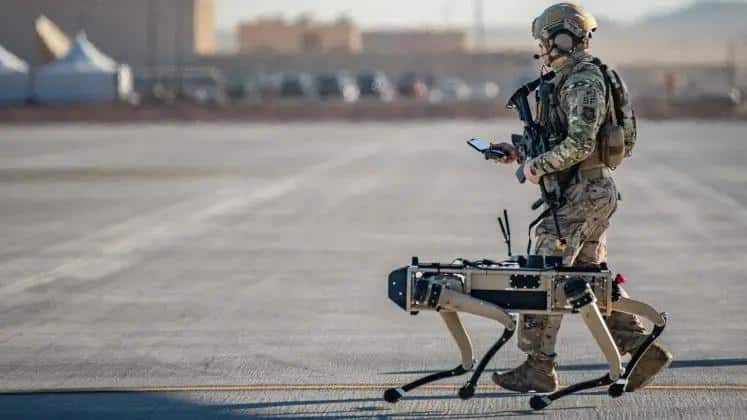
- a robotic mule can then move the wounded out of the kill zone;
- armored MEDEVAC takes over for protected transfer and full stabilization.
In Afghanistan, K-MAX validated the concept of autonomous cargo resupply. At sea, the T-150 now supports “last mile” logistics. On land, TRUAS illustrates the maturation of short-range autonomous transport. None is certified for CASEVAC yet, but all converge on the same goal: reducing vulnerability and delay.
Drones buy minutes; armored MEDEVAC saves lives. Drones help close the last mile; protected medical evacuation sustains survival over time. Medical success does not lie in replacing one with the other, but in making them work together: a fast, protected, interoperable chain capable of preserving the decisive hour.