

The renewed violence between Cambodia and Thailand in 2025 is a threshold conflict between two mid-sized armies fighting with what they actually have on hand: BM-21 rocket launchers and heavy Chinese systems on one side, modernized F-16s and radars on the other. Between these two poles, mines, drones, and conventional artillery shape a hybrid battlefield where every salvo carries an immediate human and political cost.
A local crisis with strategic effects
The confrontation truly escalates in late July 2025: artillery exchanges along several dozen kilometers of border, Cambodian BM-21 rockets fired into Thai districts, Thai counterstrikes, and the engagement of F-16s over the area.
In five days, the toll is already heavy: 48 killed and more than 270,000 displaced, with significant damage to hospitals, gas stations, and road infrastructure in Thailand’s border provinces.
Under intense diplomatic pressure, an initial ceasefire is secured at the end of July. By November, the situation deteriorates again after a mine explosion injures Thai soldiers; Bangkok accuses Phnom Penh of laying new devices, which Cambodia denies, claiming they are remnants of past wars.
In early December, fighting resumes on a large scale: within a few days, more than 500,000 people are displaced in total in Thailand and Cambodia, with mass evacuations in border provinces on both sides.
Cambodia: Soviet-era rockets and Chinese PHL-03
BM-21 Grad
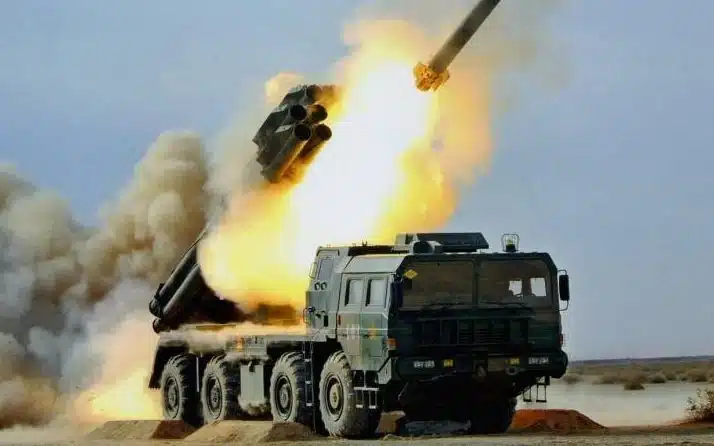
For Phnom Penh, the center of gravity clearly lies in ground-to-ground fires with the BM-21 Grad. The system is equipped with 40 122 mm tubes and, depending on the ammunition, offers a range of over 20 km, designed to strike an area rather than a precise point.

Bangkok accuses these systems of having been used against populated areas, including a provincial hospital, a gas station, and residential neighborhoods in Sisaket and Surin provinces.
Tactically, the Grad remains the archetype of an attrition weapon: precision is traded for volume of fire in the hope of generating disproportionate psychological and logistical effects compared to the cost.
PHL-03
More concerning for Thai military planners is the appearance of the PHL-03, a heavy Chinese 300 mm multiple rocket launcher derived from the Russian Smerch. Its rockets offer ranges between 70 and 130 km, can carry substantial payloads, and include guided or enhanced munitions.
For Cambodia, the attraction is obvious: offset an almost nonexistent air force against the Royal Thai Air Force (RTAF) and acquire a relatively low-cost deterrent lever. A few well-positioned batteries are enough to put pressure on an operational depth that had previously been relatively insulated.
The downside is the poor accuracy of unguided munitions. In a dense border zone, every salvo mechanically increases the risk of hitting schools, pagodas, or homes, with political and diplomatic costs rising with every additional civilian casualty.
Thailand: F-16s, Artillery, and Radars
Thailand enjoys clear air superiority and a modernized artillery component. On the ground, the Royal Thai Army employs towed and self-propelled artillery, mortars of various calibers, and a more limited number of rocket batteries. These assets enable classic counter-battery missions but remain constrained by the mobility of enemy rocket launchers and the proximity of villages and religious sites.

The RTAF, which had not seen combat at this level of intensity since its border war with Laos, has deployed modernized F-16 Fighting Falcons. What is emerging is a form of airborne counter-battery:
- Surveillance radars, ground sensors, and ISR drones detect launches or impact points.
- Thai C2 prioritizes targets based on the threat posed to cities, hospitals, and infrastructure.
- F-16s are tasked on short notice to strike before Cambodian units can disperse.
This clearly improves responsiveness, but Cambodian positions are often embedded among villagers, near pagodas or listed temples. Phnom Penh accuses Thailand of striking these areas, while Bangkok denies this and highlights the proportionality of its strikes.
Mines, drones, and old-school attrition warfare
Incidents involving antipersonnel mines have injured Thai soldiers on patrol. Bangkok argues that these devices were recently laid and violate the Ottawa Convention; Phnom Penh insists they are “legacy mines” and accuses Thailand of politicizing the issue.
Beyond the legal dispute, the effect is twofold. Tactical, by slowing enemy movements and channeling patrols and psychological, by maintaining a constant sense of danger
On the drone front, open-source documentation remains partial, but several Thai sources report Cambodian drones being used to spot civilian or military targets, and even to drop explosive charges on Thai positions. Phnom Penh rejects these accusations or plays down their significance.
The Thai military also employs its own drones for border surveillance, artillery observation, and target designation in support of F-16 strikes.
The 2025 conflict between Cambodia and Thailand is not just another episode in a long-running quarrel over temples and borders. It is a revealing case study of how second-tier armies wage limited war today with the arsenals they actually have, rather than the capabilities they showcase on paper.