

AI is moving from hype to infrastructure in modern armed forces, boosting speed and awareness while widening the attack surface.
In just a few years, artificial intelligence has shifted from conference buzzword to a working tool across many advanced armed forces. It is showing up first in command centers, intelligence units, air-defense nodes, cyber teams, and even logistics. Increasingly, AI is being treated as part of the connective tissue linking sensors, shooters, and decision-makers, even if adoption remains uneven from one country to another.
That shift comes with tradeoffs. Every model, data pipeline, and cloud connection expands the attack surface. Used well, AI can strengthen responsiveness and resilience. Secured poorly, it can create subtle, but serious, gaps in the broader defense architecture.
AI as the new nervous system
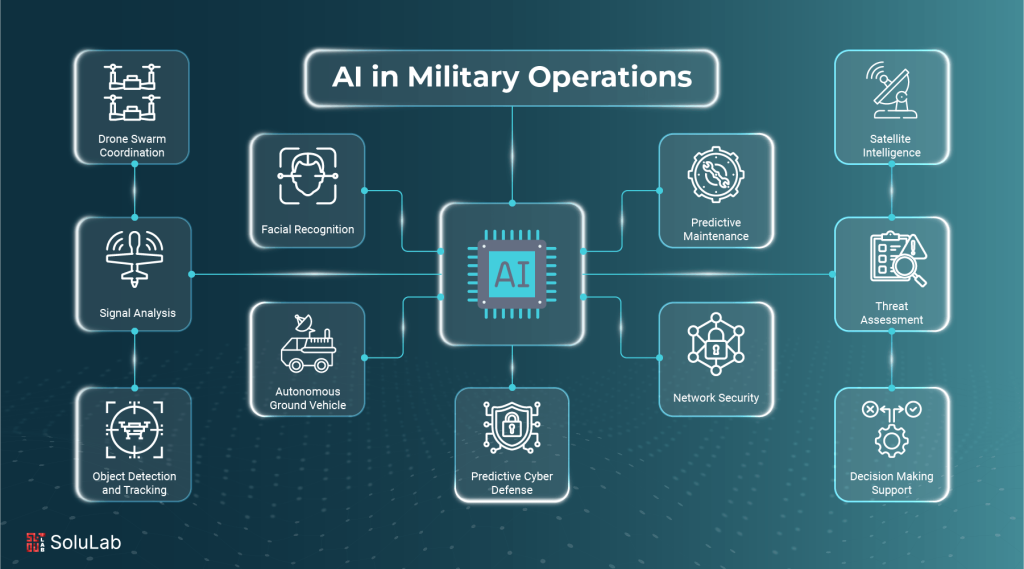
Across Western forces, AI is no longer a novelty. It is being inserted where humans are saturated by data:
- Command and control (C2): AI helps sort and prioritize massive feeds, force tracks, radar data, satellite imagery, electronic emissions, and cyber incidents. The goal is not to replace commanders, but to surface what matters, when it matters.
- Intelligence, surveillance and reconnaissance (ISR): AI automates repetitive work such as object recognition, change detection at a site, and pattern-of-life monitoring. That can speed up the detection of activity that falls outside the norm.
- Cyber defense: AI can flag network anomalies, cluster alerts, and separate routine noise from high-risk signals. When analysts cannot manually triage every event, AI becomes a force multiplier, if it is trusted and governed.
- Logistics: The armed forces are testing AI to anticipate failures, optimize inventories, and improve routing. The aim is straightforward: reduce downtime from predictable breakdowns.
In practice, AI is not just a bolt-on “AI module.” It sits between existing systems, where information moves and decisions are made.
AI for cyber defense and securing AI itself
The first use case is intuitive: using AI to defend networks more effectively.
In a security operations center (SOC), thousands of alerts can stream in, suspicious logins, anomalies, event logs, and outputs from security tools. AI can spot abnormal behavior (unusual login times, atypical data volumes, odd command sequences), correlate weak signals that collectively resemble an intrusion, and prioritize alerts so analysts can focus on the most critical cases.
On military networks, that support is increasingly essential. Attacks are more frequent, more discreet, and more automated. Without heavy automation, including AI-enabled filtering and prioritization, cyber defense teams risk being overwhelmed.
In a persistent cyber talent shortage, AI can make each analyst more effective, without claiming to replace them.

But as soon as AI becomes central, it also becomes a target.
AI systems have weaknesses of their own. They depend on training data; if an adversary can poison or manipulate inputs, it can skew model behavior, for example, nudging it to underestimate certain threat patterns. They also rely on complex machine-learning operations (MLOps) pipelines, collection, cleaning, training, deployment, and updates, where each step can be an opportunity for injection or sabotage.
The models themselves become sensitive assets. Steal them, and an adversary learns how defenses are tuned. Manipulate them, and it may be possible to create blind spots, or trigger overreactions.
These attack pathways are already well documented in the civilian sector, but they become higher-stakes when aimed at military systems. A subtle model drift can mean missing a real threat. A surge of false positives can also overload analysts and slow the decision cycle.
A faster, harder cyber fight
In cyber operations, AI is changing the tempo on both sides.
It can help attackers, producing more convincing phishing at scale, automating reconnaissance, and generating commodity malware faster. It also enables states to scale cafragilitiesmpaigns by automating tasks that previously consumed time and manpower. For defenders, it raises the premium on continuous monitoring and rapid correlation, and in some cases encourages more proactive approaches to detect campaigns earlier.
Adopting AI without losing control
The armed forces cannot ignore AI. Without it, they will struggle to keep pace with the volume of data, the speed of threats, and the scale of industrial competition. AI is already shaping how forces see, interpret, and protect the battlefield.
Yet each new AI capability introduces new weaknesses: dependence on specific data, complex MLOps chains, multiple suppliers, and exposure to novel attack paths. AI does not eliminate vulnerabilities, it shifts them and creates new ones.
The priority is not deploying “more AI,” but deploying it under control: auditable systems, clear accountability, compartmentalized architectures, and an operational culture that keeps humans as the final authority.