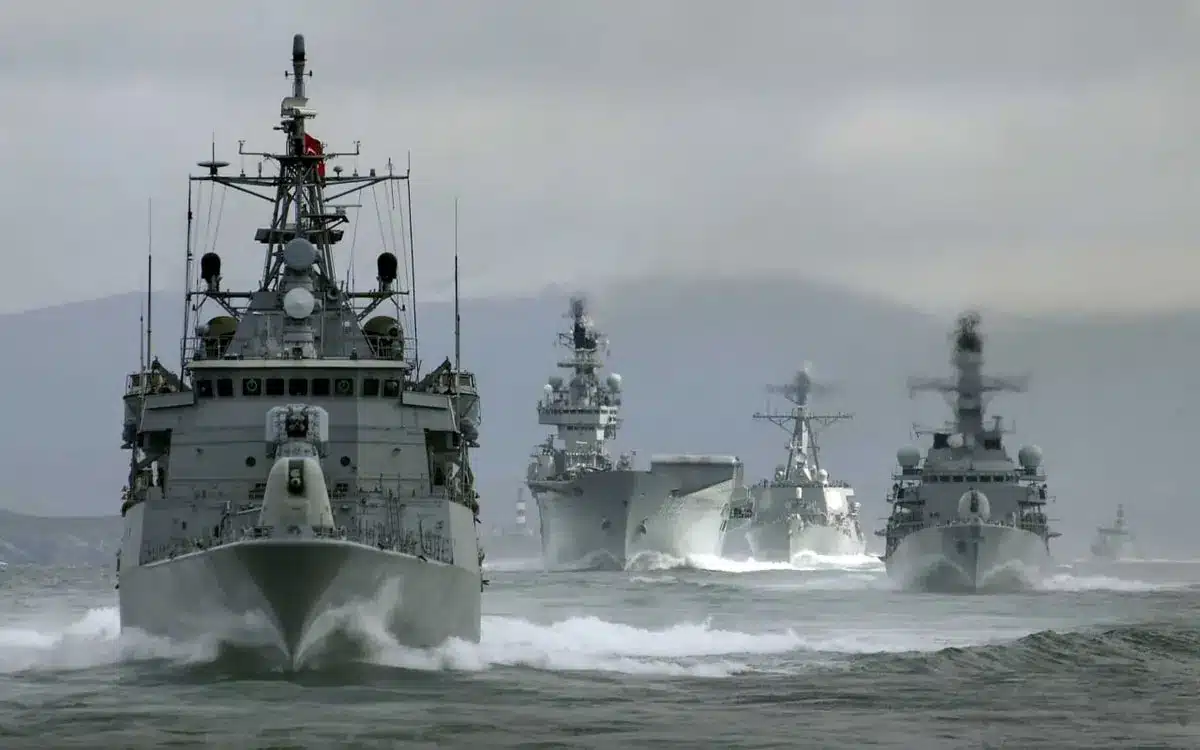



For the past decade, the “combat cloud” largely lived in airpower briefings. Now, the concept is quietly migrating to the maritime domain. The premise is familiar: link sensors, platforms, and weapons into a distributed network where information moves faster than forces maneuver, and where any shooter can leverage the best available sensor. At sea, however, that logic collides with long distances, a heavily contested electromagnetic environment, and sovereignty constraints that are often sharper than in permissive waters.
From a “Connected” frigate to a real combat cloud
In today’s fleets, “cloud” and “digital” labels are everywhere, but connectivity alone does not equal a combat cloud.
A “connected” warship typically means improved reach-back to shore and better connectivity with partners. Classic network-centric architectures can share tracks and messages, but they often remain rigid and stovepiped. Even a higher-throughput data link may only increase bandwidth, without turning the network into a shared services environment.
A naval combat cloud goes further. Units publish and consume data (tracks, threat libraries, signatures) and services (multi-sensor fusion, decision aids, fire-control-quality solutions) as common resources, designed for resilience. The objective is no longer just platform connectivity, but shared information and shared compute across the force.
A concept suited to Europe’s maritime realities
Maritime realities add friction that air-domain “combat cloud” discussions often underplay:
- Naval task groups can be separated by hundreds of nautical miles, relying on a fragile mix of line-of-sight radios, SATCOM, and troposcatter.
- In the Baltic, Mediterranean, and High North, jamming, ducting effects, and line-of-sight limits can degrade both detection and communications.
- Submarines, UUVs, and seabed sensors must be integrated without compromising stealth and emission discipline.
- Dependence on SATCOM is rising as GNSS interference and cyber pressure on space and ground segments become routine.

Europe adds a political layer: multinational task groups must share a common tactical picture and execute cooperative engagements, while preserving national authority over force employment and protecting sensitive data.
What’s already emerging: industrial building blocks and European frameworks
On the technical side, early building blocks are already visible. Thales is promoting its NEXIUM Defence Cloud as a deployable classified cloud concept, alongside “collaborative combat” approaches for naval operations. Combat management systems (CMS) such as TACTICOS, SETIS, and 9LV are steadily moving toward more modular, app-like architectures and data-centric integration, key enablers for cloud-style services.
In parallel, secure IP networking backbones are maturing. Efforts such as the UK’s shared infrastructure initiatives and France’s RIFAN program underpin data transport at fleet level. The UK has been explicit about a “software-defined” direction, with StrikeNet and related modernization lines often framed as core enablers for a future maritime combat cloud.
At EU level, the European Defence Fund (EDF) increasingly functions as a test bench: calls such as “Digital Ship and Naval Combat Cloud” and “Naval Collaborative Surveillance,” prototypes for shared track management in air defense, and work on federating national clouds rather than building a single monolithic “super cloud.” Nordic navies, meanwhile, combine the 9LV ecosystem with national sensors and expanding UUV/USV efforts, while parts of Europe’s AI start-up scene position on acoustic classification and distributed undersea surveillance.
A four-layer model for the naval combat cloud
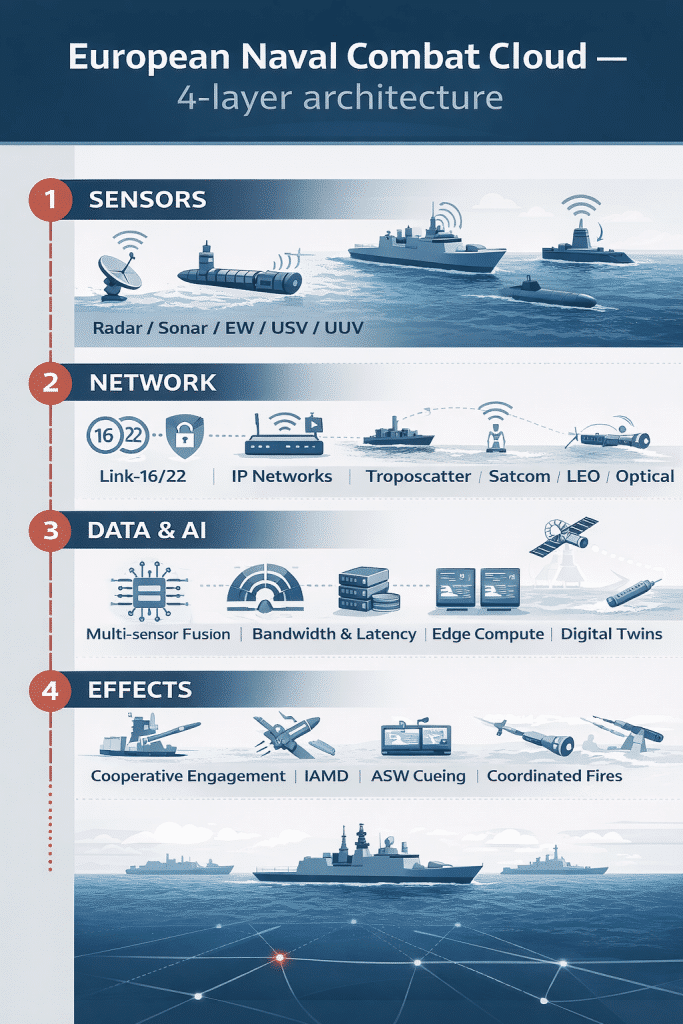
A practical way to frame the target architecture is four layers:
Sensors: air-defense radars, hull and towed sonars, seabed acoustic networks, EW suites, ISR payloads on aircraft and drones, and USV/UUV “pickets” operating forward. The goal is not to stream everything, but to share fused tracks and relevant features (acoustic fingerprints, EW parametrics) where they drive decisions.
Network: legacy tactical links (Link-16/Link-22) alongside secure IP networks over HF/VHF/UHF, relays, troposcatter, and SATCOM, eventually complemented by optical links and LEO constellations. The design requirement is graceful degradation: when SATCOM or GNSS is denied, the system adapts quality of service rather than collapsing.
Data and AI: multi-sensor fusion, bandwidth/latency management, and disciplined choices on what stays onboard versus what is shared as “products” (contact classification, threat prioritization). Defense clouds can host AI algorithms and digital twins, updated centrally, executed at the edge.
Effects: this is where the concept pays off: coordinated fires across surface-to-air missiles, anti-ship missiles, naval gunfire, and coastal batteries; cooperative engagements where one ship’s radar supports another ship’s missile; and integrated air and missile defense built around an engagement-quality picture.
Operational “Test Beds”: Baltic, Eastern Mediterranean, North Atlantic
Several theaters already hint at what a European naval combat cloud could unlock:
- Baltic Sea: persistent GNSS jamming/spoofing and suspicious activity near subsea infrastructure can make traditional surveillance brittle. A combat cloud could help sustain shared air/surface awareness through network gaps, coordinate defense against mixed missile-and-drone threats, and enable distributed EW tactics across allies.
- Eastern Mediterranean: in a gray-zone environment, the priority is often persistent monitoring of subsea critical infrastructure, early detection of hostile activity, and coordinated graduated responses—boarding, shadowing, cyber options—between partner navies.
- North Atlantic: at the center of NATO ASW, the aim is to fuse acoustic inputs from seabed networks, UUVs, and towed arrays with airborne patrols and surface escorts—turning scattered cues into coherent undersea tracks that can be shared across national boundaries.

The hard parts: EM, cyber, doctrine, sovereignty
Fielding a naval combat cloud raises four recurring challenges with strong local autonomy.
- Contested EM spectrum: GNSS interference, targeted jamming of tactical links and SATCOM, and the force’s own emission signature. Navies will need architectures built to operate under EMCON (Emission Control), with strong local autonomy.
- Cybersecurity: a defense cloud must be administered, patched, and monitored. The accountability question is non-trivial—nation, alliance, EU framework, or industry—and segmentation between NATO/EU/national environments must avoid lateral pathways for compromise.
- Doctrine and legal responsibility: who can shoot, based on which sensors, under which rules of engagement? How are multi-national, AI-assisted assessments integrated into decision cycles—and who is responsible if an engagement is based on shared data that proves wrong?
- Sovereignty: EW libraries, cryptography, and national signatures are among the most sensitive assets. Gateway design, encryption, and classification policy will decide whether Europe achieves a genuinely federated combat cloud or ends up with semi-interoperable national mini-clouds.

2035: federated or fragmented?
By 2035, Europe’s most advanced navies could operate in a multi-domain combat cloud where maritime forces plug into air, land, space, cyber, and seabed layers. Digital twins of theaters such as the Baltic or the GIUK gap (Greenland–Iceland–United Kingdom) could train crews and algorithms on the same architectures used in operations, supported by live-virtual-constructive events.
But three choices will shape the outcome:
- How far should decision support—and in some cases engagement authority—move toward shared systems?
- How hard should truly open standards be enforced against proprietary stacks?
- Which mission sets should be prioritized first (IAMD, ASW, gray-zone operations, etc.)?
Europe does not yet field a fully mature naval combat cloud, but the pieces are increasingly visible: defense-cloud concepts, more open CMS architectures, EDF experimentation, and national digital backbones. The question is no longer whether the technology will exist—it is whether it will be connected through federated interoperability or remain a layered set of national silos. That answer will shape not only Europe’s future fleets, but the credibility of a European combat cloud across domains.