


The integration of artificial intelligence into armed forces is often framed as a technological rupture. In practice, it is better understood as an operational adaptation: helping human decision-makers manage information volumes that now exceed what traditional workflows can handle within required timelines.
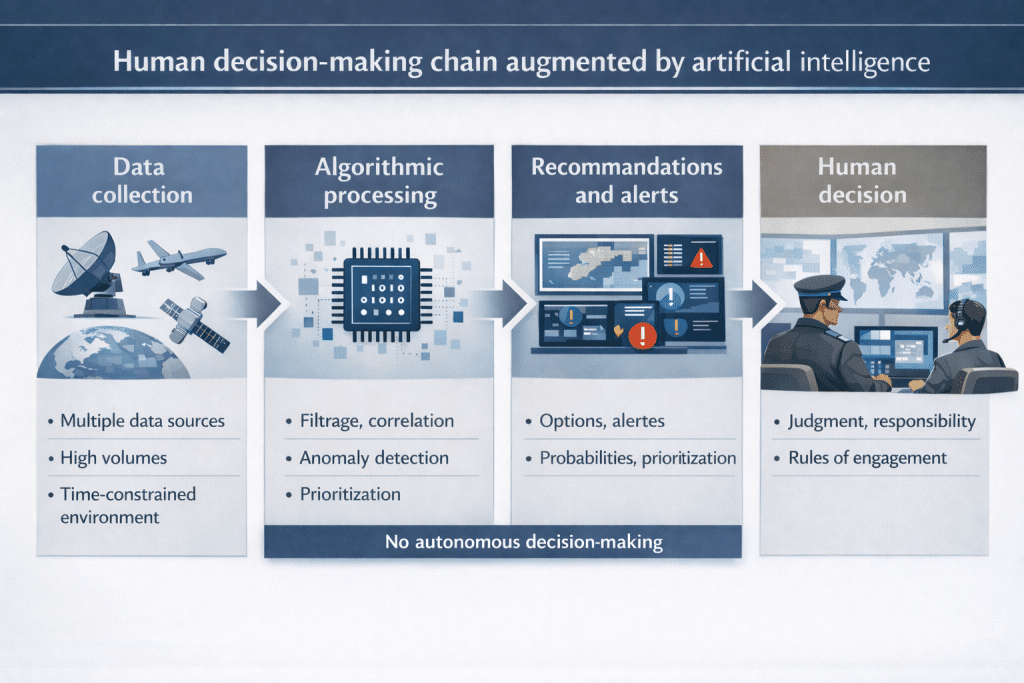
Since January 1, 2024, updated strategies and policy documents have consistently reinforced one principle: algorithms structure and accelerate information processing, but humans retain decision authority.
The revised strategy issued by NATO on July 10, 2024, explicitly reaffirms that artificial intelligence systems must remain under appropriate and responsible human control, consistent with international humanitarian law and national legal frameworks.
Operationally, most integration efforts have clustered around two problem sets where information overload and time compression are most acute: intelligence and air defense.
Intelligence: Collection has outpaced exploitation
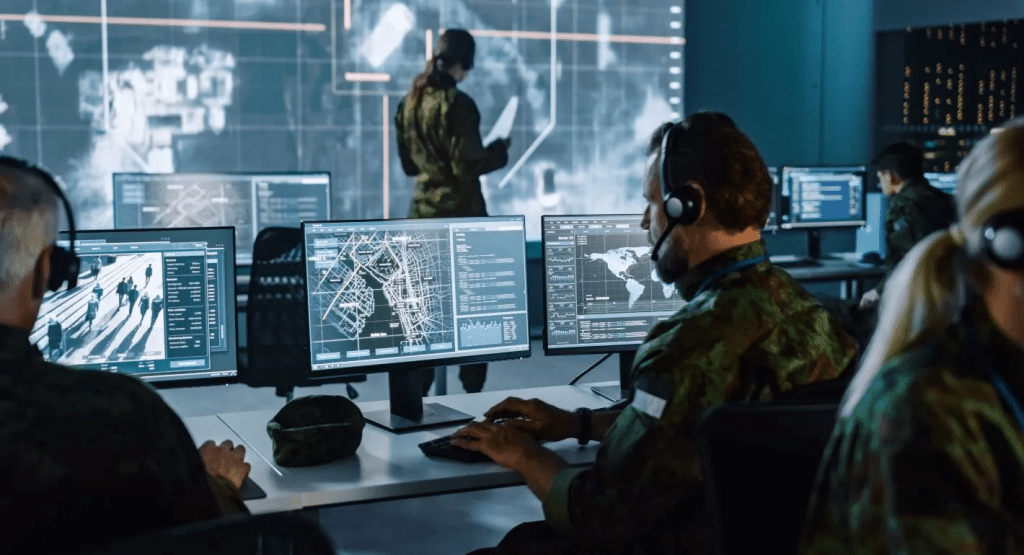
The proliferation of sensors has reshaped the intelligence enterprise. High-resolution imagery, electromagnetic collection, commercial data feeds, and open-source material generate a volume of information that human analysts alone cannot process at scale.
Artificial intelligence tools are employed to flag anomalies, correlate disparate sources, and prioritize potential signals of interest. The United States Department of Defense has emphasized that such systems must remain explainable and auditable under its responsible artificial intelligence framework.
The primary contribution of artificial intelligence is not prediction in a strategic sense. It is noise reduction and workflow acceleration. Analysts retain authority to validate, contextualize, and interpret outputs, which mitigates the risk of undetected bias. In practice, artificial intelligence shifts human effort away from first-pass sorting and toward higher-order analysis.
A less visible constraint concerns data integrity. Systems that perform well in controlled testing environments have, in some cases, degraded when exposed to contested or incomplete operational data. This gap between laboratory performance and field reliability helps explain the cautious pace of large-scale deployment.
Air defense: Managing saturation without delegating engagement authority
Air defense presents a different operational pressure. In a saturation scenario, a command center may need to assess dozens of tracks simultaneously, with decision timelines measured in seconds.
Artificial intelligence-enabled decision-support systems assist operators by ranking threats based on probabilistic assessments and presenting engagement options. However, weapons release decisions remain under human authority. National strategies across Europe, including that of the United Kingdom Ministry of Defence, explicitly reaffirm the requirement for human control over critical functions.
This restraint is not purely legalistic. It reflects strategic calculation. Fully delegating engagements to automated systems could reduce latency, but it would also increase the operational and political cost of error. Current practice therefore favors accelerated human decision-making rather than maximum system autonomy.

Capabilities deliberately not pursued
An important but underexamined dimension concerns what armed forces have chosen not to field. In several cases, more advanced automation sequences were tested and subsequently scaled back in favor of hybrid configurations.
The reasons were not exclusively technical. Organizational accountability and political responsibility played a central role. Preserving a clearly identifiable human decision-maker remains essential to maintaining legitimacy and control, particularly in high-tempo environments.
This deliberate limitation reflects doctrinal maturity. The objective is not autonomy for its own sake, but resilient decision-making under pressure.
Three criteria for assessing military decision-support systems
A military system incorporating artificial intelligence can be evaluated using three practical criteria:
- A clearly identifiable human decision authority capable of overriding system recommendations
- The ability to operate in degraded conditions without full algorithmic dependence
- Traceability of system outputs to enable post-action review and accountability
These criteria help distinguish genuine decision support from partial automation.
Conditions for success and persistent risks
Operational integration depends on factors that receive less public attention than system capabilities: high-quality and representative training data, resilience in contested environments, targeted training for commanders and analysts, and sustained software maintenance over time.
The most consistent risk identified in institutional literature is algorithmic overconfidence, particularly under time pressure. Work conducted through the European Defence Agency underscores the importance of verification, validation, and continuous system evaluation as foundations for operational trust.
What artificial intelligence actually changes
The transformation underway is evolutionary rather than revolutionary. Artificial intelligence does not remove humans from the decision loop; it compresses the time available for deliberation and increases the tempo at which information is processed.
This acceleration reshapes the relationship between tactical execution, operational coordination, and strategic oversight. Over the medium term, the central challenge may be less about technological autonomy and more about whether military and political institutions can absorb faster decision cycles without eroding accountability or legitimacy.
Artificial intelligence within armed forces functions today as a cognitive multiplier rather than a replacement for command authority. In both intelligence and air defense, it reduces informational noise, prioritizes urgency, and accelerates preparation for action. Final decisions remain human, accountable, and bounded by established legal and doctrinal frameworks. The enduring transformation lies in managing time, safeguarding data integrity, and sustaining institutional responsibility within increasingly compressed decision environments.