


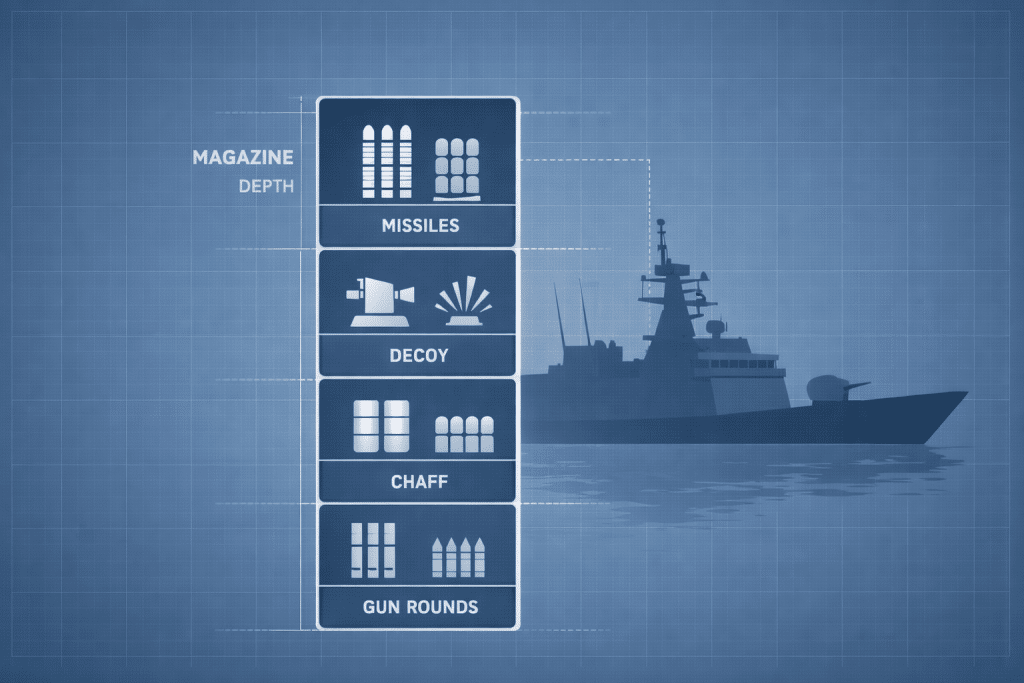
Attacks by drones and other “attritable” vectors have changed what naval defense really means. The key issue is no longer just radar quality or missile range. It’s endurance. How many days can a warship hold out before it runs down its missiles, decoys, chaff, and its ability to sustain fire?
Saturation is not simply “a lot of threats.” It’s the moment the crew and the combat system must handle too many tracks in too little time. Every “premium” engagement consumes a resource that may not be available later.
In that context, firing a high-end interceptor at every drone isn’t just expensive. It accelerates magazine depletion and creates a tactical risk. A defense that empties its magazine too quickly becomes vulnerable to the second wave, often lower, faster, or more coordinated.
What “cheap shot” means in practice
“Cheap shot” rests on a straightforward idea: engage a threat with the most available option that remains effective enough to deliver the required probability of neutralization. The goal is to preserve “premium” AAW missiles for cases where the low-cost layer cannot reliably handle the target.
This is not a universal recipe. It’s a discipline. And it only works if three conditions are met.
First, the threat must be “manageable”, typically slow to subsonic, with limited terminal maneuver. Second, the ship must maintain a solid track despite sea clutter and weather. Third, the crew must know when to switch up. That is the hardest part. Cheap-shot logic becomes dangerous when you stick with it too long, even as the situation demands a more robust solution.
That is where the central risk emerges: leakage. A threat gets through. A cheap shot missed at the wrong moment is not a financial loss. It can be the loss of the platform.
A credible cheap-shot approach therefore requires clear prerequisites: sensors and fusion strong enough to hold small targets; soft-kill consumables stocked for endurance; and gun munitions suited to the mission. And finally, most importantly, training built around the transition, so the crew knows when to step up one rung on the engagement ladder.
Two theaters, two lessons
Red Sea: disciplined use of the low-cost layer
In the Red Sea, several navies have demonstrated a graduated engagement logic against a repetitive threat set. The pattern is visible: use guns against certain drones when geometry allows, and keep premium missiles for harder profiles.
The Royal Navy said HMS Diamond’s crew also used a 30 mm gun to shoot down a Houthi drone. USNI News reported USS Stockdale downed a UAV with its 5-inch gun. Naval News reported the Italian destroyer ITS Caio Duilio neutralized a drone in the Red Sea with its 76 mm gun.
These episodes do not prove a single, formal “cheap shot” doctrine implemented identically everywhere. They show something else: a practice, a logic, and a priority, preserving AAW missile magazine depth in a campaign that lasts.
Black Sea: the inverse risk
In the Black Sea, Ukraine’s strike campaign (missiles and drones) gradually increased the operational risk for Russian units based in Sevastopol, to the point that Russia relocated part of its fleet to Novorossiysk, according to open sources.
At the same time, Ukraine claimed in December 2025 that it used an underwater drone to attack a Russian submarine in Novorossiysk, while Moscow disputed the extent of the damage.
The sustainability lesson is not just about budgets. In a prolonged confrontation, munition consumption, defensive tempo, repair capacity, and base resilience can matter as much as the nominal performance of individual systems.

Naval “cheap shot” is a response to a simple reality: in an attrition fight, running out of stockpiles can become as decisive as radar quality or missile sophistication. The winning approach is not “shoot the cheapest.” It is shoot smart, using an engagement architecture that handles volume without sacrificing assurance when assurance becomes indispensable.
Even when this approach is not publicly formalized under the “cheap shot” label, the underlying practice is spreading and becoming more systematic, as recent operations suggest.