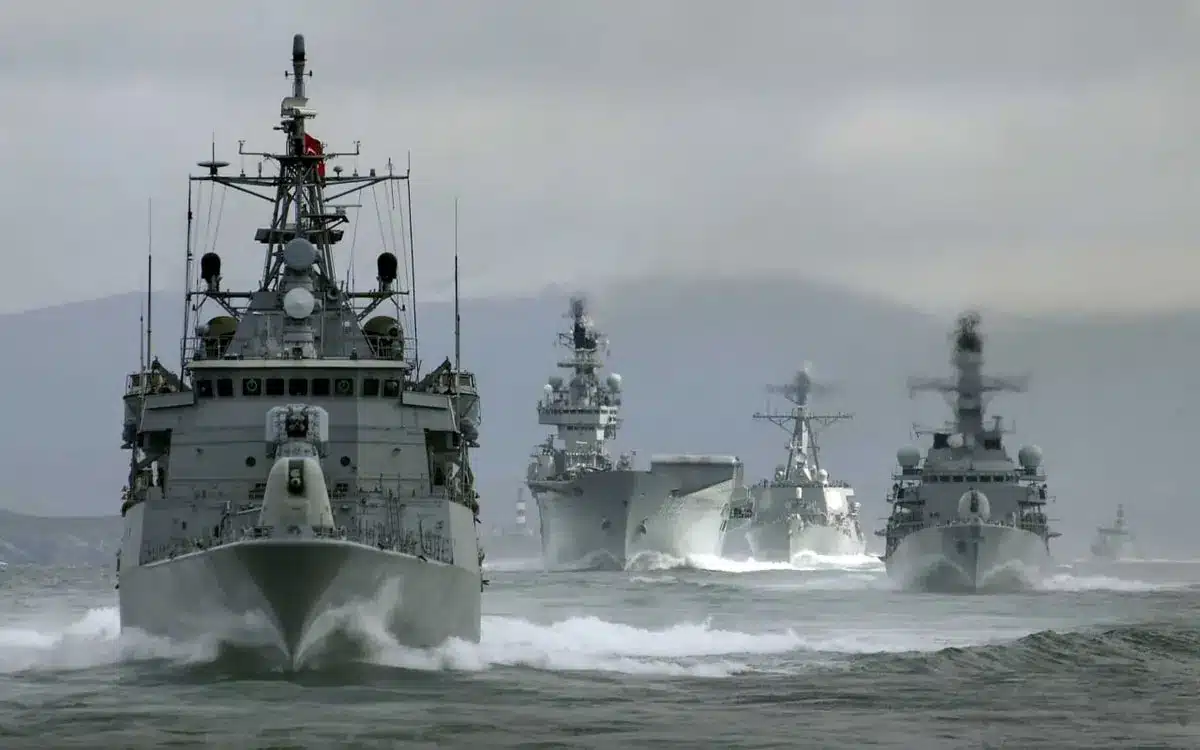



In 2025, Greece structured its air–maritime training cycle around operational needs rather than theatrics. There was no diplomatic grandstanding, no symbolic shows for a domestic audience. Athens built a coherent sequence of exercises designed to shorten the kill chain, secure key coastal approaches, test amphibious capabilities in realistic conditions and, above all, prove that its navy and air force can now react in concert to any regional turbulence.
Proving it in live-fire drills
It all starts in the spring at Andravida, with INIOCHOS 2025. Greek and allied fighters ran complex scenarios of air superiority, deep strike, electronic warfare and combined operations, with twelve participating nations and three observers. But the objective went well beyond the airspace itself: those tactical schemes fed directly into the frigates’ firing procedures and the integration of anti-submarine warfare (ASW) helicopters — both essential to reacting quickly to a surface or subsurface threat.

A few days later, the center of gravity shifted south into the Cretan Sea, with a PASSEX bringing together the Hellenic Navy and the French carrier strike group. ASW drills, combined maneuvers, exchanges of procedures: cooperation deepened. The French brought high-end assets; Athens used the drills to refine its operating profile. Air–sea coordination stopped being just a reflex and started to look like a shared operational language.
On June 23, the shift became even more concrete. The Hellenic Navy ran a series of live-fire missile drills from different platforms, validating the full sensor–effector chain in a stressed environment. Without entering into non-public technical details, the exercise confirmed that crews can execute successive firing sequences with real fluidity. In an island-heavy operating environment with complex geography, that level of mastery has immediate tactical value — and a clear deterrent effect.
Securing corridors and beaches
July extended the effort with ARGO-25, a bilateral amphibious exercise once again with France. On the menu: sea–air–land synchronization, landing planning, coastal logistics. A credible amphibious operation presupposes secured air corridors and a suppressed subsurface threat. ARGO-25 showed that these conditions can be met in a Mediterranean environment along a fragmented coastline where every islet matters.

In the autumn, the agenda became more specialized. In September, Greece deployed its submarine rescue capabilities during SMEREX 25 in Italy, under an allied framework (Greece, Italy, Turkey, Pakistan, the United Kingdom, plus 16 observing navies). Less visible than missile shots, but fundamental: in a crowded Mediterranean, the ability to respond quickly to a submarine casualty, speak the same technical language with other navies and integrate disparate rescue systems is a prerequisite for real freedom of action beneath the surface. At the same time, Athens demonstrated its responsiveness in the Aegean. Against a backdrop of persistent regional tensions, it mobilized aircraft and warships within hours for an ad hoc exercise. The message was clear: the Greek armed forces can pivot very quickly from scheduled training to a credible operational posture.
The cycle closed in October with AEGEAN SEAL 25-I, the annual mine countermeasures (MCM) and explosive ordnance disposal (EOD) exercise for eight participating navies. Uncrewed surface and underwater vehicles, clearance divers, supporting helicopters: it was hardly the most spectacular phase, but it underpins everything else. Without cleared sea lanes, no landings are possible; without amphibious options, there is no durable control of the islets; without those forward footholds, neither fleet nor air force can maneuver effectively.
Turning deterrence into a visible posture
In the background, NATO provided the framework and the Mediterranean remained the main operating theater. Dynamic Manta, in February 2025, with eleven allied nations, refreshed Greece’s ASW reflexes alongside allied submarines, frigates and maritime patrol aircraft. The lessons were reinjected at national level, in narrower and more demanding waters where acoustic conditions are complex and cross-platform cooperation counts as much as technology.
Taken together, 2025 sketched a genuine convergence of effects. The speed of engagement has improved: June’s live-fire drills reduced the time between detection and strike. Operational freedom of action has been reinforced: SMEREX 25 and AEGEAN SEAL helped secure undersea maneuver and approach routes. Power projection remains measured but credible: ARGO-25 validated the ability to land, hold a coastline and sustain coastal logistics. Finally, the responsiveness demonstrated in September illustrated a modular, available force able to adjust its posture at short notice.
One final act remains on the horizon: LAILAPS 25. If the exercise is confirmed for December, it would allow Athens to validate the entire cycle against a scenario blending ASW, air defense, mine warfare and amphibious operations in a coherent theater. It would be the logical conclusion to a year run at high operational tempo, a year in which the Hellenic Navy and Air Force no longer simply coexist, but converge to fight faster, more precisely, and as a genuinely joint force.